Thank you for visiting SNEWPapers!
Sign up free
Story
February 24, 1875
Green Mountain Freeman
Montpelier, Washington County, Vermont
What is this article about?
J. L. Edson shares personal experiences and historical insights on cheese making evolution from 1837, detailing traditional methods, improvements, scientific explanations, and industry growth to 300 million pounds annually.
Clipping
OCR Quality
95%
Excellent
Full Text
Cheese.
BY J. L. EDSON, ESQ., OF EAST MONTPELIER.
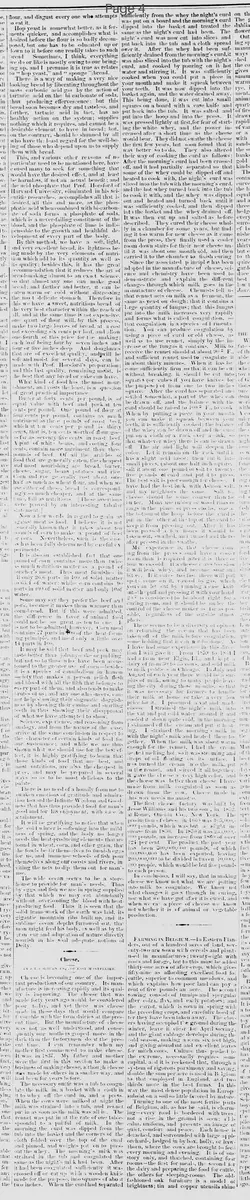
Cheese is becoming one of the important productions of our country. Its manufacture is increasing rapidly and its quality is improving. The cheese that was made forty years ago would be considered poor today, and yet there was cheese made in those days that would compare favorably with the farm dairies at the present time. But the manufacture of cheese was not as well understood, and consequently our mothers groped more in the dark than the factory men do at the present time. I can remember when my mother first commenced to make cheese. It was in 1837. My father and mother were the first in this section to make a business of making cheese, although cheese was made by others in a smaller way, and had been for years before.
The necessary outfit was a tub to coagulate the milk in, a basket with a cloth in it to whey off the curd in, and a press. When the cows were milked at night the milk was strained into a tub, and rennet put in as soon as the milk was all in. The rennet was put in at the rate of one tablespoonful to a pailful of milk. In the morning the curd was dipped from the tub into the basket and the corners of the cloth folded over the top of the curd and pinned, and weights put on to press out the whey. The morning's milk was strained in the tub and coagulated the same as the night's milk had been. After it had been coagulated sufficiently it was crossed off or cut up with a wooden knife made for the purpose, into squares of about two inches. When the curd had separated sufficiently from the whey the night's curd was put on a board and the morning's curd dipped into the basket and treated the same as the night's curd had been. The night's curd was now cut into slices and put back into the tub and a cloth spread over it. After the whey had been sufficiently drained from the morning's curd, it was also sliced into the tub with the night's curd, and cooked by pouring on it hot water and stirring it. It was sufficiently cooked when you could put a piece in your mouth and make it squeak between your teeth. It was now dipped into the basket again, and the water drained away. This being done, it was cut into small squares on a board with a case knife and put back into the tub. It was salted and put into the hoop and into the press. It was pressed lightly at first, for fear of starting the white whey, and the power increased after a short time as the cheese would bear. They did not swathe the cheese the first few years, but soon found that it was better so to do. They also altered their way of cooking the curd as follows:
After the morning's curd had been crossed off, and it had partially separated so that some of the whey could be dipped off and heated to cook with, the night's curd was sliced into the tub with the morning's curd, and the hot whey turned back into the tub to cook it with, and the whey was dipped out and heated and turned back until it was sufficiently cooked, and then dipped into the basket and the whey drained off. It was then cut up and salted as before described. They cured their cheese wholly in a chamber for some years, but finding it too warm for new cheese as it came from the press, they finally used a cooler room down stairs for their new cheese until it was about one month old, and then carried it to the chamber to finish curing.
Since the associated principle has been adopted in the manufacture of cheese, science and chemistry have been used to demonstrate and explain the different changes through which milk goes in the manufacture of cheese. Chemists tell us that rennet acts on milk as a ferment, the same as yeast on dough: that it contains a large quantity of fungus; that this fungus put into the milk increases very rapidly and forms what is called coagulation, so that coagulation is a species of fermentation. You can produce coagulation by using a piece of curd or old cheese, as well as to use rennet, simply by the increase of the fungus it contains. Milk to receive the rennet should be at about 90° F., and sufficient rennet used to coagulate it in about thirty minutes. When it has become sufficiently firm so that it can be cut without breaking, it should be cut into squares (or cubes if you have knives for the purpose) of from one to two inches square. After the curd has separated and settled somewhat, a part of the whey can be drawn off, and the balance with the curd should be raised to 100° F., to cook. When by putting a piece in your mouth you can make it squeak between your teeth, it is sufficiently cooked: the balance of the whey can be drawn off and the curd put on a cloth or a rack over a sink, so that whatever whey there is can be drawn off. The air and light will deepen the color. Let it remain through until it has a slight acid taste; then cut it into small pieces, (about one half inch square), salt without one pound of salt to twenty-five pounds of curd and put it to press. The best salt is poor enough for cheese. I have had the best luck with Ashton salt, and my neighbors the same. Salt for cheese should be some coarser than for butter. Many use rubber or wool rims on rings in the place of press cloths, one at the bottom of the hoop before the curd is put in, the other at the top of the curd to keep it from pressing out. After it has been pressed a few hours it should be taken out, swathed, and in the swathe thereafter pressed.
My experience is, that cheese coming from the press should have a cooler room than is required after it is three or four weeks old. If a cheese cures too slow it will let whey, and become sour and bitter. If it cures too fast there will pit spots come on it, caused by gas, which you can let out by running a case knife into the puff and pressing it with your hand. 65° is considered to be about right for curing room, and it should be under the control of the cheese maker as far as possible, regardless of the outside atmosphere.
There seems to be a diversity of opinion on returning the cream that has been taken off of the milk before coagulation. Some holding that it can do no harm. As I have had some experience in this direction I will give it: from 1850 to 1861 I had a farm near Elgin, Ill., and kept a dairy of from 50 to 60 cows, and sold milk to milk peddlers in Chicago. In July and August of each year there would be a surplus of milk, owing to many people leaving the city during those months, so that it was necessary for farmers to handle their milk at home or take a very low price for it. I procured a vat and made cheese. I strained the night's milk into the vat and put cold water around it and cooled it down quite cold. In the morning I skimmed off the cream and put it heating. I strained the morning's milk in with the night's milk and heated them together. When the milk was about warm enough for the rennet, I had the cream heated melting hot so it was steaming and drops of oil floating on its surface. I now turned the cream on the milk, put in the rennet, and stirred it all together. It gave the cheese a very high color, and the cheese was better than cheese I have made from milk coagulated as soon as drawn from the cow. Cheese made in this way needs no annatto.
The first cheese factory was built by Jesse Williams and his two sons, in 1852 at Rome, Oneida Co., New York. The production of cheese in 1850 was 60,000,000 pounds, which was but a slight increase from 1840. In 1870 it was 235,000,000 pounds, an increase from 1860 of over 124 per cent. The product the past year has been 300,000,000 pounds, of which 100,000,000 has been exported, leaving 200,000,000 to be divided between 50,000,000 people, which would be but five pounds to each person.
In conclusion, I will say, that in making cheese we know not what we are putting into milk to coagulate. We know not what changes it goes through in curing, nor what we have got after it is cured, and when we eat a piece of cheese we know not whether it is of animal or vegetable production.
BY J. L. EDSON, ESQ., OF EAST MONTPELIER.
Cheese is becoming one of the important productions of our country. Its manufacture is increasing rapidly and its quality is improving. The cheese that was made forty years ago would be considered poor today, and yet there was cheese made in those days that would compare favorably with the farm dairies at the present time. But the manufacture of cheese was not as well understood, and consequently our mothers groped more in the dark than the factory men do at the present time. I can remember when my mother first commenced to make cheese. It was in 1837. My father and mother were the first in this section to make a business of making cheese, although cheese was made by others in a smaller way, and had been for years before.
The necessary outfit was a tub to coagulate the milk in, a basket with a cloth in it to whey off the curd in, and a press. When the cows were milked at night the milk was strained into a tub, and rennet put in as soon as the milk was all in. The rennet was put in at the rate of one tablespoonful to a pailful of milk. In the morning the curd was dipped from the tub into the basket and the corners of the cloth folded over the top of the curd and pinned, and weights put on to press out the whey. The morning's milk was strained in the tub and coagulated the same as the night's milk had been. After it had been coagulated sufficiently it was crossed off or cut up with a wooden knife made for the purpose, into squares of about two inches. When the curd had separated sufficiently from the whey the night's curd was put on a board and the morning's curd dipped into the basket and treated the same as the night's curd had been. The night's curd was now cut into slices and put back into the tub and a cloth spread over it. After the whey had been sufficiently drained from the morning's curd, it was also sliced into the tub with the night's curd, and cooked by pouring on it hot water and stirring it. It was sufficiently cooked when you could put a piece in your mouth and make it squeak between your teeth. It was now dipped into the basket again, and the water drained away. This being done, it was cut into small squares on a board with a case knife and put back into the tub. It was salted and put into the hoop and into the press. It was pressed lightly at first, for fear of starting the white whey, and the power increased after a short time as the cheese would bear. They did not swathe the cheese the first few years, but soon found that it was better so to do. They also altered their way of cooking the curd as follows:
After the morning's curd had been crossed off, and it had partially separated so that some of the whey could be dipped off and heated to cook with, the night's curd was sliced into the tub with the morning's curd, and the hot whey turned back into the tub to cook it with, and the whey was dipped out and heated and turned back until it was sufficiently cooked, and then dipped into the basket and the whey drained off. It was then cut up and salted as before described. They cured their cheese wholly in a chamber for some years, but finding it too warm for new cheese as it came from the press, they finally used a cooler room down stairs for their new cheese until it was about one month old, and then carried it to the chamber to finish curing.
Since the associated principle has been adopted in the manufacture of cheese, science and chemistry have been used to demonstrate and explain the different changes through which milk goes in the manufacture of cheese. Chemists tell us that rennet acts on milk as a ferment, the same as yeast on dough: that it contains a large quantity of fungus; that this fungus put into the milk increases very rapidly and forms what is called coagulation, so that coagulation is a species of fermentation. You can produce coagulation by using a piece of curd or old cheese, as well as to use rennet, simply by the increase of the fungus it contains. Milk to receive the rennet should be at about 90° F., and sufficient rennet used to coagulate it in about thirty minutes. When it has become sufficiently firm so that it can be cut without breaking, it should be cut into squares (or cubes if you have knives for the purpose) of from one to two inches square. After the curd has separated and settled somewhat, a part of the whey can be drawn off, and the balance with the curd should be raised to 100° F., to cook. When by putting a piece in your mouth you can make it squeak between your teeth, it is sufficiently cooked: the balance of the whey can be drawn off and the curd put on a cloth or a rack over a sink, so that whatever whey there is can be drawn off. The air and light will deepen the color. Let it remain through until it has a slight acid taste; then cut it into small pieces, (about one half inch square), salt without one pound of salt to twenty-five pounds of curd and put it to press. The best salt is poor enough for cheese. I have had the best luck with Ashton salt, and my neighbors the same. Salt for cheese should be some coarser than for butter. Many use rubber or wool rims on rings in the place of press cloths, one at the bottom of the hoop before the curd is put in, the other at the top of the curd to keep it from pressing out. After it has been pressed a few hours it should be taken out, swathed, and in the swathe thereafter pressed.
My experience is, that cheese coming from the press should have a cooler room than is required after it is three or four weeks old. If a cheese cures too slow it will let whey, and become sour and bitter. If it cures too fast there will pit spots come on it, caused by gas, which you can let out by running a case knife into the puff and pressing it with your hand. 65° is considered to be about right for curing room, and it should be under the control of the cheese maker as far as possible, regardless of the outside atmosphere.
There seems to be a diversity of opinion on returning the cream that has been taken off of the milk before coagulation. Some holding that it can do no harm. As I have had some experience in this direction I will give it: from 1850 to 1861 I had a farm near Elgin, Ill., and kept a dairy of from 50 to 60 cows, and sold milk to milk peddlers in Chicago. In July and August of each year there would be a surplus of milk, owing to many people leaving the city during those months, so that it was necessary for farmers to handle their milk at home or take a very low price for it. I procured a vat and made cheese. I strained the night's milk into the vat and put cold water around it and cooled it down quite cold. In the morning I skimmed off the cream and put it heating. I strained the morning's milk in with the night's milk and heated them together. When the milk was about warm enough for the rennet, I had the cream heated melting hot so it was steaming and drops of oil floating on its surface. I now turned the cream on the milk, put in the rennet, and stirred it all together. It gave the cheese a very high color, and the cheese was better than cheese I have made from milk coagulated as soon as drawn from the cow. Cheese made in this way needs no annatto.
The first cheese factory was built by Jesse Williams and his two sons, in 1852 at Rome, Oneida Co., New York. The production of cheese in 1850 was 60,000,000 pounds, which was but a slight increase from 1840. In 1870 it was 235,000,000 pounds, an increase from 1860 of over 124 per cent. The product the past year has been 300,000,000 pounds, of which 100,000,000 has been exported, leaving 200,000,000 to be divided between 50,000,000 people, which would be but five pounds to each person.
In conclusion, I will say, that in making cheese we know not what we are putting into milk to coagulate. We know not what changes it goes through in curing, nor what we have got after it is cured, and when we eat a piece of cheese we know not whether it is of animal or vegetable production.
What sub-type of article is it?
Biography
Historical Event
What themes does it cover?
Triumph
What keywords are associated?
Cheese Making
Rennet Coagulation
Dairy History
Curd Cooking
Cheese Factory
What entities or persons were involved?
J. L. Edson
Jesse Williams
Where did it happen?
East Montpelier; Near Elgin, Ill.; Rome, Oneida Co., New York
Story Details
Key Persons
J. L. Edson
Jesse Williams
Location
East Montpelier; Near Elgin, Ill.; Rome, Oneida Co., New York
Event Date
1837; 1850 1861; 1852
Story Details
Personal account of early cheese making methods starting in 1837, improvements in processes, scientific insights on coagulation, experiences with cream addition, and growth of cheese industry from 60 million pounds in 1850 to 300 million recently.