Thank you for visiting SNEWPapers!
Sign up free
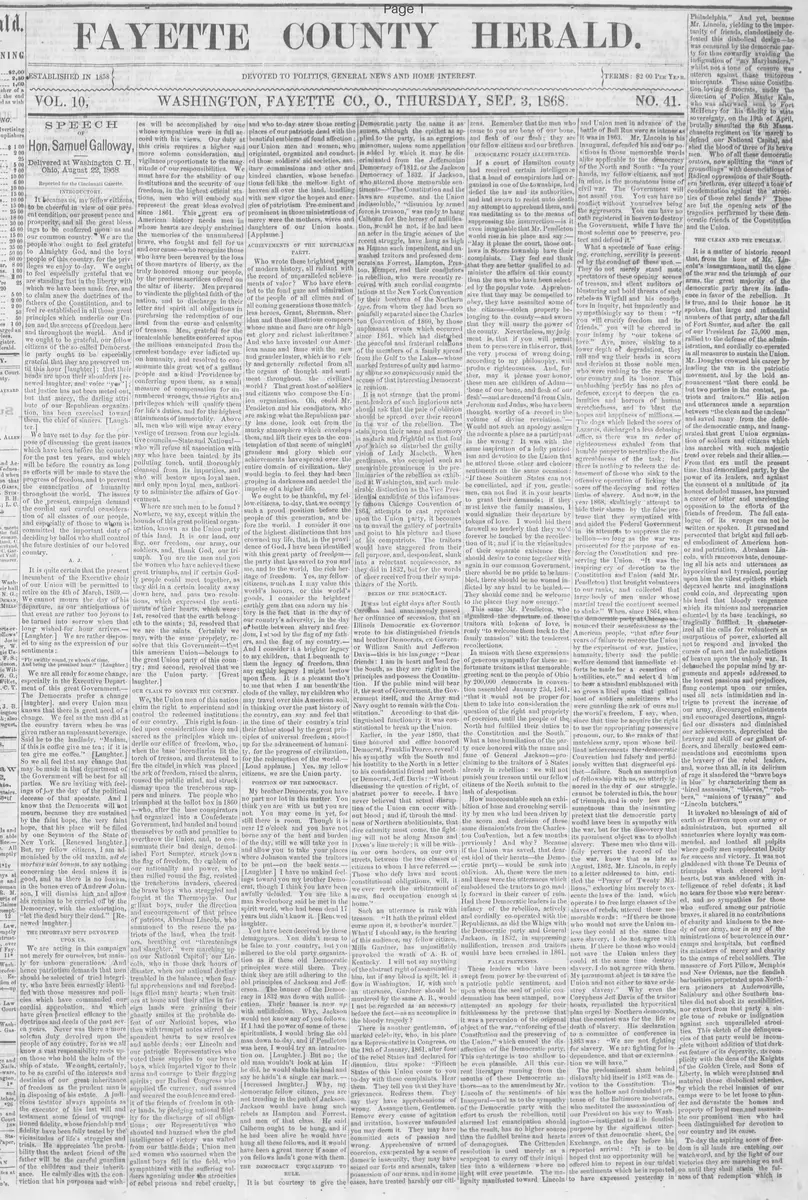
Fayette County Herald
Washington Court House, Fayette County, Ohio
What is this article about?
Republican speech in Washington C.H., Ohio, on Aug. 22, 1868, by A.J., lambasting Democrats for aiding rebels, lauding Union victories under Lincoln and Grant, emancipation, and Reconstruction policies, while endorsing Grant-Colfax ticket and candidate John A. Smith. (248 chars)
Merged-components note: These components form a single continuous transcript of a political speech ('Reported for the Cincinnati Gazette') spanning pages 1 and 2 in sequential reading order. Merged into one logical story unit; label changed from 'editorial' for the final component to 'story' as it is a reported narrative.
Clippings
1 of 2
OCR Quality
Full Text
25
Delivered at Washington C. H.
Ohio, August 22, 1868.
Reported for the Cincinnati Gazette.
$5.00
INTRODUCTORY.
It becomes us, my fellow citizens, to be cheerful in view of our present condition, our present peace and prosperity, and all the great blessings to be conferred upon us and our common country. We are the people who ought to feel grateful to Almighty God, and the loyal people of this country, for the privileges we enjoy to-day. We ought to feel especially grateful that we are standing fast in the liberty with which we have been made free, and to claim anew the doctrines of the fathers of the Constitution, and to feel re-established in all those great principles which underlie our Union and the success of freedom here and throughout the world. And if we ought to be grateful, our fellow citizens of the so-called Democratic party ought to be especially grateful that they are preserved until this hour [laughter]; that their heads are upon their shoulders [renewed laughter, and voice "yes"]; that justice has not been meted out, but that mercy, the darling attribute of our Republican organization, has been exercised toward them, the chief of sinners. [Laughter.]
We have met to-day for the purpose of discussing the great issues which have been before the country for the past ten years, and which will be before the country as long as efforts will be made to stave the progress of freedom, and to prevent the emancipation of humanity throughout the world. The issues of the present campaign demand the cordial and careful consideration of all classes of our people, and especially of those to whom is committed the important duty of deciding by ballot who shall control the future destinies of our beloved country.
A. J.
It is quite certain that the present incumbent of the Executive chair of our Union will be permitted to retire on the 4th of March, 1869. We cannot mourn the day of his departure, as our anticipations of that event are rather too joyous to be turned into sorrow when that long wished-for hour arrives. [Laughter.] We are rather disposed to sing as the expression of our sentiments:
"Fly swiftly round, ye wheels of time,
And bring the promised hour." [Laughter.]
We are all ready for some change, especially in the Executive Department of this great Government. The Democrats prefer a change [laughter], and every Union man knows that there is great need of a change. We feel as the man did at the country tavern when he was given rather an unpleasant beverage. Said he to the landlady, "Madam, if this is coffee give me tea; if it is tea give me coffee." [Laughter.] So we all feel that any change that may be made in that department of the Government will be best for all parties. We are inviting with feelings of joy the day of the political decease of that apostate. And I know that the Democrats will not mourn, because they are sustained by the faint hope, the very faint hope, that his place will be filled by one Seymour of the State of New York. [Renewed laughter.] But, my fellow citizens, I am admonished by the old maxim, nil de mortuis nisi bonum, to say nothing concerning the dead unless it is good, and as there is no bonum, in the bones even of Andrew Johnson, I will dismiss him and allow his remains to be carried off by the Democracy, with the exhortation, "let the dead bury their dead." [Renewed laughter.]
THE IMPORTANT DUTY DEVOLVED UPON US.
We are acting in this campaign not merely for ourselves, but mainly for unborn generations. And hence patriotism demands that men should be selected of tried integrity, who have been earnestly identified with those measures and policies which have commanded our cordial approbation, and which have given practical efficacy to the doctrines and deeds of the past seven years. Never was there a more solemn duty devolved upon the people of any country, for as we all know a vast responsibility rests upon those who hold the helm of the ship of state. We ought, certainly, to be as careful of the interests and destinies of our great inheritance of freedom as the prudent man is in disposing of his estate. A judicious testator always appoints as the executor of his last will and testament some friend of unquestioned fidelity, whose friendship and fidelity have been fully tested by the vicissitudes of life's struggles and trials. He appreciates the probability that the ardent friend of the father will be the careful guardian of the children and their inheritance. He calmly dies with the conviction that his purposes and wishes
es will be accomplished by one whose sympathies were in full accord with his views. Our duty at this crisis requires a higher and more solemn consideration, and vigilance proportionate to the magnitude of our responsibilities. We must have for the stability of our institutions and the security of our freedom, in the highest official stations, men who will embody and represent the great ideas evolved since 1861. This great era of American history needs men in whose hearts are deeply enshrined the memories of the unnumbered brave, who fought and fell for us and our cause—who recognize those who have been bereaved by the loss of those martyrs of liberty, as the truly honored among our people, by the precious sacrifices offered on the altar of liberty. Men prepared to vindicate the plighted faith of the nation, and to discharge in their letter and spirit all obligations in purchasing the redemption of our land from the curse and calamity of treason. Men, grateful for the incalculable benefits conferred upon the millions emancipated from the cruelest bondage ever inflicted upon humanity, and resolved to consummate this great act of a gallant people and a kind Providence by conferring upon them, as a small measure of compensation for unnumbered wrongs, those rights and privileges which will qualify them for life's duties, and for the highest attainments of immortality. Above all, men who will wipe away every vestige of treason from our legislative councils—State and National—who will refuse all association with any who have been tainted by its polluting touch, until thoroughly cleansed from its impurities, and who will bestow upon loyal men, and only upon loyal men, authority to administer the affairs of Government.
Where are such men to be found? Nowhere, we say, except within the bounds of this great political organization, known as the Union party of this land. It is our land, our flag, our freedom, our army, our soldiers, and, thank God, our triumph. You are the men and you the women who have achieved these great triumphs, and if certain godly people could meet together, as they did in a certain locality away down here, and pass two resolutions, which expressed the sentiments of their hearts, which were: 1st, resolved that the earth belongeth to the saints; 2d, resolved that we are the saints. Certainly we may, with the same propriety, resolve that this Government—that this American Union—belongs to the great Union party of this country; and second, resolved that we are the Union party. [Great laughter.]
We, the Union men of this nation claim the right to superintend and control the redeemed institutions of our country. This right is founded upon considerations deep and sacred as the principles which underlie our edifice of freedom, who, when the base incendiaries lit the torch of treason, and threatened to fire the citadel in which was placed the ark of freedom, raised the alarm, roused the public mind, and struck dismay upon the treacherous sappers and miners. The people who triumphed at the ballot box in 1860—who, after the base conspirators had organized into a Confederate Government, had banded and bound themselves by oath and penalties to overthrow the Union, and, to consummate their bad design, demolished Fort Sumter, struck down the flag of freedom, the emblem of our nationality and power, who then rallied round the flag, resisted the treacherous invaders, cheered the brave boys who struggled and fought at the Thermopylae. Our gallant boys, under the direction and encouragement of that prince of patriots, Abraham Lincoln, who summoned to the rescue the patriots of the land, when the traitors, breathing out "threatenings and slaughter," were marching upon our National Capitol; our Lincoln, who in those dark hours of disaster, when our national destiny trembled in the balance; when fearful apprehensions and sad forebodings filled many hearts; when traitors at home and their allies in foreign lands were grinning their ghastly smiles at the probable defeat of our National hopes, who then with trumpet notes stirred despondent hearts to new resolves and noble deeds; our Lincoln and our patriotic Representatives who voted these supplies to our brave boys, which imparted vigor to their arms and courage to their flagging spirits; our Radical Congress who supplied the currency, and assured and secured the confidence and credit of the friends of freedom in other lands, by pledging national fidelity for the discharge of all obligations; our Representatives who shouted and huzzaed when the glad intelligence of victory was wafted from our battle-fields; Union men and women who mourned when the gallant boys fell in the field, who sympathized with the suffering soldiers agonizing under the atrocities of rebel prisons and rebel cruelty,
and who to-day strew those resting places of our patriotic dead with the beautiful emblems of fond affection: our Union men and women, who originated, organized and conducted those soldiers' aid societies, sanitary commissions and other and kindred charities, whose benefactions fell like the mellow light of heaven all over the land, kindling with new vigor the hopes and energies of patriotism. Pre-eminent and prominent in those ministrations of mercy were the mothers, wives and daughters of our Union hosts. [Applause.]
ACHIEVEMENTS OF THE REPUBLICAN PARTY.
Who wrote these brightest pages of modern history, all radiant with the record of unparalleled achievements of valor? Who have elevated to the fond gaze and admiration of the people of all climes and of all coming generations those matchless heroes, Grant, Sherman, Sheridan and those illustrious compeers whose name and fame are our highest glory and richest inheritance? And who have invested our American name and fame with the new and grander luster, which is so richly and generally reflected from all the organs of thought and sentiment throughout the civilized world? That great host of soldiers and citizens who compose the Union organization. Oh, could Mr. Pendleton and his coadjutors, who are asking what the Republican party has done, look out from the murky atmosphere which envelops them, and lift their eyes to the contemplation of that scene of mingled grandeur and glory which our achievements have spread over the entire domain of civilization, they would begin to feel they had been groping in darkness and needed the impulse of a higher life.
We ought to be thankful, my fellow citizens, to-day, that we occupy such a proud position before the people of this generation, and before the world. I consider it one of the highest distinctions that has crowned my life, that, in the providence of God, I have been identified with this great party of freedom—the party that has saved to you and me, and to the world, the rich heritage of freedom. Yes, my fellow citizens, much as I may value this world's honors, or this world's goods, I consider the brightest earthly gem that can adorn my history is the fact that in the day of our country's adversity, in the day of battle between slavery and freedom, I stood by the flag of my fathers, and the flag of my country. And I consider it a brighter legacy to my children, that I bequeath to them the legacy of freedom, than any earthly legacy I might bestow upon them. It is a pleasant thought to me that when I am beneath the clods of the valley, my children who may travel over this American soil, in thinking over the past history of the country, can say and feel that in the time of their country's trial their father stood by the great principles of universal freedom; stood up for the advancement of humanity, for the progress of civilization, for the redemption of the world. [Loud applause.] Yes, my fellow citizens, we are the Union party.
POSITION OF THE DEMOCRACY.
My brother Democrats, you have no part nor lot in this matter. You think you are with us but you are not. You may come in yet, for still there is room. Though it is near 12 o'clock and you have not borne any of the heat and burden of the day, still we will take you in and allow you to take your places where Johnson wanted the traitors to be put—on the back seats. [Laughter.] I have no unkind feelings toward you my brother Democrat, though I think you have been awfully deluded. You are like a man Swedenborg said he met in the spirit world, who had been dead 17 years but didn't know it. [Renewed laughter.]
You have been deceived by these demagogues. You didn't mean to be false to your country, but you adhered to the old party organization as if these old Democratic principles were still there. They think they are still adhering to the old principles of Jackson and Jefferson. The banner of the Democracy in 1832 was down with nullification. Their banner is now up with nullification. Why, Jackson would not know any of you fellows. If I had the power of some of these spiritualists, I would bring the old man down to-day, and if Pendleton was here, I would try an introduction on. [Laughter.] But no; the old man wouldn't look at him. If he did, he would shake his head and say he hadn't a single ear mark. [Increased laughter.] Why, my democratic fellow citizen, you are not treading in the path of Jackson. Jackson would have hung such rebels as Hampton and Forrest and men of that class. He said Calhoun ought to be hung, and if he had been alive he would have hung all these fellows, and it would have been a great mercy if some of you fellows hadn't gone with them.
THE DEMOCRACY UNQUALIFIED TO RULE.
Democratic party the name it assumes, although the epithet as applied to the party, is an egregious misnomer, unless some appellation is added by which it may be discriminated from the Jeffersonian Democracy of 1812, or the Jackson Democracy of 1832. If Jackson, who uttered those memorable sentiments—"The Constitution and the laws are supreme, and the Union indissoluble," "disunion by armed force is treason," was ready to hang Calhoun for the heresy of nullification, would he not, if he had been an actor in the tragic scenes of the recent struggle, have hung as high as Haman such impenitent, and unwashed traitors and professed democrats as Forrest, Hampton, Preston, Kemper, and their coadjutors in rebellion, who were recently received with such cordial congratulations at the New York Convention by their brethren of the Northern type, from whom they had been so painfully separated since the Charleston Convention of 1860, by those unpleasant events which occurred since 1861, which had disturbed the peaceful and fraternal relations of the members of a family spread from the Gulf to the Lakes—whose marked features of unity and harmony shone so conspicuously amid the scenes of that interesting Democratic reunion.
It is not strange that the prominent leaders of such inglorious acts should ask that the pale of oblivion should be spread over their record in the war of the rebellion. The stain upon their name and memory is as dark and frightful as that foul spot which so disturbed the guilty vision of Lady Macbeth. When gentlemen, who occupied such an unenviable prominence in the preliminaries of the rebellion as exhibited at Washington, and such undesirable distinction as the Vice Presidential candidate of this infamously famous Chicago Convention of 1864, attempts to cast reproach upon the Union party, it becomes us to unveil the gallery of portraits and point to his picture and those of his compatriots. The traitors would have staggered from their fell purpose, and, despondent, slunk into a reluctant acquiescence, as they did in 1832, but for the words of cheer received from their sympathizers of the North.
It was but eight days after South Carolina had unanimously passed her ordinance of secession, that an Illinois Democratic ex-Governor wrote to his distinguished friends and brother Democrats, ex-Governor William Smith and Jefferson Davis—this is his language: "Dear friends: I am in heart and soul for the South, as they are right in the principles and possess the Constitution. If the public mind will bear it, the seat of Government, the Government itself, and the Army and Navy ought to remain with the Constitution." According to that distinguished functionary it was constitutional to break up the Union.
Earlier, in the year 1860, that time honored and office honored Democrat, Franklin Pierce, revealed his sympathy with the South and his hostility to the North in a letter to his confidential friend and brother Democrat, Jeff. Davis: "Without discussing the question of right, of abstract power to secede, I have never believed that actual disruption of the Union can occur without blood; and if, through the madness of Northern abolitionists, that dire calamity must come, the fighting will not be along Mason and Dixon's line merely; it will be within our own borders, on our own streets, between the two classes of citizens to whom I have referred. Those who defy laws and scout constitutional obligations, will, if we ever reach the arbitrament of arms, find occupation enough at home."
Such an utterance is rank with treason. "It hath the primal eldest curse upon it, a brother's murder."
What if I should say, in the hearing of this audience, my fellow citizen, Mills Gardner, has unjustifiably provoked the wrath of A. B. of Kentucky. I will not say anything of the abstract right of assassinating him, but if any blood is spilt, let it flow in Washington. If, with such an utterance, Gardner should be murdered by the same A. B., would I not be regarded as an accessory before the fact—as an accomplice in the bloody tragedy?
There is another gentleman, of marked celebrity, who, in his place as a Representative in Congress, on the 18th of January, 1861, after four of the rebel States had declared for disunion, thus spoke: "Fifteen States of this Union come to you to-day with these complaints. Hear them. They tell you that they have grievances. Redress them. They say they have apprehensions of wrong. Assuage them, Gentlemen. Remove every cause of agitation and irritation, however unfounded you may deem it. They may have committed acts of passion and wrong. Apprehensive of armed coercion, exasperated by a sense of domestic insecurity, they may have seized our forts and arsenals, taken possession of our arms, and in some cases, have treated harshly our citizens
If a court of Hamilton county had received certain intelligence that a band of conspirators had organized in one of the townships, had defied the law and its authorities and had sworn to resist unto death any attempt to apprehend them, and was meditating as to the means of suppressing the insurrection—is it even imaginable that Mr. Pendleton would rise in his place and say: "May it please the court, those outlaws in Storrs township have their complaints. They feel and think that they are better qualified to administer the affairs of this county than the men who have been selected by the popular vote. Apprehensive that they may be compelled to obey, they have assaulted some of the citizens—stolen property belonging to the county—and sworn that they will usurp the power of the county. Nevertheless, my judgment is, that if you will permit them to persevere in this error, that the very process of wrong doing, according to my philosophy, will produce righteousness. And, further, may it please your honor, these men are children of Adam—'bone of our bone, and flesh of our flesh'—and are descended from Cain, Jereboam and Judas, who have been thought worthy of a record in the volume of divine revelation.'"
Would not such an apology assign the advocate a place as a participant in the wrong? It was with the same inspiration of a lofty patriotism and devotion to the Union that he uttered those other and choicer sentiments on the same occasion: "If these Southern States can not be conciliated, and if you, gentlemen, can not find it in your hearts to grant their demands; if they must leave the family mansion, I would signalize their departure by tokens of love. I would bid them farewell so tenderly that they would forever be touched by the recollection of it; and if in the vicissitudes of their separate existence they should desire to come together with us again in our common Government, there should be no pride to be humbled, there should be no wound inflicted by any hand to be healed. They should come and be welcome to the places they now occupy."
This same Mr. Pendleton, who signalized the departure of those traitors with tokens of love, is ready "to welcome them back to the family mansion" with the tenderest recollections.
In unison with these expressions of generous sympathy for these unfortunate traitors is that memorable greeting sent to the people of Ohio by 200,000 democrats in convention assembled January 23d, 1861, "that it would not be proper for them to take into consideration the question of the right and propriety of coercion, until the people of the North had fulfilled their duties to the Constitution and the South."
What a base humiliation of the party once honored with the name and fame of General Jackson—proclaiming to the traitors of 5 States already in rebellion: we will not punish your treason until our fellow citizens of the North submit to the lash of despotism
How unaccountable such an exhibition of base and crouching servility by men who had been driven by the scorn and derision of these same disunionists from the Charleston Convention, but a few months previously! And why? Because if the Union was saved, that dearest idol of their hearts—the Democratic party—would be sunk into oblivion, Ah, these were the men and these were the utterances which emboldened the traitors to go madly forward in their career of ruin. Had these Democratic leaders in the infancy of the rebellion, actively and cordially co-operated with the Republicans, as did the Whigs with the Democratic party and General Jackson, in 1832, in suppressing nullification, treason and traitors would have been crushed in 1861.
FALSE PRETENSES.
These leaders who have been swept from power by the current of a patriotic public sentiment, and upon whom the seal of public condemnation has been stamped, now attempted an apology for their faithlessness by the pretense that it was a perversion of the original object of the war. "enforcing of the Constitution and the preserving of the Union." which caused the disaffection of the Democratic party. This subterfuge is too shallow to be even plausible. All this current literature running from the mouths of these Democratic authors—as to the amendment by Mr. Lincoln of the sentiments of his Inaugural—and as to the sympathy of the Democratic party with the effort to crush the rebellion, until alarmed lest emancipation should be the result, has no higher source than the fuddled brains and hearts of demagogues. The Crittenden resolution is used merely as a scapegoat to carry off their iniquities into a wilderness where no light will ever penetrate. The malignity manifested toward Lincoln
and Union men in advance of the battle of Bull Run were as intense as it was in 1863. Mr. Lincoln in his Inaugural, defended his and our positions in those memorable words alike applicable to the democracy of the North and South: "In your hands, my fellow-citizens, and not in mine, is the momentous issue of civil war. The Government will not assail you.
You can have no conflict without yourselves being the aggressors.
You can have no oath registered in heaven to destroy the Government, while I have the most solemn one to preserve, protect and defend it."
What a spectacle of base cringing, crouching, servility is presented by the conduct of these men. They do not merely stand mute spectators of these opening scenes of treason, and silent auditors of blustering and bold threats of such rebels—as Wigfall and his coadjutors in iniquity, but impudently and sympathizingly say to them: "If you will crucify freedom and its friends," you will be cheered in your infamy by "our tokens of love." Aye, more, sinking to a lower depth of degradation, they rail and wag their heads in scorn and derision at those noble men, who were rushing to the rescue of our country and its honor. This unblushing perfidy has no plea of defence, except to deepen the calamities and horrors of human wretchedness, and to blast the hopes and happiness of millions. The dogs which licked the sores of Lazarus, discharged a less debasing office, as there was an order of righteousness exhaled from that humble pauper to neutralize the disagreeableness of the task: but there is nothing to redeem the debasement of those who sink to the offensive operation of licking the sores off the decaying and rotten limbs of slavery. And now, in the year 1868, skulkingly attempt to hide their shame by the false pretense that they sympathized with and aided the Federal Government in its attempts to suppress the rebellion—so long as the war was prosecuted for the purpose of enforcing the Constitution and preserving the Union. "It was the inspiring cry of devotion to the Constitution and Union (said Mr. Pendleton) that brought volunteers to our ranks, and collected that large body of men under whose martial tread the continent seemed to shake." When, since 1864, when the democratic party at Chicago announced their senselessness as the American people, "that after four years of failure to restore the Union by the experiment of war, justice, humanity, liberty and the public welfare demand that immediate efforts be made for a cessation of hostilities, etc," and selected him to bear a standard emblazoned with so gross a libel upon that gallant host of soldiers and citizens who were guarding the ark of our and the world's freedom. I say, when, since that time he acquire the right to use this appropriating possessive pronoun, our, to the ranks of that matchless army, upon whose brilliant achievements the democratic Convention had falsely and perfidiously written that disgraceful epithet—failure. Such an assumption of fellowship with us, so utterly ignored in the day of our struggle, cannot be tolerated in this, the hour of triumph, and is only less presumptuous than the insinuating pretext that the democratic party would have been in sympathy with the war, but for the discovery that its prominent object was to abolish slavery. These men who thus willfully pervert the record of the war, know that as late as August, 1862, Mr. Lincoln, in reply to a letter addressed to him, entitled the "Prayer of Twenty Millions," exhorting him merely to execute the laws of the land, which operated to free large classes of the slaves of rebels, uttered these memorable words: "If there be those who would not save the Union unless they could at the same time save slavery, I do not agree with them. If there be those who would not save the Union unless they could at the same time destroy slavery, I do not agree with them. My paramount object is to save the Union and not either to save or destroy slavery." Why even the Corypheus Jeff Davis of the traitor hosts, repudiated the hypocritical plan urged by Northern democrats, that the contest was for the life or death of slavery. His declaration to a committee of conference in 1863 was: "We are not fighting for slavery. We are fighting for independence, and that or extermination we will have."
The predominant sham behind disloyalty hid itself in 1862 was devotion to the Constitution. This was the hollow and fraudulent pretense of the Baltimore mobocrats, who meditated the assassination of our President on his way to Washington—instigated to this fiendish purpose by the significant utterances of that democratic sheet, the Exchange, on the day before his reported arrival: "It is to be hoped that no opportunity will be offered him to repeat in our midst the sentiments which he is reported to have expressed yesterday in Philadelphia." And yet, because Mr. Lincoln, yielding to the importunity of friends, clandestinely defeated this diabolical design—he was censured by the democratic party for thus cowardly avoiding the indignation of "my Marylanders," whilst not a tone of censure was uttered against those traitorous miscreants. These same Constitution loving democrats, under the direction of Police Master Kane, who was afterward sent to Fort McHenry for his fidelity to state sovereignty, on the 19th of April, brutally assaulted the 6th Massachusetts regiment on its march to defend our National Capital, and shed the blood of three of its brave men. Who of all these democratic orators, now splitting the "ears of groundlings" with denunciations of Radical oppressions of their Southern brethren, ever uttered a tone of condemnation against the atrocities of those rebel fiends? These are but the opening acts of the tragedies performed by these democratic friends of the Constitution and the Union.
Philadelphia." And yet, because Mr. Lincoln, yielding to the importunity of friends, clandestinely defeated this diabolical design—he was censured by the democratic party for thus cowardly avoiding the indignation of "my Marylanders," whilst not a tone of censure was uttered against those traitorous miscreants. These same Constitution loving democrats, under the direction of Police Master Kane, who was afterward sent to Fort McHenry for his fidelity to state sovereignty, on the 19th of April, brutally assaulted the 6th Massachusetts regiment on its march to defend our National Capital, and shed the blood of three of its brave men. Who of all these democratic orators, now splitting the "ears of groundlings" with denunciations of Radical oppressions of their Southern brethren, ever uttered a tone of condemnation against the atrocities of those rebel fiends? These are but the opening acts of the tragedies performed by these democratic friends of the Constitution and the Union.
THE CLEAN AND THE UNCLEAN.
It is a matter of historic record that, from the hour of Mr. Lincoln's inauguration, until the close of the war and the triumph of our arms, the great majority of the democratic party threw its influence in favor of the rebellion. It is true, and to their honor be it spoken, that large and influential numbers of that party, after the fall of Fort Sumter, and after the call of our President for 75,000 men, rallied to the defense of the administration, and cordially co-operated in all measures to sustain the Union. Mr. Douglas crowned his career by leading the van in the patriotic movement, and by the bold announcement "that there could be but two parties in the contest, patriots and traitors." His action and utterances made a separation between "the clean and the unclean" and saved many from the defilement of the democratic camp, and inaugurated that great Union organization of soldiers and citizens which has marched with such majestic tread over rebels and their allies. From that era until the present time, that demoralized party, by the power of its leaders, and against the consent of a multitude of its honest deluded masses, has pursued a career of bitter and unrelenting opposition to the efforts of the friends of freedom. The full catalogue of its wrongs can not be written or spoken. It pursued and persecuted that bright and full orbed embodiment of American honor and patriotism—Abraham Lincoln, with rancorous hate, denouncing all his acts and utterances as hypocritical and tyrannical, pouring upon him the vilest epithets which depraved hearts and imaginations could coin, and deprecating upon his head that bloody vengeance which its minions and mercenaries educated by its base teachings, so tragically fulfilled. It characterized all the calls for volunteers as usurpations of power, exhorted all not to respond and invoked the curses of men and the maledictions of heaven upon the unholy war. It debauched the popular mind by arguments and appeals addressed to the lowest passions and prejudices, flung contempt upon our armies, used all arts of intimidation and intrigue to prevent the increase of our army, discouraged enlistments and encouraged desertions, magnified our disasters and diminished our achievements, depreciated the bravery and skill of our gallant officers, and liberally bestowed commendations and encomiums upon the bravery of the rebel leaders, and, worse than all, in its delirium of rage it slandered the "brave boys in blue" by characterizing them as "hired assassins," "thieves,
"rob-
bers," "minions of tyranny" and "Lincoln butchers."
It invoked no blessings of aid of earth or Heaven upon our army or administration, but spurned all sanctuaries where loyalty was commended, and loathed all pulpits where godly men supplicated Deity for success and victory. It was not gladdened with those Te Deums of triumphs which cheered loyal hearts, but was saddened with intelligence of rebel defeats; it had no tears for those who were bereaved, and no sympathies for those who suffered among our patriotic braves. it shared in no contributions of charity and kindness to the needy of our army, nor in any of the ministrations of benevolence in our camps and hospitals, but confined its ministers of mercy and charity to the camps of rebel soldiers. The massacre of Fort Pillow, Memphis and New Orleans, nor the fiendish barbarities perpetrated upon Northern prisoners at Andersonville, Salisbury and other Southern bastiles did not shock its sensibilities, nor extort from that party a single tone of rebuke or indignation against such unparalleled atrocities. This sketch of the delinquencies of that party would be incomplete without addition of that darkest feature of its depravity, its complicity with the dens of the Knights of the Golden Circle, and Sons of Liberty, in which were planned and matured those diabolical schemes, by which the rebel inmates of our camps were to be let loose to plunder and devastate the homes and property of loyal men, and assassinate our prominent men who had been distinguished for devotion to our country and its cause.
To-day the aspiring sons of freedom in all lands are catching our watchword, and by the light of our victories they are marching on and on until they shall attain the fullness of that redemption which is the birthright of all mankind.
our boast and our glory to-day.—
So I say we are the men and you are the women that have done all this. Is there any democratic sister here that can claim any share in the great work of philanthropy? If there is, let her say so, for as they say in meeting, "speaking will relieve you." We Union people have done this great work, and I never felt better than I feel to-day. Why I would not be with the Democrats for any earthly consideration. Why, I tell you, my apostate brethren, you will never lose the odor that is gathering around you in these latter times. The leprosy could be cured in the camp of Israel, but the leprosy of treason is so mingled with the blood of the slain defenders of our country that it never dies out. And, although you may not think of it when you are in your grave, my old Democratic brethren, your children and your children's children will be visited with the charge that their ancestor in the days of his country's struggle, and the great battle between liberty and freedom, was false to the standard of his country, to that star spangled banner, the emblem of nationality and universal freedom. These men didn't like Lincoln, they didn't like the soldiers. they didn't like the soldier's aid society; they didn't like legal tenders, because they hadn't any.— They didn't like the nigger. They never did like the old fellow. And the nigger has a good reason for never liking them. It has been sort of mutual admiration society There was nothing done that you liked, my democratic friend. You never sympathized with us in our victories, did you? How was it when the tidings of victory were borne upon the breeze from those battle-fields? What did you do then? I know what I did then; I hurrahed, and I was so rejoiced I was scarcely able to tell whether I was in the body or out of the body I remember when we received the intelligence in Columbus of the fall of Vicksburg, and the success of our arms. The boys got the tar and boxes, and hogsheads—they didn't ask whose they were. They felt that this country belonged to the Union. They lit their bonfires, and swung their hats and cheered; their mothers were there, and the daughters and little children of these mothers all joined in the music. I remember that as I was going down along the streets that night I met a democrat who had a sorrowful woful goneness in his looks, as if he had been at a funeral or invited to a funeral. Said he : "Where did they get this news. Galloway?" I said: "I don't know." Said he: "I don't believe it is reliable." Said I: "I don't know. but I feel as good as if it was." "Well," said he, "after all it was no large thing, those fellows were almost starved to death." I remember, also, that sad evening after the Bull Run disaster. when every true patriot felt as if all was gone, these men were seen on the streets with cheerful countenances, their faces lit up with smiles and kindled with hope.- These same men now are going around telling you that they saved the country; yet the country didn't know it. Their own wives didn't know it, and what a woman don't know it is useless for any one to know. How was it, for example, when our National Congress passed a bill providing for the arming and equipping of negroes? Ah, that was awful! You could hear them throughout the country say that if the negro was put into the army we would be gone up. They never could stand by the negro in battle. They didn't believe in shooting rebels by anybody, and especially not by having the trigger pulled by one of these "niggers." How was it when the proclamation of emancipation sounded the jubilee to the down-trodden slave? How was it when that great act, issued by the illustrious Abraham Lincoln, was sounded throughout the land ? How was it with these Democratic brethren of ours? We rejoiced, for we soon saw the signs of a brighter day. The sunshine was visible above the horizon where all had been dark. Then it seemed that the blessings fell from heaven upon our brave boys in battle. That was but the beginning of the dawn that brightened on and on until its full splendor irradiated the land.- And you don't like that, my Democratic brother, yet you are glad now that slavery is abolished. Did you do it? Not much. You know you have no lot or part in this matter Don't think these colored people do not understand this. Is it any wonder that they won't vote for you? It is a wonder that they will look at you. I would not black your boots for you if I were the darkies. [Laughter.] I would not stoop so low. I say to you to-day, although you rejoice in the act of emancipation which reflects such a glory upon the page of our history, upon the page of civilization and the progress of the kingdom of righteousness, I say, my Democratic fellow-citizens, to-day, that you had no part nor lot in bringing about these great blessings, and we have but little, except that which consists in having been the humble instruments under the God of battles, who led us forward and give us a pillar of cloud by day, and a pillar of fire by night, and'enabled us to go through all our hardships until we passed through the Red Sea of our trials, and sung the song of deliverance, saying,"The horse and the rider of rebellion is put to flight and the people are made free."
EFFECTS OF THE DRAFT ON THE UN-
TERRIFIED.
No. You didn't like that, and I'll tell you what you didn't like quite as well as that: that was the conscription act, otherwise called the draft. [Laughter.] That was the day that tried men's souls. [Laughter.]There was general mourning throughout the country in that hour. Oh there never was at any pool of Bethesda such a crowd of lame, and halt, and blind. Poor human nature never was afflicted with such aches and pains as visited poor fallen humanity then, especially of the Democratic party.- [Great laughter.]
Great laughter. I In that hour of sadness the Rachels of the Democratic party refused to be comforted, because they feared they would lose their only husbands, if not their only sons and those colored men that look so unlovely at all other times, there had a beauty about them in the eyes of the Democrat, that did not merely greet his vision, but gladdened his heart. Instead of crying "Oh, for a lodge in some vast wilderness, in contiguity with the shade," their cry was, "Oh, for a nigger to come in this hour of trouble and pour consolation upon my poor, broken-hearted wife and children, who fear that I am to be dragged from this home of freedom into this ungodly war." [Laughter.] You have seen some of these fellows. Yes, I could tell an interesting fact of a prominent Democrat of this town, who swore that he would die before he would be drafted. Though he never liked a negro, he could have been seen one Sunday morning with a carpet-bag on one arm and a negro on the other, marching up to the Provost Marshal to deliver this interesting substitute, who had come to him, as he thought, a God-send in that hour of his adversity. [Laughter.] Oh, how he loved the Constitution and the Union in those days of trial. What specimens of bravery were exhibited by some of these Democrats. Why, in our county they met in the little town of Dublin, on the Scioto river, and, after having been exhorted by the patriotic teachings of George E. Pugh, that distinguished Democrat, who now claims that he helped save the Union, resolved, first, that this draft was unconstitutional—they all felt it in their constitutions. [Laughter.] There was a weakness, or, as the fellow said, a begoneness about them, that showed it was unconstitutional. Resolved, second, that they never, never would submit to this unconstitutional draft. And down here in Butler county, where this genuine, Union-loving, loyal party clung to the Constitution in that hour of trial, there they resolved that they would die in the last ditch before they would submit to the draft. Yes, they would never yield. They could not kill rebels, but if this Union feeling was aroused within them they would kill these Provost Marshals or any other officers of the law, who would attempt to execute the draft. So it was throughout the land. Why, up here in Holmes county, the banner democratic county of the State, and unsurpassed in the world, they met in companies and made a regiment, and made a proclamation that they would resist to the death these officers of the law. Well, Gov. Todd, who was then Governor of Ohio, and who was a Democrat, sent to Camp Chase, ordering a company to go up and meet these brave democrats, who would peril all and shed the last drop of blood, not in defense of the Union, but of their constitutions. [Laughter.] This company went up and met these men in one of the valleys there.- They had an old swivel. Boom went the swivel, and boom went the boys. John Gilpin, in his race, never made such time as did these brave democrats. None of those braves could be seen standing up in defense of their rights. The fight was over; no blood was shed: not a drum was heard, nor a funeral note. [Laughter.]
One of our soldiers said he saw one of the fellows run down in a deep valley, where the sun shines but about three hours in a day, and following, met there a couple of fellows putting their bags on their horses and their constitutions on the bags, and when asked where they were going, said they were just going with a small grist to a mill about five miles off. That was the last patriotic achievement of the Democrats of Holmes county. Ah, my Democratic fellow-citizens, there was nothing so pleasant to the olfactories of Democrats in that hour of tribulation as the scent of the track the poor negro's heel had made from year to year from Kentucky to the land of Canada. There many of them met with their half brothers and sisters from Kentucky and Virginia. [Laughter.] Where were you, my Democratic friend, In that hour of tribulation ? Did you get a substitute in the person of a colored man ? Or did you go to Canada? Or did you stay at home? Could you be seen? Many Democrats were among the things that were invisible in that sore hour of trial and calamity. Yet, these are the men—those who deserted that flag in the hour of adversity; the men that denounced your soldiery, the men that traduced you, that villified your Radical Congress; these are the men who impudently come before the people of this country in the year of grace 1868, and ask the people to clothe them with power.
NEW YORK CONVENTION.
These ignoble antecedents may enlighten the public mind as to that strange coalescence which recently occurred at the New York Democratic Convention. Eight years separation with its vicissitudes and trials seemed to have softened the asperities of their nature, as the Convention was even more fraternal than when they so unkindly parted at Charleston in 1860. There were no expressions of penitence for the misbehaviors and shortcomings of the years of civil strife, and no concessions for any offences of word or deed, all were ready to admit that the separation had been merely geographical, and that although "absent in body," they had enjoyed communings in spirit. It is obvious from the absence of all allusions or innuendoes as to treason, blood, atrocity, barbarity or any other strong suggestive word, that their differences had been merely apparent; and there more beautiful than ever before, was illustrated the poetical idea, "distinct as the billows, but one as the sea."- as the variety seemed to be in the greater or less swell of the waves than in their constituent elements. There was entire unanimity in the sentiment that neither the rebels nor the rebel states had been disorganized by the war, and that all relations moral, political and personal, of the great Democratic amity, remained in 'statu quo ante bellum. What a beautiful spectacle of unity! There was Vallandigham, there was Jewett, and there was Thurman on the one side, and Forrest, and Wade Hampton, and the ex-rebel Gen. Preston and others on the other side, and in the same assembly was Joe Williams, a colored delegate from Tennessee. What a phenomenon! A "nigger" in a Democratic camp!
I fancy I see Joe Williams. that colored delegate, embracing in the arms of brotherly love Gen. Forrest, the hero of Fort Gibson, who had specially distinguished himself at Fort Pillow by the massacre of Joe's colored brethren, thus bringing to pass, not the millennial period of the church, when the wolf shall lie down with the lamb and the leopard with the kid, but a wonderful, a wonderful era for a Democratic Convention, although an ordinary one in the social arrangement- when a rebel, a Democrat and a "nigger" shall lie down together, [laughter] when they should sit in council together in reference to the great interests of the country. I fancy I see Joe Williams after this first embrace making some inquiries of his newly formed friend, Forrest. Says he: "Is you dat rebel dat fought at Fort Pillow and killed de poor nigger-dat massacred my bredren down dar? What kind of a 'smbly is dis, anyhow? [Great laughter. A voice, "Joe Williams is dead."] My friend says the poor negro is dead." Well, it was enough to kill any negro. [Laughter.] I regret the mention of his name in such a disrespectful connection. It seems he has been punished sufficiently in the providence of God for being found in such company. [Renewed laughter.]
Ah, my fellow citizens, that motley assemblage was but a reproduction, in a changed but concentrated form, of the spirit and power of what has been supposed to be a crushed rebellion. If you should see me walking arm in arm with an unwashed penitentiary convict on the streets of Columbus, and should hear that I was in daily converse and communication with the fellow, extending to him the hospitalities of my home and the familiar courtesies of social life, would you not brand all my professions of honor and morality as insincere: would I not be suspected of complicity with his rascalities, and would I not, as I deserved, be scourged with the scorn and contempt of an indignant public sentiment. And yet, where is there a felon in the cells of our prisons, and so sunk and steeped in the depravity of a great crime, as those traitors who prepared the cross for the crucifixion of the dearest hopes and privileges of American freemen.
RECONSTRUCTION.
And yet, those men thus debauched, by sympathy with disloyalty and hostility to the highest and best results achieved by our struggles, have the effrontery to ask the men who trampled upon the banner of the Union and of freedom, hoisted the rebel flag, toiled and fought for the overthrow of the Government, and were only prevented from accomplishing their diabolical purpose by the richest and dearest sacrifice of blood and treasure ever offered upon Freedom's altar, shall, unrepentant and unforgiven, be restored to a power which they had polluted by their perjuries, and abandoned by their treason. The doctrine of Mr. Pendleton and the party is thus announced in his speech of July 24: "When Johnson surrendered to Sherman, the last armed man laid down his arms, and the last army surrendered. The States of the South were then in full operation and vigor. Many of their office holders, it is true, had been killed; many of them had fled: many of them were liable to indictment and punishment. Nevertheless the forms of the State Government were their own, and the Constitutions were as full of vigor as they had ever been." The logic of that statesman is that the act of surrender was an act of absolution, and that the traitor pro facto rose to the dignity and franchise of a law abiding citizen. This certainly is a novel process of purification. Why did they surrender? The alternative was surrender or death, and they prudently preferred the former. "How is your sick wife ?" said the clergyman to her husband. "She is werry bad and going to die," "Is she resigned?" "Vat is dat?" "Is she willing to die?" "I dink she is as she got to die any how." There is not a culprit overpowered and arrested by an officer of the law, who does not yield as gracefully as the rebels did to Sherman. Yet according to this logic, as soon as the burglar lays down his tools, the larcener gives up the stolen property, or the assassin his deadly weapon, each and all ipso facto arise from the degradation of criminals, to their former law abiding condition; what balderdash, "what fine entanglements we weave, when first we practice to deceive."
Mr. Pendleton's error consists in considering a rebel a mere blunderer, who has innocently stumbled into a mistake, and in not appreciating the terrible significance of the crime of treason. The man who believes, according to a certain writer that "sin consists in a derangement of the stomach," will lumber himself with purgatives and emetics rather than penitence and humiliation. The man who has never felt the bitterness of depravity, will never understand the power and sweetness of salvation. To such an one the act of Cain killing Abel would be merely an unfortunate demonstration of individual sovereignty and of fraternal unkindness; and hence his banishment as a "fugitive and vagabond," a merciless act of tyranny. With such intellectual and patriotic views, Democracy and secessionism are convertible terms, and the traitor of yesterday may to-day be a full and acceptable communicant in a Democratic convention. Mr. Pendleton admits that at least a slight paralysis had struck the organs of these rebel governments. "Many office holders had been killed; many of them had fled: many of them had been liable to indictment and punishment." "Nevertheless," says this constitutional lawyer, "the forms of the State Governments were their own." What! Does a conspiracy remain in full vigor and are its possible results unimpaired, after the conspirators have been arrested and reserved for punishment? Is stolen property to be appropriated to the benefit of the thief after he has been caught and convicted? Does a form of government purposely and maliciously framed to fit the Confederate Constitution and union of traitors, and emblematized by a rebel flag, ablaze with the inscription "Down with Freedom's Star Spangled Banner," remain "as full of vigor as it ever had been," after its migratory principle, the Government itself, had perished? Is its "whereabouts' even as certain as that of the Irishman's kettle?- "Captain," said the cook of a ship. "can a thing be said to be lost when you know where it is?" "Surely not, Patrick," said the Captain.- "Faith, then," said the sailor, "the kittle's safe, for its in the bottom of the sea." [Laughter.] Why, even the vision of Johnson, purblind as he is, and intellectually and morally diseased as he has become, was clearer upon that point than the able and intellectual Pendleton. He said that the rebel States were "paralyzed, disorganized, broken down, out of breath." The trouble with that eminent functionary, who has been more anxious to take care of State and National constitutions than his own, was that he was slightly "out of breath" himself. when he began to breathe his slightly scented loyal breath upon the prostrate rebel States. Ah, my fellow-citizens, those rebels who recently insulted the patriotic people by their insolent utterances, do not even imagine that they and the governments they had framed were in the Union in the spring of 1865.- These men who are now polluting their lips, and derisively sneering at carpet-baggers, were sunk to a depth of beggary and humiliation which no carpet-bagger has ever sounded. Then these gray pilgrims, and pilgrims of the gray cloth, who, but a few years before, in the chambers of the national legislature, talked vauntingly of their pedigree and power—cracked the despot's whip over freemen's heads, and defiantly and menacingly pointed the revolver at all who doubted their chivalrous pretensions—could be seen begging for pardon at the mercy seat of the White House.- Ah, how withered those wings of nobility! What a fall was there, my countrymen, when those once lofty gentlemen fell down at the feet of Andrew Johnson, ready to tie or untie the lacelet of Andrew's shoe, crouched before that strange Excellency with a depth of homage and humility which even their poor negroes could not have equalled, and begged him with tearful eyes and sad hearts to pardon the iniquities of their treason, and give them a citizen's view of the old banner of beauty and emblem of nationality. One of that interesting band. one a member of the United States Senate, one morning came to me while I was standing in the entrance pressing the highest gratification at meeting me in this vale of tears after so many years of, painful separation, smilingly asked me if I had any influence with Mr. Johnson. I told him but a little. He then requested its exercise in his behalf, assuring me that he was sincerely penitent for his errors; that he had been misled and deceived, and that in his judgment the leaders of the rebellion, such as Davis, ought to be hung. After hearing his expressions of profound sorrow, I went over the Hall with him to Senator Wilson, of Massachusetts, whom also he was delighted to see, commended him to the Senator's care and passed off. That gentleman was pardoned through the interposition of Senator Wilson, and so far as I know has maintained the integrity of his professions. O how refreshing in that hour of bitter desolation and of deep conviction, for these Southern pilgrims to have heard the glad tidings of this Democratic dispensation from its distinguished statesman. Be of good cheer. Let not your hearts be troubled. We welcome you back to the "family mansion" with those tokens of love which we expressed when you so suddenly left our fraternal embraces."Return to your homes, as the surrender has restored you to loyalty and to the Union.
If the Northern Democracy had submitted as gracefully to the arbitrament of the sword and the results of the war, as their allies of the South did in 1865, these angry storms of passion now lashing the popular mind never would have risen. The breezes which fanned the gradual dying embers of discontent have blown from the North. The policy of reconstruction inaugurated by the noble Lincoln, and carried forward by the loyal people through its Representatives, has been characterized by a forbearance and magnanimity worthy of a gallant people. The fundamental idea upon which all legislative policy has been based, has been the protection of loyal people in establishing republican Governments, harmonizing with the other Governments of the Union. The systematic, persistent and malignant policy of the Democracy has been to inflame the passions and prejudices of the disloyal—to animate them with the hope of co-operation in the consummation of their mad schemes of wickedness—to heighten their delirium of folly and fanaticism with delusive prospects of regaining a "lost cause"—to pour reproach upon those ministries of benevolence so generously supplied by the Freedmen's Bureau—that bountiful almoner of national hospitality, to stigmatize with epithets of contempt and vituperation, those self-sacrificing missionaries of education and civilization, who have been busying themselves in pouring the light and love of literature and religion upon benighted thousands now feeling and finding the way to higher and nobler life; and to cap the climax of this series of disgraceful and perilous movements they have recently made proclamation to the world. that "the Reconstruction acts of Congress are usurpations, unconstitutional, revolutionary and void," and have installed as a leader in the infamous movement to make effective this diabolical declaration, that modern Robespierre, General Blair, who is ready to emulate the rebel Forrest in bloody achievements.- My honest but mistaken Democratic fellow citizen, pause before you plunge into this mad current of folly and wickedness. Follow not these pioneers of a new insurrection against the national decrees - The national honor is pledged for the protection of these regenerated States, and the national power will redeem that pledge. These agitators that now sow with the wind will soon reap the whirlwind of popular indignation. These manifestos of wrath and vengeance echoed through the South, and re-echoed by the national Democracy, will so arouse the energies and so stir the patriotic heart of our loyal people, that soon there will be uttered a voice and verdict which will consign these disturbers of our national peace and purity to a grave from which there will be no resurrection.
And yet this great patriotic Union party, great in its civil and military achievements, and still grander in the exercise and exhibition of magnanimity and clemency to a conquered foe, is assailed with a ferocity unequaled except by the demoniacs of the country of the Gergesenes, who, taunting their divine benefactor, exclaimed, "Art thou come hither to torment us before the time ?" Even now traitors such as Toombs,' Hill, Hampton and Forrest, "unwhipt of Justice," laden with the iniquities of treachery and cruelty, and reeking with the gore of the martyrs of' freedom whom they have caused to be slain. are now filling the Southern air with their insolent tones of hate and revenge against those whose mercy has preserved them from the deserved doom of the worst of felons. Aye, more. Every breeze brings us the sad tidings of outrages and massacres unsurpassed in the annals of savage cruelty, which have been perpetrated by those rebel fiends, who have been instigated to their work of destruction and death by the disloyal teachings of Confederate Generals and other master spirits of the rebellion. My Democratic friend, is your indignation not excited as you hear of the numberless slaughters of brave and true that they stood by our banner and cause in the hour of our adversity and trials; preferred freedom to slavery, the companionship of patriots to the fellowship of traitors. and the old Star Spangled Banner of Union to the flag of treason and disunion. Does it not surprise you into honest doubts of the propriety of your position, that those chivalric gentlemen, who gloated with delight at the barbarities perpetrated on your suffering and dying sons in Southern prisons, and who dance with glee at the massacre of your brave boys, should not only appear unabashed in'the presence of the fathers, mothers, brothers and sisters of their lost braves, but should be welcomed to the embraces of the leaders of your party. Yet a spectator and participator in such strange scenes and affiliations--a prominent Ohio politician, in his speech delivered since the meeting of that memorable 4th of July Convention, remarks, "that the basis of the present Republican organization is bigotry, hatred and revenge." Bigotry! Look and read our banners, all radiant with the inscription, "Freedom of and for the world." Hear the notes of our trump of jubilee, "Liberty to the captive and the opening of the prison doors to them that are bound," and the rejoicing voices of emancipated millions as they render thanksgiving to God for the presence and power of our Union organization. Listen to the music of the march of the freemen of the world as they move under the inspiration of our victories over the worst of despotism. Hate and revenge! Why, it has been our love of the right and hatred of wrong, our love of freedom and hatred of slavery, our love for universal humanity and hatred of universal oppression, which has magnified us in the sight and admiration of the world, and so elevated our home of freedom, that every patriot may, with propriety, exclaim, "Beautiful for situation is our Mount Zion, the joy of the whole earth."
GRANT AND COLFAX.
I cannot longer detain you.- [Cries of "go on, go on, go on."] I must omit a discussion of the financial and other important questions, and a consideration of the merits of our gallant standard-bearers, Grant and Colfax. The military triumphs of the one, and the civil merits of the other are familiar as household words. Grant is but a synonym for unsullied renown, and Colfax for untainted integrity. Both are identified with the trials and triumphs of our arms and our patriotism. Both have come out of the fiery furnace, thro' which freedom has passed, purified and meet for the service of a free and gallant people. Honor them by your votes, and they will honor you and your blessed heritage of Freedom by their devotion.
J.A. SMITH, CANDIDATE FOR CONGRESS.
I congratulate you upon your choice of a Congressional standard bearer, John A. Smith. companion ion of my boyhood, my manhood and my riper years. I know him well. His honor and his country are dearer to him than his life. He will never betray you nor the great cause which he has so ardently espoused and advocated. Eminent for ability, and still more eminent for his devotion to the right, elect him and he and I and all loyal people will be grateful for the honor conferred upon him, upon this district and the State.
My fellow citizens, we have reached a solemn and momentous crisis in our country. The same foe whom you have fought and conquered on battlefields, and at the ballot-box, have concentrated their forces and challenged you to the combat. Earnest voices of this age, of the past age, and of all ages, exhort you to renewed zeal and fidelity to those principles which underlie all permanent progress and prosperity. I know that your vivid memories still clasp the merits of the martyred Lincoln, and that as you recall the ignoble deeds of the party whose emissary so tragically fulfilled the wishes and the threats of traitors, a voice from that patriot's grave urges you to avenge his death by consummating the lofty purposes of his noble heart. " There comes also a voice from those many battlefields and Southern bastiles, where lie the bones of hundreds of thousands of our country's bravest and best of patriots, calling upon you to preserve unimpaired the principles for which they sacrificed their lives, and to brand with enduring infamy the traitors who drank their blood. With those voices of the dead, there comes a thrilling cry of terror and entreaty from the loyal white and colored patriots of the reconstructed States, appealing to you and to all the friends of freedom and the Union to protect them from outrage and assassination, and their new Governments from the polluting and fatal influence of unrepentant rebels. Contemplate fully and solemnly the demands and responsibilities which urge you to diligence and duty. Realize that you are identified with the party of progress, of humanity, of civilization and of christianity; that your name has been enrolled in that noble organization of soldiers and citizens who have rescued from the grasp of treason, and preserved the rich inheritance for the present and all coming generations, and resolve that you will transmit to your children and children's children a name and deeds adorned with purposes and acts of patriotism. My fellow-citizens. be faithful a few months longer, and my word for it, a richer victory will crown your brow than has ever yet adorned it. I hear the coming tramp of the men who, in the ides of November, will put out the enemies of freedom and the enemies of man. I exhort you to go forward, stand to your post, you have everything to encourage you. A bright future is before you, and be especially strengthened by the conviction that when you and I shall have been laid in the grave, the recollections of what we have done, will teach the generations yet to come to know what we can know but by anticipation, that a good name is better than precious ointment, and that a man who has identified himself with the great cause of freedom, will be as immortal as justice and judgment, which are the habitation of the throne of God. [Prolonged applause.]
What sub-type of article is it?
What themes does it cover?
What keywords are associated?
What entities or persons were involved?
Where did it happen?
Story Details
Key Persons
Location
Washington C. H., Ohio
Event Date
August 22, 1868
Story Details
A Republican orator delivers a lengthy speech criticizing the Democratic Party's sympathy for the Confederacy during the Civil War, praising the Union party's role in preserving the Union, abolishing slavery, and achieving Reconstruction, while endorsing Grant, Colfax, and local candidate John A. Smith.