Thank you for visiting SNEWPapers!
Sign up free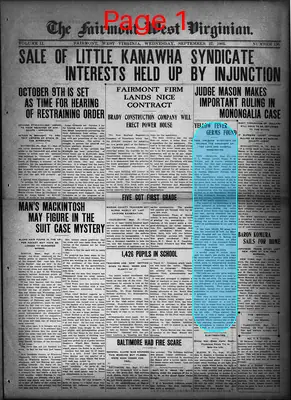
Story
September 27, 1905
The Fairmont West Virginian
Fairmont, Marion County, West Virginia
What is this article about?
Scientists at New Orleans Charity Hospital, including Drs. O. L. Pothier, Joseph Hume, F. H. Watson, and M. Couret, announce the identification of yellow fever germs in patients' blood, enabling diagnoses and paving the way for prevention.
Clipping
OCR Quality
95%
Excellent
Full Text
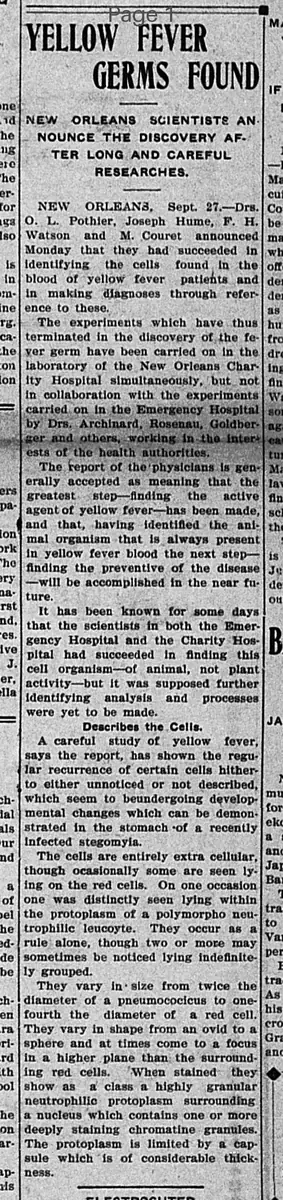
YELLOW FEVER GERMS FOUND
NEW ORLEANS SCIENTISTS ANNOUNCE THE DISCOVERY AFTER LONG AND CAREFUL RESEARCHES.
NEW ORLEANS, Sept. 27.--Drs. O. L. Pothier, Joseph Hume, F. H. Watson and M. Couret announced Monday that they had succeeded in identifying the cells found in the blood of yellow fever patients and in making diagnoses through reference to these.
The experiments which have thus terminated in the discovery of the fever germ have been carried on in the laboratory of the New Orleans Charity Hospital simultaneously, but not in collaboration with the experiments carried on in the Emergency Hospital by Drs. Archinard, Rosenau, Goldberger and others, working in the interests of the health authorities.
The report of the physicians is generally accepted as meaning that the greatest step--finding the active agent of yellow fever--has been made, and that, having identified the animal organism that is always present in yellow fever blood the next step finding the preventive of the disease--will be accomplished in the near future.
It has been known for some days that the scientists in both the Emergency Hospital and the Charity Hospital had succeeded in finding this cell organism--of animal, not plant activity--but it was supposed further identifying analysis and processes were yet to be made.
Describes the Cells.
A careful study of yellow fever says the report, has shown the regular recurrence of certain cells hitherto either unnoticed or not described, which seem to be undergoing developmental changes which can be demonstrated in the stomach of a recently infected stegomyia.
The cells are entirely extra cellular though occasionally some are seen lying on the red cells. On one occasion one was distinctly seen lying within the protoplasm of a polymorphonuclear leucocyte. They occur as a rule alone, though two or more may sometimes be noticed lying indefinitely grouped.
They vary in size from twice the diameter of a pneumococcus to one-fourth the diameter of a red cell. They vary in shape from an ovoid to a sphere and at times come to a focus in a higher plane than the surrounding red cells. When stained they show as a class a highly granular neutrophilic protoplasm surrounding a nucleus which contains one or more deeply staining chromatin granules. The protoplasm is limited by a capsule which is of considerable thickness.
NEW ORLEANS SCIENTISTS ANNOUNCE THE DISCOVERY AFTER LONG AND CAREFUL RESEARCHES.
NEW ORLEANS, Sept. 27.--Drs. O. L. Pothier, Joseph Hume, F. H. Watson and M. Couret announced Monday that they had succeeded in identifying the cells found in the blood of yellow fever patients and in making diagnoses through reference to these.
The experiments which have thus terminated in the discovery of the fever germ have been carried on in the laboratory of the New Orleans Charity Hospital simultaneously, but not in collaboration with the experiments carried on in the Emergency Hospital by Drs. Archinard, Rosenau, Goldberger and others, working in the interests of the health authorities.
The report of the physicians is generally accepted as meaning that the greatest step--finding the active agent of yellow fever--has been made, and that, having identified the animal organism that is always present in yellow fever blood the next step finding the preventive of the disease--will be accomplished in the near future.
It has been known for some days that the scientists in both the Emergency Hospital and the Charity Hospital had succeeded in finding this cell organism--of animal, not plant activity--but it was supposed further identifying analysis and processes were yet to be made.
Describes the Cells.
A careful study of yellow fever says the report, has shown the regular recurrence of certain cells hitherto either unnoticed or not described, which seem to be undergoing developmental changes which can be demonstrated in the stomach of a recently infected stegomyia.
The cells are entirely extra cellular though occasionally some are seen lying on the red cells. On one occasion one was distinctly seen lying within the protoplasm of a polymorphonuclear leucocyte. They occur as a rule alone, though two or more may sometimes be noticed lying indefinitely grouped.
They vary in size from twice the diameter of a pneumococcus to one-fourth the diameter of a red cell. They vary in shape from an ovoid to a sphere and at times come to a focus in a higher plane than the surrounding red cells. When stained they show as a class a highly granular neutrophilic protoplasm surrounding a nucleus which contains one or more deeply staining chromatin granules. The protoplasm is limited by a capsule which is of considerable thickness.
What sub-type of article is it?
Medical Curiosity
Curiosity
Historical Event
What themes does it cover?
Triumph
Recovery
What keywords are associated?
Yellow Fever
Germ Discovery
New Orleans
Scientists
Blood Cells
Diagnosis
Prevention
What entities or persons were involved?
O. L. Pothier
Joseph Hume
F. H. Watson
M. Couret
Archinard
Rosenau
Goldberger
Where did it happen?
New Orleans
Story Details
Key Persons
O. L. Pothier
Joseph Hume
F. H. Watson
M. Couret
Archinard
Rosenau
Goldberger
Location
New Orleans
Event Date
Sept. 27
Story Details
Scientists identify cells in yellow fever patients' blood as the disease's germ, enabling diagnosis; experiments conducted at Charity Hospital parallel those at Emergency Hospital; organism described in detail, promising future prevention.