Thank you for visiting SNEWPapers!
Sign up free
Letter to Editor
November 3, 1892
The Salt Lake Herald
Salt Lake City, Salt Lake County, Utah
What is this article about?
Reminiscences countering claims against Mormon leaders' politics, asserting their Democratic roots with 1860 anecdote of Brigham Young urging a Democratic vote and Civil War discussions among figures like Charles C. Rich and George Q. Cannon.
Clipping
OCR Quality
98%
Excellent
Full Text
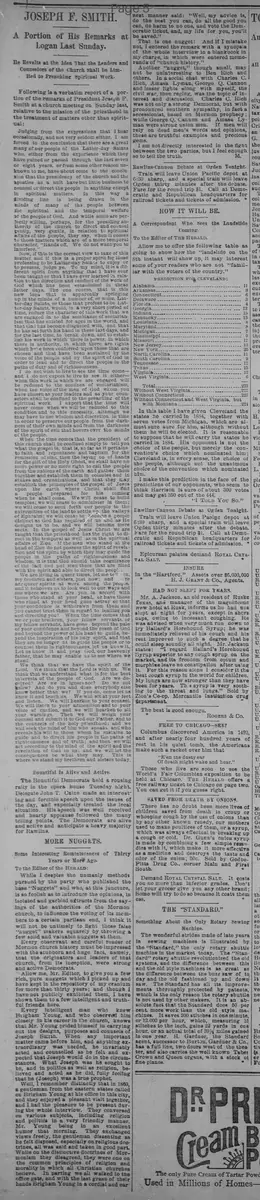
MORE NUGGETS
Some Interesting Reminiscences of Thirty Years or More Ago
To the Editor of the Herald:
While I despise the unmanly methods pursued by the party who published the base "Nuggets" and who, at this juncture, is so foolish as to introduce the opinions, in isolated and garbled extracts from the sayings of the authorities of the Mormon church, to influence the voting of its members to a certain partisan end, I think it will not be untimely to fight those false "nugget" makers squarely by throwing a few solid and valuable nuggets at them.
Every observant and careful reader of Mormon church history must be impressed with the stubborn and huge fact, namely, that the originators and leaders of that church, from its inception, were strong and active Democrats.
Allow me, Mr. Editor, to give you a few rich, pure nuggets which I picked up and have kept in the repository of my cranium for more than thirty years; and though I have not publicly exhibited them, I have shown them to a few intelligent and truthful friends here.
Every intelligent man who knew Brigham Young, and who observed him closely in his career in the church, knows that Mr. Young prided himself in carrying out the designs, purposes and counsels of Joseph Smith.
When any important matter came before him, and anything extraordinary was needed, he invariably acted and counselled as he felt and expected that Joseph would do in the circumstances. What Joseph was he sought to be, and in politics as well as religion, believed and acted as he did, fully feeling that he (Joseph) was a true prophet.
Well, I remember distinctly that in 1860 a gentleman from the eastern states called on Brigham Young at his office in this city, and they enjoyed and I had the pleasure to be present during the whole interview. They conversed on various subjects, including religion and politics in a very friendly manner. Mr. Young being in an excellent humor that morning. They exchanged views freely, the gentleman dissenting as he felt disposed especially on religious doctrines, all was said and taken in good part.
While on the distinctive doctrines of Mormonism they disagreed, they were one on the common principles of religion and morality in which all Christian churches believe. In parting we all walked to the office gate, and with the last grasp of their hands Brigham Young in a cordial and earnest manner said: "Well, my advice is, do the best you can, do all the good you can, do harm to no one, and vote the Democratic ticket, and, my life for you, you'll be saved."
That is one nugget! And if I mistake not, I entered the remark with a synopsis of the whole interview in a blankbook in my charge, in which were entered memoranda of "church history."
Another "nugget" though small, may not be uninteresting to Ben Rich and others. In a social chat with Charles C. Rich, Amasa Lyman, George Q. Cannon and lesser lights along with myself, the civil war, then raging, was the topic of interest and discussion. Charles C. Rich was not only a strong Democrat, but with pronounced southern sympathy, in fact a secessionist, based on Mormon prophecy; while George Q. Cannon and Amasa Lyman were strong union men. If men will rely on dead men's words and opinions, these are truthful examples and precious gems.
I am not directly interested in the fight between the two parties, but I feel enough so to tell the truth.
M.
Some Interesting Reminiscences of Thirty Years or More Ago
To the Editor of the Herald:
While I despise the unmanly methods pursued by the party who published the base "Nuggets" and who, at this juncture, is so foolish as to introduce the opinions, in isolated and garbled extracts from the sayings of the authorities of the Mormon church, to influence the voting of its members to a certain partisan end, I think it will not be untimely to fight those false "nugget" makers squarely by throwing a few solid and valuable nuggets at them.
Every observant and careful reader of Mormon church history must be impressed with the stubborn and huge fact, namely, that the originators and leaders of that church, from its inception, were strong and active Democrats.
Allow me, Mr. Editor, to give you a few rich, pure nuggets which I picked up and have kept in the repository of my cranium for more than thirty years; and though I have not publicly exhibited them, I have shown them to a few intelligent and truthful friends here.
Every intelligent man who knew Brigham Young, and who observed him closely in his career in the church, knows that Mr. Young prided himself in carrying out the designs, purposes and counsels of Joseph Smith.
When any important matter came before him, and anything extraordinary was needed, he invariably acted and counselled as he felt and expected that Joseph would do in the circumstances. What Joseph was he sought to be, and in politics as well as religion, believed and acted as he did, fully feeling that he (Joseph) was a true prophet.
Well, I remember distinctly that in 1860 a gentleman from the eastern states called on Brigham Young at his office in this city, and they enjoyed and I had the pleasure to be present during the whole interview. They conversed on various subjects, including religion and politics in a very friendly manner. Mr. Young being in an excellent humor that morning. They exchanged views freely, the gentleman dissenting as he felt disposed especially on religious doctrines, all was said and taken in good part.
While on the distinctive doctrines of Mormonism they disagreed, they were one on the common principles of religion and morality in which all Christian churches believe. In parting we all walked to the office gate, and with the last grasp of their hands Brigham Young in a cordial and earnest manner said: "Well, my advice is, do the best you can, do all the good you can, do harm to no one, and vote the Democratic ticket, and, my life for you, you'll be saved."
That is one nugget! And if I mistake not, I entered the remark with a synopsis of the whole interview in a blankbook in my charge, in which were entered memoranda of "church history."
Another "nugget" though small, may not be uninteresting to Ben Rich and others. In a social chat with Charles C. Rich, Amasa Lyman, George Q. Cannon and lesser lights along with myself, the civil war, then raging, was the topic of interest and discussion. Charles C. Rich was not only a strong Democrat, but with pronounced southern sympathy, in fact a secessionist, based on Mormon prophecy; while George Q. Cannon and Amasa Lyman were strong union men. If men will rely on dead men's words and opinions, these are truthful examples and precious gems.
I am not directly interested in the fight between the two parties, but I feel enough so to tell the truth.
M.
What sub-type of article is it?
Historical
Reflective
Persuasive
What themes does it cover?
Politics
Religion
What keywords are associated?
Mormon Leaders
Brigham Young
Democratic Party
Joseph Smith
Civil War
Church History
Partisan Politics
What entities or persons were involved?
M.
To The Editor Of The Herald
Letter to Editor Details
Author
M.
Recipient
To The Editor Of The Herald
Main Argument
early mormon leaders, including joseph smith and brigham young, were strong democrats; the letter counters false claims by sharing anecdotes, such as brigham young's 1860 advice to vote democratic for salvation and civil war discussions revealing partisan sympathies among leaders.
Notable Details
Brigham Young Advised A Visitor In 1860: 'Do The Best You Can, Do All The Good You Can, Do Harm To No One, And Vote The Democratic Ticket, And, My Life For You, You'll Be Saved.'
Charles C. Rich Was A Strong Democrat With Southern Sympathies; George Q. Cannon And Amasa Lyman Were Union Men.