Thank you for visiting SNEWPapers!
Sign up free
Gazette Of The United States
Philadelphia, Philadelphia County, Pennsylvania
What is this article about?
Translation of Turgot's 1776 memorial to the French king analyzes France and Spain's interests in the British-American quarrel, favoring colonial independence to weaken Britain while warning against reconciliation or offensive war that could unite them.
Clipping
OCR Quality
Full Text
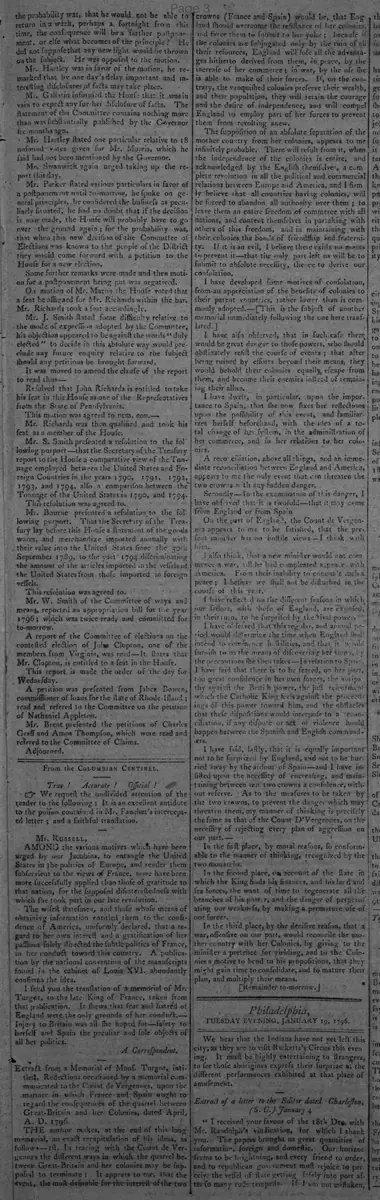
True! Accurate! Official!
a We request the undivided attention of the reader to the following: It is an excellent antidote to the poison contained in Mr. Fauchet's intercepted letter; and a faithful translation.
Mr. Russell,
AMONG the various motives which have been urged by our Jacobins, to entangle the United States in the politics of Europe, and render them subservient to the views of France, none have been more successfully applied than those of gratitude to that nation, for the supposed disinterestedness with which she took part in our late revolution.
The wisest statesmen, and those whose means of obtaining information entitled them to the confidence of America, uniformly declared, that a regard to her own interest and a gratification of her passions solely directed the subtle politics of France, in her conduct toward this country. A publication by the national convention of the manuscripts found in the cabinet of Louis XVI. abundantly confirms the idea.
I send you the translation of a memorial of Mr. Turgot, to the late King of France, taken from that publication. It shows that fear and hatred of England were the only grounds of her conduct. Injury to Britain was all he hoped for--safety to herself and Spain the peculiar and sole objects of all her politics.
A Correspondent.
Extract from a Memorial of Mon. Turgot, entitled, Reflections occasioned by a memorial communicated to the Count de Vergennes, upon the manner in which France and Spain ought to regard the consequences of the quarrel between Great-Britain and her Colonies, dated April A. D. 1776.
THE author makes, at the end of this long memorial, an exact recapitulation of his ideas, as follows--1st. In tracing with the Count de Vergennes the different ways in which the quarrel between Great-Britain and her colonies may be supposed to terminate: It appears to me, that the event, the most desirable for the interest of the two crowns (France and Spain) would be, that England should overcome the resistance of her colonies, and force them to submit to her yoke; because if the colonies are subjugated only by the ruin of all their resources, England will lose all the advantages hitherto derived from them, in peace, by the increase of her commerce; in war, by the use she is able to make of their forces. If, on the contrary, the vanquished colonies preserve their wealth, and their population, they will retain the courage and the desire of independence, and will compel England to employ part of her forces to prevent them from revolting anew.
The supposition of an absolute separation of the mother country from her colonies, appears to me infinitely probable. There will result from it, when the independence of the colonies is entire, and acknowledged by the English themselves, a complete revolution in all the political and commercial relations between Europe and America, and I firmly believe that all countries having colonies, will be forced to abandon all authority over them; to leave them an entire freedom of commerce with all nations, and content themselves in partaking with others of this freedom, and in maintaining, with their colonies the bonds of friendship and fraternity. If it is an evil, I believe there exists no means to prevent it--that the only part left us will be to submit to absolute necessity, thence to derive our consolation.
I have developed some motives of consolation, from an appreciation of the benefits of colonies to their parent countries, rather lower than is commonly adopted.--This is the subject of another memorial immediately following the one here translated.
I have also observed, that in such case there would be great danger to those powers, who should obstinately resist the course of events; that after being ruined by efforts beyond their means, they would behold their colonies equally escape from them, and become their enemies instead of remaining their allies.
I have dwelt, in particular, upon the importance to Spain, that she now fixes her reflections upon the possibility of this event, and familiarizes herself beforehand, with the idea of a total change of her system, in the administration of her commerce, and in her relations to her colonies.
A reconciliation, above all things, and an immediate reconciliation between England and America, appears to me the only event that can threaten the two crowns with any sudden danger.
Secondly--In the examination of this danger, I have observed that it is twofold--that it may come from England or from Spain
On the part of England, the Count de Vergennes appears to me to be satisfied, that the present minister has no hostile views--I think with him.
I also think, that a new minister would not commence a war, till he had completed a peace with America. From their inability to conclude such a peace; I believe we shall not be disturbed in the course of this year.
I have reflected on the different seasons in which our sailors, with those of England, are exposed, in their turn, to be surprised by the rival power
I have observed that this regular, and annual period would determine the time when England shall intend to commence hostilities, and that it would furnish to us the means of discovering her views, by the precautions she then takes--In relation to Spain.
I have said that there is to be feared, on her part, too great confidence in her own forces, the antipathy against the British power. the just resentment which the Catholic King feels against the proceedings of this power toward him, and the obstacles that these dispositions would interpose to a reconciliation, if any dispute or act of violence should happen between the Spanish and English commanders.
I have said, lastly, that it is equally important not to be surprised by England, and not to be hurried away by the ardour of Spain--and I have insisted upon the necessity of increasing, and maintaining between our two crowns a confidence, without reserve. As to the measures to be taken by the two crowns, to prevent the danger which may threaten them, my manner of thinking is precisely the same as that of the Count de Vergennes, on the necessity of rejecting every plan of aggression on our part.
In the first place, by moral reasons, so conformable to the manner of thinking, recognized by the two monarchs.
In the second place, on account of the state in which the King finds his finances, and his land and sea forces, the want of time to regenerate all the branches of his power, and the danger of perpetuating our weakness, by making a premature use of our forces.
In the third place, by the decisive reason, that a war, offensive on our part, would reconcile the mother country with her Colonies, by giving to the minister a pretence for yielding, and to the Colonies a motive to bend to his propositions, that they might gain time to consolidate, and to mature their plan, and multiply their means.
[Remainder to-morrow.]
What sub-type of article is it?
What keywords are associated?
What entities or persons were involved?
Where did it happen?
Foreign News Details
Primary Location
France
Event Date
April A. D. 1776
Key Persons
Outcome
hypothetical outcomes discussed: british subjugation of colonies weakens england; absolute separation leads to free commerce and loss of colonial authority; reconciliation between britain and america poses danger to france and spain; recommends no offensive war to avoid uniting them.
Event Details
Turgot's memorial recapitulates views on British-American quarrel: prefers British victory through ruin to weaken England; sees colonial independence as probable, revolutionizing Europe-America relations and forcing colonial freedom; warns of dangers in resisting events or pursuing aggressive war, which could reconcile Britain and colonies; urges France and Spain to maintain confidence and avoid aggression due to financial and military weaknesses.