Thank you for visiting SNEWPapers!
Sign up free
Independent Journal, Or, The General Advertiser
New York, New York County, New York
What is this article about?
Reports on the 1787 Dutch political crisis: Prince of Orange captures Wijk, devastations in Middleburg and Flushing, diplomatic efforts by France, Prussia, and Britain; Princess of Orange's letter protesting detention; threats of civil war.
Merged-components note: Continuation of the same foreign news article on the Dutch political crisis involving the Prince and Princess of Orange, spanning multiple components across pages 2 and 3.
Clippings
1 of 2
OCR Quality
Full Text
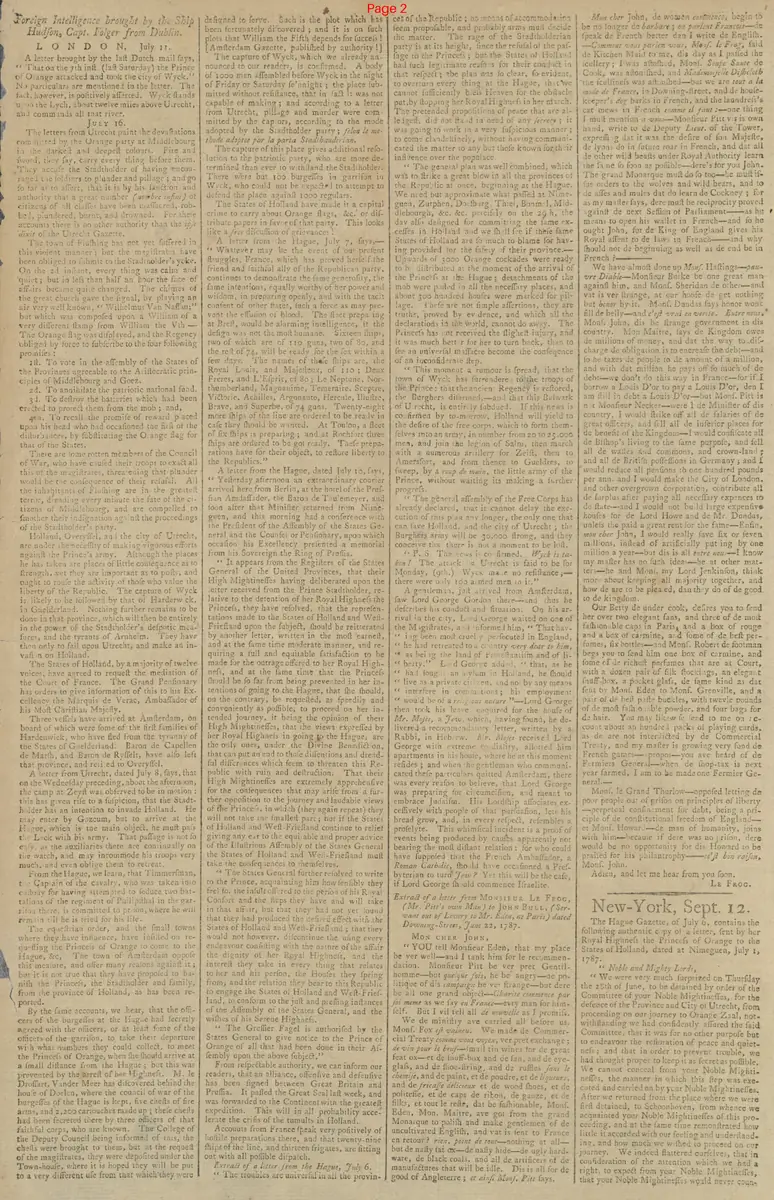
LONDON, July 11.
A letter brought by the last Dutch mail says,
"That on the 2nd inst. (last Saturday) the Prince of Orange attacked and took the city of Wijk."
No particulars are mentioned in the letter. The fact, however, is positively asserted. Wijk stands upon the Leck, about twelve miles above Utrecht, and commands all that river.
JULY 16.
The letters from Utrecht paint the devastations committed by the Orange party at Middleburg in the darkest and deepest colours. Fire and sword, they say, carry every thing before them.
They accuse the Stadtholder of having encouraged the soldiers to plunder and pillage; and go so far as to assert, that it is by his sanction and authority that a great number (nombre infini) of citizens of all classes have been massacred, robbed, plundered, burnt, and drowned. For these accounts there is no other authority than the ipse dixit of the Utrecht Gazette.
The town of Flushing has not yet suffered in this violent manner: but the magistrates have been obliged to submit to the Stadtholder's yoke.
On the 2nd instant, every thing was calm and quiet; but in less than half an hour the face of affairs became quite changed. The chimes of the great church gave the signal, by playing an air very well known, "Wilhelmus Van Nassou;" but which was composed upon a William of a very different stamp from William the Vth.
The Orange flag was displayed, and the Regency obliged by force to subscribe to the four following promises:
1st. To vote in the assembly of the States of the Province agreeable to the Aristocratic principles of Middleburg and Goes.
2d. To annihilate the patriotic national fund.
3d. To destroy the batteries which had been erected to protect them from the mob; and,
4th. To recall the promise of reward placed upon his head who had occasioned the first of the disturbances, by substituting the Orange flag for that of the States.
There are some rotten members of the Council of War, who have caused their troops to exact all this of the magistrates, threatening that plunder would be the consequence of their refusal. All the inhabitants of Flushing are in the greatest terror, dreading every minute the fate of the citizens of Middleburg, and are compelled to smother their indignation against the proceedings of the Stadtholder's party.
Holland, Overyssel, and the city of Utrecht, are under the necessity of making vigorous efforts against the Prince's army. Although the places he has taken are places of little consequence as to strength, yet they are important as to posts, and ought to rouse the activity of those who value the liberty of the Republic. The capture of Wijk is likely to be followed by that of Harderwijk, in Gelderland. Nothing further remains to be done in that province, which will then be entirely in the power of the Stadtholder's despotic measures, and the tyrants of Arnheim. They have then only to fall upon Utrecht, and make an invasion on Holland.
The States of Holland, by a majority of twelve voices, have agreed to request the mediation of the Court of France. The Grand Pensionary has orders to give information of this to his Excellency the Marquis de Verac, Ambassador of his Most Christian Majesty.
Three vessels have arrived at Amsterdam, on board of which were some of the first families of Harderwijk, who have fled from the tyranny of the States of Gelderland. Baron de Capellen de Marsch, and Baron de Ryfel, have also left that province, and retired to Overyssel.
A letter from Utrecht, dated July 8, says, that on the Wednesday preceding, about the afternoon, the camp at Zeist was observed to be in motion: this has given rise to a suspicion, that the Stadtholder has an intention to invade Holland. He may enter by Goejum, but to arrive at the Hague, which is the main object, he must pass the Leck with his army. That passage is not so easy, as the auxiliaries there are continually on the watch, and may incommode his troops very much, and even oblige them to retreat.
From the Hague, we learn, that Timmerman, the Captain of the cavalry, who was taken in custody for having attempted to seduce two battalions of the regiment of Philippinal in the garrison there, is committed to prison, where he will remain till he is tried for his life.
The equestrian order, and the small towns where they have influence, have insisted on requiring the Princess of Orange to come to the Hague, &c. The town of Amsterdam opposes this measure, and offer many reasons against it; but it is not true that they have proposed to banish the Princess, the Stadtholder and family, from the province of Holland, as has been reported.
By the same accounts, we hear, that the officers of the burghers at the Hague had secretly agreed with the officers, or at least some of the officers of the garrison, to take their departure with what numbers they could collect, to meet the Princess of Orange, when she should arrive at a small distance from the Hague; but this was prevented by the arrest of her Highness. M. le Drouart, Van der Meer has discovered behind the house of Doelen, where the council of war of the burghers of the Hague is kept, five chests of fire-arms, and 2200 cartouches made up; these chests had been secreted there by three officers of that faithful corps, who are known. The College of the Deputy Council being informed of this, the chests were brought to them, but at the request of the magistrates, they were deposited under the Town-house, where it is hoped they will be put to a very different use from that which they were designed to serve. Such is the plot which has been fortunately discovered; and it is on such plots that William the Fifth depends for success!
[Amsterdam Gazette, published by authority!]
The capture of Wijk, which we already announced to our readers, is confirmed. A body of 3000 men assembled before Wijk in the night of Friday or Saturday e'enight; the place submitted without resistance, that it was not capable of making; and according to a letter from Utrecht, pillage and murder were committed by the captors, according to the mode adopted by the Stadtholder party; felon methods adopted par la parte Stathoudérienne.
The capture of this place gives additional resolution to the patriotic party, who are more determined than ever to withstand the Stadtholder.
There were but 100 burghers in garrison in Wijk, who could not be expected to attempt to defend the place against 3000 regulars.
The States of Holland have made it a capital crime to carry about Orange flags, &c. or distribute papers in favour of that party. This looks like a free discussion of grievances!
A letter from the Hague, July 7, says,
"Whatever may be the event of our present struggles, France, which has proved herself the friend and faithful ally of the Republican party, continues to demonstrate the same generosity, the same intentions, equally worthy of her power and wisdom, in preparing openly, and with the tacit consent of other states, such a force as may prevent the effusion of blood. The fleet preparing at Brest, would be alarming intelligence, if the design was not the most humane. Sixteen ships, two of which are of 110 guns, two of 80, and the rest of 74, will be ready for the sea within a few days. The names of those ships are, the Royal Louis, and Magnifique, of 110; Deux Freres, and L'Esprit, of 80: Le Neptune, Northumberland, Magnanime, Temeraire, Sceptre, Victorie, Achilles, Argonaute, Hercule, Illustre, Brave, and Superbe, of 74 guns. Twenty-eight more ships of the line are ordered to be ready in case they should be wanted. At Toulon, a fleet of six ships is preparing; and at Rochefort three ships are ordered to be got ready. These preparations have for their object, to restore liberty to the Republics."
A letter from the Hague, dated July 10, says,
"Yesterday afternoon an extraordinary courier arrived here from Berlin, at the hotel of the Prussian Ambassador, the Baron de Thulemeyer, and soon after that Minister returned from Nimeguen, and this morning had a conference with the President of the Assembly of the States General and the Council or Pensionary, upon which occasion his Excellency presented a memorial from his Sovereign the King of Prussia.
"It appears from the Registers of the States General of the United Provinces, that their High Mightinesses having deliberated upon the letter received from the Prince Stadtholder, relative to the detention of her Royal Highness the Princess, they have resolved, that the representations made to the States of Holland and West-Friesland upon the subject, should be reiterated by another letter, written in the most earnest, and at the same time moderate manner, and requiring a full and equitable satisfaction to be made for the outrage offered to her Royal Highness, and at the same time that the Princess should be so far from being prevented in her intentions of going to the Hague, that she should, on the contrary, be requested, as speedily and conveniently as possible, to proceed on her intended journey, it being the opinion of their High Mightinesses, that the views expressed by her Royal Highness in going to the Hague, are the only ones, under the Divine Benediction, that can put an end to those dissensions and dreadful differences which seem to threaten this Republic with ruin and destruction. That their High Mightinesses are extremely apprehensive for the consequences that may arise from a further opposition to the journey and laudable views of the Princess, in which (they again repeat) they will not take the smallest part; but if the States of Holland and West-Friesland continue to refuse giving any ear to the equitable and proper advice of the Illustrious Assembly of the States General the States of Holland and West-Friesland must take the consequences to themselves."
"The States General further resolved to write to the Prince, acquainting him how sensibly they feel for the insult offered to the person of his Royal Consort and the steps they have and will take in that affair, but that they had not yet found that they had produced the desired effect with the States of Holland and West-Friesland; that they would not however, discontinue the using every endeavour consistent with the nature of the affair the dignity of her Royal Highness, and the interest they take in every thing that relates to her and his person, the House they spring from, and the relation they bear to this Republic to engage the States of Holland and West-Friesland, to conform to the just and pressing instances of the Assembly of the States General, and the wishes of his Serene Highness."
"The Greffier Fagel is authorised by the States General to give notice to the Prince of Orange of all that had been done in their Assembly upon the above subject,"
From respectable authority, we can inform our readers, that an alliance, offensive and defensive has been signed between Great Britain and Prussia. It passed the Great Seal last week, and was forwarded to the Continent with the greatest expedition. This will in all probability accelerate the crisis of the tumults in Holland.
Accounts from France speak very positively of hostile preparations there, and that twenty-nine ships of the line, and thirteen frigates, are fitting out with all possible dispatch.
Extract of a letter from the Hague, July 6.
"The troubles are universal in all the provinces of the Republic: no means of accommodation seem probable, and probably arms must decide the matter. The rage of the Stadtholderian party is at its height, since the refusal of the passage to the Princess; but the States of Holland had such legitimate reasons for their conduct in that respect; the plan was so clear, so evident, to overturn every thing at the Hague, that we cannot sufficiently bless Heaven for the obstacle put, by stopping her Royal Highness in her march.
The pretended propositions of peace that are alleged, did not stand in need of any secrecy; it was going to work in a very suspicious manner; to come clandestinely, without having communicated the matter to any but those known for their influence over the populace
The general plan was well combined, which was to strike a great blow in all the provinces of the Republic at once, beginning at the Hague. We need but approximate what passed at Nimeguen, Zutphen, Doesburg, Tiel, Bommel, Middleburg, &c. &c. precisely on the 29th, the day also designed for committing the same excesses in Holland and we shall see if these same States of Holland are so much to blame for having provided for the safety of their province.
Upwards of 3000 Orange cockades were ready to be distributed at the moment of the arrival of the Prince at the Hague; detachments of the mob were posted in all the necessary places, and about two hundred houses were marked for pillage. These are not simple assertions, they are truths, proved by evidence, and which all the declarations in the world, cannot do away. The Princess has not received the slightest injury, and it was much better for her to turn back, than to see an universal massacre become the consequence of an inconsiderate step.
"This moment a rumour is spread, that the town of Wijk has surrendered to the troops of the Prince: that the ancient Regency is restored, the Burghers disarmed,--and that this Bulwark of Utrecht, is entirely subdued. If this news is confirmed by to-morrow, Holland will yield to the desire of the free corps. which to form themselves into an army, in number from 20 to 25,000 men, and join the legion of Salm, then march with a numerous artillery for Zeist, then to Amersfoort, and from thence to Gelderland, to sweep, by a coup de main, the little army of the Prince, without waiting its making a further progress,
"The general assembly of the Free Corps has already declared, that it cannot delay the execution of this plan any longer, the only one that can save Holland, and the city of Utrecht; the Burghers army will be 30,000 strong, and they conceive that there is not a moment to be lost.
P. S. The news is confirmed. Wijk is taken! The attack on Utrecht is said to be for Monday, (6th.) Wijk made no resistance;-- there were only two armed men in it."
A gentleman, just arrived from Amsterdam, saw Lord George Gordon there and thus he describes his conduct and situation. On his arrival in the city, Lord George waited on one of the Magistrates, and informed him, "That having been most cruelly persecuted in England, he had retreated to a country very dear to him, as being the land of Protestantism and of liberty." Lord George added. "that, as he had found an asylum in Holland, he should live as a private citizen, and not by any means interfere in commotions; his employment would be of a religious nature "Lord George then took his leave enquired for the house of Mr. Moses, a Jew, which, having found, he delivered a recommendatory letter, written by a Rabbi, in Hebrew. Mr. Moses received Lord George with extreme cordiality, allotted him apartments in his house, where he at this moment resides ; and when he gentleman who communicated these particulars quitted Amsterdam, there was every reason to believe, that Lord George was preparing for circumcision, and meant to embrace Judaism. His Lordship associates excessively with people of that persuasion, lets his beard grow, and, in every respect, resembles a proselyte. This whimsical incident is a proof of events being produced by causes apparently not bearing the most distant relation: for who could have supposed that the French Ambassador, a Roman Catholic, should have occasioned a Presbyterian to turn Jew ? Yet this will be the case, if Lord George should commence Israelite.
New-York, Sept. 12.
The Hague Gazette, of July 6, contains the following authentic copy of a letter, sent by her Royal Highness the Princess of Orange to the States of Holland, dated at Nimeguen, July 1, 1787.
"Noble and Mighty Lords,
We were very much surprised on Thursday the 29th of June, to be detained by order of the Committee of your Noble Mightinesses, for the defence of the Province and City of Utrecht, from proceeding on our journey to Orange Zaal, notwithstanding we had confidently assured the said Committee, that it was for no other purpose but to endeavour the restoration of peace and quietness; and that in order to prevent trouble, we had thought proper to keep it as secret as possible.
We cannot conceal from your Noble Mightinesses, the manner in which this step was executed and carried on by your Noble Mightinesses. After we returned from the place where we were first detained, to Schoonhoven, from whence we acquainted your Noble Mightinesses of this proceeding, and at the same time remonstrated how little it accorded with our feeling and understanding, and how much we wished to proceed on our journey. We indeed flattered ourselves, that in consideration of the attention which we had a right to expect from your Noble Mightinesses, that your Noble Mightinesses would never countenance such violent measures against our person, as we are sorry to find has been done, by the assistance which your Noble Mightinesses have given to the deliberations of the Committee of Utrecht, and the orders which they have presumed to give on this occasion.
Maintenance the behaviour of your Committee. But upon knowledge of the same, would have afforded us the means of accomplishing our journey and our intentions, meant for the good of the country. But on the contrary, your Noble Mightiness have not only made us wait at Schoonhoven until Saturday, the 20th of June, for your answer but at that time sent us word, that no conclusive answer could be then given; which we received a letter from the principal of the aforesaid Committee, informing us, "That your conduct had been approved of by your Noble Mightiness "The approbation of your Noble Mightiness, of our being detained, notwithstanding our verbal assurances, and our writing the proceedings, besides the express application made by the States General at their last meeting, to grant us a free passage to Orange Zal, we cannot consider otherwise, than as a public proof of insulting our illustrious word and declared intention; and likewise a great impediment to the liberty, which ought not to be refused to us in our present situation, especially in this Republic in general, and your Noble Mightiness, through the aforesaid violent measure, have frustrated our good and peaceable intentions, we find ourselves obliged, not only to demand a public and ample reparation for the affront offered to us: but likewise to protest, in the most forcible manner, "That from this time, all the consequences so much dreaded from the present disturbances, and a civil war, with which we are menaced, and which we, by our interference, hoped to prevent, are entirely to be accounted for, and answered by those who, through their violent measures have prevented our endeavours, and gained a superiority by their influence." However, notwithstanding the present fermentation, and the insult offered from your Noble Mightiness, we shall never cease to further the true welfare of a nation, from which we have experienced in general, many tokens of respect and love; and we continue to receive the same, notwithstanding the humiliating resolutions and actions of your Noble Mightiness. "We recommend your Noble Mightiness to God's holy protection; being your Noble Mightiness's humble servants, WILHELMINA."
Nimeguen, July 1, 1787.
What sub-type of article is it?
What keywords are associated?
What entities or persons were involved?
Where did it happen?
Foreign News Details
Primary Location
Dutch Republic
Event Date
July 1787
Key Persons
Outcome
capture of wijk without resistance; alleged massacres, plunders in middleburg; flushing submits to stadtholder; diplomatic mediation requested from france; alliance between britain and prussia; french naval preparations; princess detained and protests.
Event Details
Amid political crisis in the Dutch Republic, the Prince of Orange's forces capture Wijk, leading to fears of invasion into Holland and Utrecht. Reports detail devastations by Orange party in Middleburg and forced submission in Flushing. States of Holland seek French mediation; Prussian ambassador presents memorial on Princess's detention. Princess of Orange writes protesting her detention en route to The Hague. French fleets prepare to support republican liberty. Lord George Gordon arrives in Amsterdam seeking asylum and possibly converting to Judaism.