Thank you for visiting SNEWPapers!
Sign up free
The National Intelligencer And Washington Advertiser
Washington, District Of Columbia
What is this article about?
Paris journals up to June 30 report a British commercial commissioner appointed to resolve disputes and possibly negotiate a treaty with France; strong support for Bonaparte's election as Consul for life; persistent bread scarcity with anticipated American flour imports; consultations on Anglo-French commerce involving M. Peuchet; high grain prices in Rotterdam due to French supplies; General Murat's arrival from Naples amid drought-induced dearth in Eastern Italy; influx of European emigrants to France; declining French funds at 55 fr. 60; and French re-establishment of slave trade contrasting British restrictions.
Merged-components note: Continuation of foreign news items from Paris journals and related European reports across the page break on page 2 to 3, with sequential reading order and topic coherence on international affairs.
Clippings
1 of 2
OCR Quality
Full Text
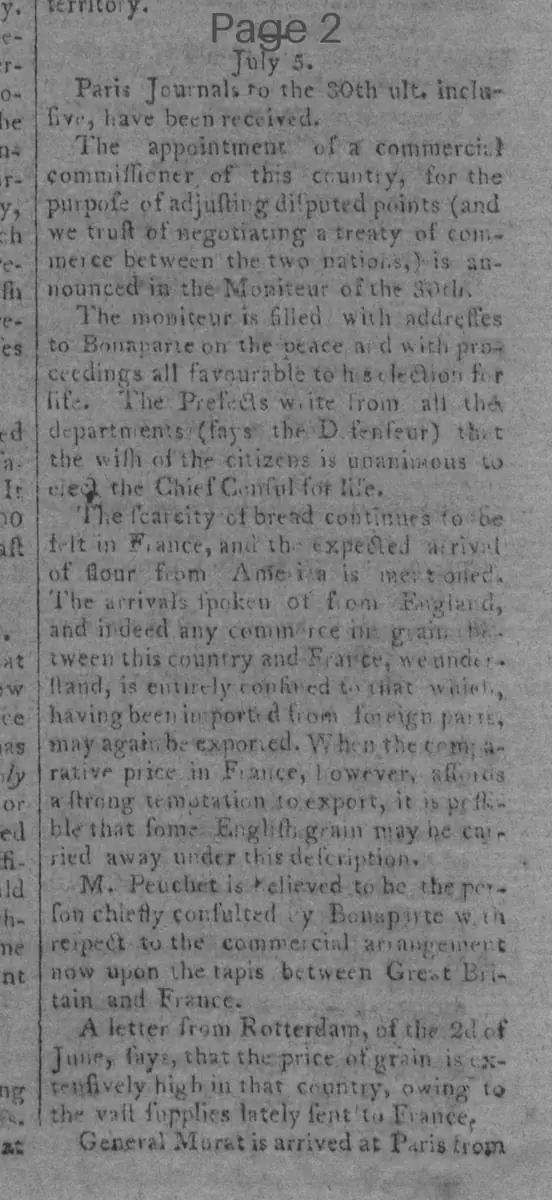
Paris Journals to the 30th ult. inclusive, have been received.
The appointment of a commercial commissioner of this country, for the purpose of adjusting disputed points (and we trust of negotiating a treaty of commerce between the two nations,) is announced in the Moniteur of the 30th.
The Moniteur is filled with addresses to Bonaparte on the peace and with proceedings all favourable to his election for life. The Prefects write from all the departments (says the Defesseur) that the wish of the citizens is unanimous to elect the Chief Consul for life.
The scarcity of bread continues to be felt in France, and the expected arrival of flour from America is mentioned. The arrivals spoken of from England, and indeed any commerce in grain between this country and France, we understand, is entirely confined to that which, having been imported from foreign parts, may again be exported. When the remunerative price in France, however, allows a strong temptation to export, it is possible that some English grain may be carried away under this description.
M. Peuchet is believed to be the person chiefly consulted by Bonaparte with respect to the commercial arrangement now upon the tapis between Great Britain and France.
A letter from Rotterdam, of the 2d of June, says, that the price of grain is exceedingly high in that country, owing to the vast supplies lately sent to France.
General Murat is arrived at Paris from Naples. Accounts from that city state, that the whole of Eastern Italy is threatened with absolute dearth, which is to be ascribed to the excessive dryness of the season.
The emigrants are pouring into France from all quarters of Europe.
The French funds seem to be rather on the decline. The Moniteur no longer calls the Fers Confide by that name, but the five per cents. They are 55 fr. 60 the price which our Irish five per cents bore after the rebellion.
While the French government is re-establishing the slave trade, the British is considering of imposing additional restrictions upon it.
What sub-type of article is it?
What keywords are associated?
What entities or persons were involved?
Where did it happen?
Foreign News Details
Primary Location
Paris
Event Date
Journals To The 30th Ult.
Key Persons
Outcome
proceedings favourable to bonaparte's election for life; french funds at 55 fr. 60; eastern italy threatened with dearth.
Event Details
Paris journals announce appointment of a commercial commissioner to adjust disputes and negotiate treaty with France; Moniteur reports addresses supporting Bonaparte's lifelong election with unanimous departmental wishes; bread scarcity persists with expected American flour and restricted English grain exports; M. Peuchet consulted on Anglo-French commercial arrangement; Rotterdam grain prices high due to French supplies; General Murat arrives from Naples; emigrants enter France; French funds decline; French re-establish slave trade while British consider restrictions.