Thank you for visiting SNEWPapers!
Sign up free
The National Intelligencer And Washington Advertiser
Washington, District Of Columbia
What is this article about?
On May 1, 1802, the U.S. House of Representatives debated recommitting the Committee of Investigation's report on treasury accounts, navy yards, and appointments. Speakers including Bayard, Griswold, Nicholson, and Randolph discussed financial practices, Mr. Tracy's and Mr. Dawson's cases, and navy yard purchases. The motion to recommit failed 22-46.
Clipping
OCR Quality
Full Text
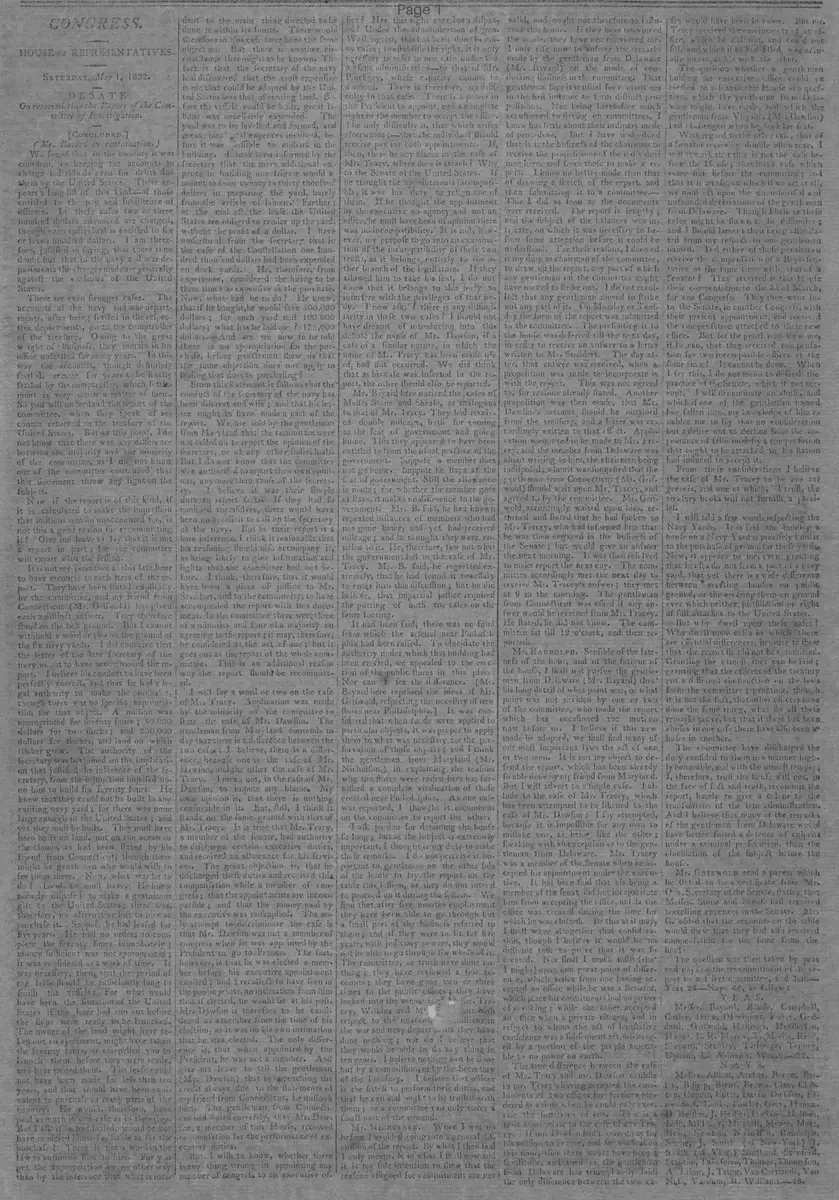
HOUSE OF REPRESENTATIVES.
SATURDAY, MAY 1, 1802.
DEBATE
On recommitting the Report of the Committee of Investigation.
[CONCLUDED.]
(Mr. Bayard in continuation.)
We found that in the treasury it was common, in keeping the accounts to charge individuals even for debts due them by the United States. There appears a long list of this kind of those entitled to the pay and subsistence of officers. In these cases two or three hundred dollars advanced are charged, though each individual is entitled to six or even hundred dollars. I am therefore justified in saying, that there is no doubt but that in the navy and war departments the charges made are generally against the creditors of the United States.
There are even stronger cases. The accounts of the navy and war departments, after being settled in the respective departments, go to the comptroller of the treasury. Owing to the great weight of business, they remain in his office unsettled for many years. In this way the accounts, though definitely settled, remain for years to be finally settled by the comptroller, which settlement is very much a matter of form.
So you will understand the report of the committee, when they speak of accounts returned to the treasury of the United States. But on this point, I do not know that there was any difference between the majority and the minority of the committee, as I do not know one of the committee contended that this document threw any light on the subject.
Now if the report is of this kind, if it is calculated to make the impression that millions remain unaccounted for, is not this a good reason for recommitting it? Give me leave to say that it is not a report in part; for the committee will expire with the session.
It is not my intention at this late hour to have recourse to each item of the report. They have been stated explicitly by the committee, and my friend from Connecticut (Mr. Griswold) has given each a distinct answer. They therefore stand on the best ground. But I cannot withhold a word or two on the ground of the six navy yards. I did conceive that the letter of the late secretary of the navy ought to have accompanied the report. I believe his conduct to have been perfectly correct, and that he had a legal authority to make the purchase, though there was no specific appropriation for that object. A million was appropriated for seventy fours; 50,000 dollars for two docks; and 200,000 dollars for timber, and land on which timber grew. The authority of the secretary was bottomed on the implication that justified the inference of the secretary, from the injunction imposed upon him to build six seventy fours. He knew that they could not be built in any existing navy yard; for there was none large enough in the United States; and yet they must be built. They must have been built on land, not on the ocean or the clouds, as had been stated by his friend from Connecticut, though there might be gentlemen who would wish to see them there. Now, what was he to do? Land, he must have. He knew nobody disposed to make a gratuitous gift to the United States; there was, therefore, no alternative but to hire or purchase it. Suppose he had leased for five years. He had no orders to complete the seventy fours immediately; money sufficient was not appropriated; it was considered as a work of time. It was necessary, then, that the period of the lease should be sufficiently long to finish the vessels: For what would have been the situation of the United States if the lease had run out before the ships were ready to be launched. The owner of the land might have taken out an ejectment, might have taken the seventy fours, or compelled you to launch them before they were ready, and have ruined them. The lease could not have been made for less than ten years, and that would have been equivalent to purchase in many parts of the country. He would, therefore, have paid as much in one case as in the other. But I ask if he had leased, would he not have rendered himself as liable as on the purchase? There is not a word in the law to authorize him to hire. For you get the appropriation by no other way than by the inference that what is incident to the main thing directed to be done is within its limits. There would therefore in this case have been the same objection. But there is another circumstance that ought to be known. The fact is that the secretary of the navy had discovered that the most expensive mode that could be adopted by the United States was that of renting land. Before the vessels could be built, great labour was necessarily expended. The yard was to be levelled and formed, and great incidental expenses incurred, before it was possible to embark in the building. I have been informed by the secretary that the mere additional expense in building one frigate would amount to from twenty to thirty thousand dollars in preparing the yard, barely from the article of labour. Farther: at the end of the lease the United States are obliged to render up the yard, without the profit of a dollar. I have understood from the secretary that in the case of the Constellation one hundred thousand dollars had been expended on dock yards. He, therefore, from experience, considered the hiring to be three times as expensive as the purchase. Now, what had he to do? He knew, that if he bought, he would save 500,000 dollars; for each yard cost 100,000 dollars; what has he laid out? 175,000 dollars. And are we now to be told there is no appropriation for the purchase, before gentlemen show us that the same objection does not apply to leasing that does to purchasing?
From this statement it follows that the conduct of the secretary of the navy has been discreet and wise; and that his letter ought to have made a part of the report. We are told by the gentleman from Maryland that the committee were not called on to report the opinion of the secretary, or of any other individuals. But I do not know that the committee was authorized to report their own opinions, any more than those of the secretary. I believe it was their simple duty to report facts. If they had so confined themselves, there would have been no occasion to call on the secretary of the navy. But as their report is a bare inference, I think it reasonable that his reasoning should also accompany it, as being likely to give information and lights that the committee had not before. I think, therefore, that it would have been a piece of justice to Mr. Stoddert, and to the community, to have accompanied the report with this document. To the committee there were three of a minority and four of a majority on agreeing to the report; it may, therefore, be considered as the act of one; but it goes out as the report of the whole committee. This is an additional reason why the report should be recommitted.
I will say a word or two on the case of Mr. Tracy. Application was made by the minority of the committee to state the case of Mr. Dawson. The gentleman from Maryland contends today that there is a difference between the two cases: I believe, there is a difference, because one is the case of Mr. Dawson, and the other the case of Mr. Tracy. I mean not, in the case of Mr. Dawson, to impute any blame. My own opinion is, that there is nothing censurable in it. But, still, I think it stands on the same ground with that of Mr. Tracy. It is true that Mr. Tracy, a member of the senate, had authority to discharge certain executive duties, and received an allowance for his services. The great objection is, that he discharged these duties and received this compensation while a member of congress; that the appointments are incompatible; and that the money paid by the executive was misapplied. The only attempt to discriminate the case is that Mr. Dawson was not a member of congress when he was appointed by the President to go to France. The fact, however, is that he was elected a member before his executive appointment expired; and I recollect to have seen in the public prints, an intimation from him that if elected, he would be at his post. Mr. Dawson is therefore to be considered as a member from the time of his election, as it was on his own intimation that he was elected. The only difference is, that when appointed by the President, he was not a member. And give me leave to tell the gentleman (Mr. Dawson) that in impeaching the credit always due to the statements of my friend from Connecticut, he mistook him. The gentleman from Connecticut had stated correctly, that Mr. Dawson, a member of this House, received compensation for the performance of executive duties.
But, I wish to know, whether there is any thing wrong in appointing any member of congress to an executive office? Has this right ever been disputed? Under the administration of Gen. Washington, this has been done in many cases; to establish the right, it is only necessary to refer to one case under the present administration—to that of Mr. Pinckney, whose capacity cannot be doubted. There is therefore, no difficulty in that case. There is a power in the President to appoint, and a complete right in the member to accept the office. The only difficulty is, that which arises afterwards;—that the individual should receive pay for both appointments. If, then, there be any blame in the case of Mr. Tracy, where does it attach? Why to the Senate of the United States. If he thought the appointments incompatible, it was his duty to resign one of them. If he thought the appointment by the executive an agency and not an office, he must have been of opinion there was no incompatibility. It is not, however, my purpose to go into an examination of the incompatibility of these two trusts, as it belongs, entirely to the other branch of the legislature. If they allowed him to take his seat, I do not know that it belongs to this body to interfere with the privileges of that body. I now ask, if there is any dissimilarity in these two cases? I should not have dreamt of introducing into this debate the name of Mr. Dawson, if a case of a similar nature, in which the name of Mr. Tracy has been made use of, had not occurred. We did think that as his case was inserted in the report, the other should also be reported.
Mr. Bayard here noticed the cases of Messrs Stone and Sheafe, as analogous to that of Mr. Tracy. They had received double mileage, both for coming to the seat of government and going home. This they appeared to have been entitled to from the usual practice of the government. Suppose a member does not go home. Suppose he stays at the seat of government. Still the allowance is made; for whether the member goes or stays, it makes no difference to the government. Mr. B. said, he had known repeated instances of members who had not gone home, and yet had received mileage; and he thought they were entitled to it. He, therefore, saw not what the government lost in the case of Mr. Tracy. Mr. B. said, he regretted extremely, that he had found it necessary to enter into this discussion; but he did believe, that impartial justice required the putting of both the cases on the same footing.
It had been said, there was no fund from which the arsenal near Philadelphia had been raised. To elucidate the authority under which that building had been erected, we appealed to the erection of the public stores in this place. Nor can I see the difference. (Mr. Bayard here repeated the ideas of Mr. Griswold, respecting the necessity of new stores near Philadelphia.) It was considered that when funds were applied to particular objects, it was proper to apply them to what was necessary for the preservation of those objects; and I think the gentleman from Maryland (Mr. Nicholson,) in explaining the reasons why the stores were raised here has furnished a complete vindication of those erected near Philadelphia. As one case was reported, I thought it incumbent on the committee to report the other.
I ask pardon for detaining the house so long; but as the subject is extremely important, I thought it my duty to make these remarks. I do not perceive it important to gentlemen on the other side of the house to lay the report on the table this session, as they do not intend to proceed on it during the session. We find that after five months employment they have been able to go through but a small part of the business referred to them; and if they were to sit for five years, with judiciary powers, they would not be able to go through the whole of it. The committee, in truth have done nothing; they have reviewed a few accounts; they have gone two or three times to the public offices; they have looked into the account books. Tracy, Wilkins and M—but with respect to the unaccounted millions in the war and navy departments they have done nothing; nor do I believe that they would be able to do anything in ten years. I believe nothing can be done but by a commission, or by the Secretary of the Treasury. I believe that officer is the fittest to perform these duties, and that he can and may be trusted with them; as a committee can only cover a small part of the ground.
Mr. Nicholson. When I was up before I avoided going into a general discussion of the report. By what I then said I only meant, & in what I shall now add it is my sole intention to show that the reasons argued for recommittal are not valid, and ought not therefore to influence this house. If they have convinced the house, they have not convinced me.
I only rise now to answer the remarks made by the gentleman from Delaware (Mr. Bayard) on the mode of conducting business in the committee. That gentleman says it is usual for committees in the first instance to form distinct propositions. Not being heretofore much accustomed to sitting on committees, I know but little about their ordinary mode of procedure. But I have understood that it is the business of the chairman to receive the propositions of the individual members, and from these to make a report. I know no better mode than that of drawing a sketch of the report, and then submitting it to a committee.—This I did as soon as the documents were received. The report is lengthy; and the subject of the balances was intricate, on which it was necessary to bestow some attention before it could be understood. For these reasons, I deemed it my duty as chairman of the committee, to draw up the report, any part of which any gentleman on the committee might have moved to strike out. I do not recollect that any gentleman moved to strike out any part of it. On Monday or Tuesday the form of the report was submitted to the committee. The presenting it to the house was deferred till the next day, in order to receive an answer to a letter written to Mr. Stoddert. The day after, that answer was received, when a proposition was made to incorporate it with the report. This was not agreed to, for reasons already stated. Another proposition was then made, that Mr. Dawson's account should be obtained from the treasury, and a letter was accordingly written to that effect. Application was moved to be made to Mr. Tracy, and the member from Delaware was about writing to him, the chairman being indisposed; when it was suggested that the gentleman from Connecticut (Mr. Griswold) should wait upon Mr. Tracy, and agreed to by the committee. Mr. Griswold accordingly waited upon him, returned and stated that he had spoken to Mr. Tracy, who had informed him that he was then engaged in the business of the Senate; but would give an answer the next morning. It was then resolved to make report the next day. The committee accordingly met the next day to receive Mr. Tracy's answer; they met at 9 in the morning. The gentleman from Connecticut was asked if any answer would be received from Mr. Tracy. He stated, he did not know. The committee sat till 12 o'clock, and then reported.
Mr. Randolph. Sensible of the lateness of the hour, and of the fatigue of the house, I shall not pursue the gentleman from Delaware (Mr. Bayard) though his long detail of what point was, or what point was not decided by one or two of the committee, who made the report which has occasioned the motion now before us. I believe if this new mode be adopted, we shall find many of our most important laws the act of one or two men. It is not my object to defend the report, which has been already so ably done by my friend from Maryland. But I will advert to a single case. I allude to the case of Mr. Tracy, which has been attempted to be likened to the case of Mr. Dawson; I say attempted, because it is impossible for any man to mistake one, as being like the other; speaking with an exception as to the gentleman from Delaware. Mr. Tracy was a member of the Senate when he accepted his appointment under the executive. It has been said that his being a member of the senate did not incapacitate him from accepting the office, unless the office was created during the time for which he was elected. Be this as it may, I shall waive altogether that consideration, though I believe it would be no difficult task to prove that it was so created. Nor shall I much insist (though I might) upon one great point of difference, which arises from one having accepted an office while he was a Senator, which place his constituents had no power of revoking; while the other accepted an office when a private citizen, and in respect to whom the act of legislative confidence was a subsequent act, discharged by a portion of the people amenable to no power on earth.
The true difference between the case of Mr. Tracy and Mr. Dawson consists in Mr. Tracy's having accepted the emoluments of two offices for services rendered at a time when he should only exercise the functions of one. This is a trait appropriate to the case of Mr. Tracy. If Mr. Dawson had received pay for his mission to France, and for his seat on this floor, then there would have been a similitude, and then as the gentleman from Delaware has triumphantly said, the only difference between the two cases would have been in name. But Mr. Tracy received the emoluments of an office, which he did not, and could not fill, and which if he had filled, was actually incompatible with the other.
The question whether a gentleman holding an executive office could be elected to a seat in this House is a question, which the gentleman from Delaware might have made, and which the gentleman from Virginia (Mr. Dawson) had challenged when he took his seat.
With regard to the other case, that of a Senator receiving double allowance, I will remark that this is not the case before the House: that it is a case which came not before the committee; and that it is a case, on which if we act at all, we must act upon the unfounded and unsounded declarations of the gentleman from Delaware. Though I believe these cases might be shown to be dissimilar; and I should lament their being assimilated from my respect to one gentleman named. Did either of those gentlemen receive the compensation of a Representative at the same time with that of a Senator? They received in this House their compensation to the 3d of March for one Congress. They then went into the Senate, in another Congress, with their present appointment, and received the compensation attached to their new office. But let the gentleman show me, if he can, that they received compensation for two incompatible offices at the same time? It cannot be done. When I say this, I do not mean to defend the practice of the Senate, which it not corrupt, I will denominate an abuse, and which one of the gentlemen named has fallen into, my knowledge of him enables me to say that no consideration but a desire not to decline from the appearance of false modesty a compensation that ought to be attached to his station had induced to accept it.
From these considerations I believe the case of Mr. Tracy to be one sui generis, and one of which, I trust, the treasury books will not furnish a parallel.
I will add a few words respecting the Navy Yards. It is said the building a house on a Navy Yard is precisely similar to the purchase of ground for these yards. Now, it appears to me, even granting that leases do not form a part of a navy yard, that yet there is a wide difference between leasing houses on public grounds, or the erecting them on ground over which neither jurisdiction or right of soil attaches to the United States.
But why dwell upon these cases? Why dwell upon cases in which there are essential differences, in order to show that the report should not be recommitted. Granting the utmost that can be said; granting that the officers of the treasury put a different construction on the laws from the committee; granting, though it is not the fact, that other officers have done the same thing, what do all these remarks prove, but that if there has been abuses in one case there have also been abuses in another.
The committee have discharged the duty confided to them in a manner highly honorable, and with the utmost temper; I, therefore, trust the house will not, in the face of fact and truth, recommit the report, barely to give a colour to the transactions of the late administration. And I believe that many of the remarks of the gentleman from Delaware would have better suited a defence of culprits under a criminal prosecution, than the elucidation of the subject before the house.
Mr. Griswold read a paper, which he stated to be a certificate from Mr. Otis, Secretary of the Senate, stating that Messrs. Stone and Sheafe had received travelling expenses in the Senate. Mr. G. added that the accounts on the table would show that they had also received compensation for the same from the house.
The question was then taken by yeas and nays on the recommittal of the report to a select committee, and lost—
Yeas 22—Nays 46, as follow:
YEAS.
Messrs. Bayard, Bowie, Campbell, Cutler, Dana, Davenport, Foster, Goddard, Griswold, Hastings, Henderson, Huger, L. G. Morris, T. Morris, Reed, Shepard, Stanford, Tallmadge, Tenney, Upham, L. Williams, Woods.—22.
NAYS.
Messrs. Allison, Archer, Bacon, Bailey, Bishop, Brent, Brown, Clay, Cochran, Condict, Cutter, Davis, Dawson, Findlay, Eustis, Hooker, Gray, Hanna, D. Heister, J. Heister, Holland, Hughes, Leib, Milledge, Mitchell, Moore, Mott, New, Newton, Northup, Randolph, Smilie, J. Smith (of New-York) S. Smith (of Vir.) Southard, Stanford, Stanton, Tazewell, Thomas, Thompson, A. Trigg, J. Trigg, Van Cortlandt, Van Ness, Varnum, R. Williams,—46.
What sub-type of article is it?
What keywords are associated?
What entities or persons were involved?
Where did it happen?
Domestic News Details
Primary Location
United States Congress
Event Date
May 1, 1802
Key Persons
Outcome
the motion to recommit the report to a select committee was lost by a vote of 22 yeas to 46 nays.
Event Details
Debate in the House of Representatives on recommitting the Committee of Investigation's report concerning treasury accounts, navy and war department settlements, purchase of navy yards, and cases of dual compensation for Messrs. Tracy and Dawson. Speakers defended or critiqued the report's findings and committee procedures.