Thank you for visiting SNEWPapers!
Sign up free
Editorial
April 11, 1851
The Liberator
Boston, Suffolk County, Massachusetts
What is this article about?
A Western woman writes to the editor advocating for women's rights, including access to land, physical labor on frontiers, marriage without coercion, and condemning the treatment of enslaved women in the South. She calls for equal distribution of resources and defends free Black families.
Clipping
OCR Quality
95%
Excellent
Full Text
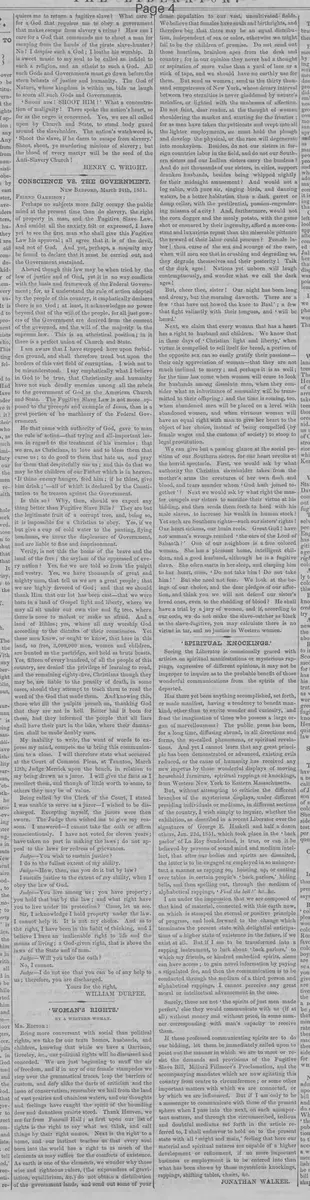
'WOMAN'S RIGHTS.'
BY A WESTERN WOMAN.
MR. EDITOR:
Being more conversant with social than political rights, we take for our texts homes, husbands, and children, knowing that while we have a Garrison, Greeley, &c., our political rights will be discussed and conceded. We are just beginning to snuff the air of freedom, and if in any of our female stampedes we step over the grammatical traces, leap the barriers of custom, and defy alike the darts of criticism and the lasso of conservatism, remember we hail from the land of vast prairies and chainless waters, and our thoughts and feelings have caught the spirit of the bounding deer and dauntless prairie steed. Thank Heaven, we are far from Faneuil Hall; as first upon our list of rights is the right to say what we think, and call things by their right names. Next is the right to a home, and our instinct teaches us that every soul born into the world has a right to as much of the elements as may suffice for the comforts of existence. As earth is one of the elements, we wonder why those wise and righteous rulers, (the expounders of gravitation, equilibrium, &c.) do not obtain a distribution of the government lands, and send out some of your dense population to our vast, uncultivated fields.
We believe that females have souls and birthrights, and therefore beg that there may be an equal distribution, independent of sex or color, otherwise we might fail to be the children of promise. Do not send out those heartless, brainless apes from the desk and counter; for in our opinion they never had a thought or aspiration of more value than a yard of lace or a stick of tape, and we should have no earthly use for them. But send us women; send us the thirty thousand sempstresses of New York, whose dreary interval between two eternities is never gladdened by nature's melodies, or lighted with the sunbeams of affection. Do not faint, dear reader, at the thought of woman shouldering the musket and starting for the frontier; for as men have taken the petticoats and crept into all the lighter employments, we must hold the plough and develop the physical, or the race will degenerate into monkevism. Besides, do not our sisters in foreign countries labor in the field, and do not our Southern sisters and our Indian sisters carry the burdens? And do not thousands of our sisters, in cities, support drunken husbands, besides being whipped nightly for their midnight amusement? And would not a log cabin, with pure air, singing birds, and dancing waters, be a better habitation than a dark garret or damp cellar, with the pestilential, passion-engendering miasma of a city? And, furthermore, would not the corn dodger and the mealy potato, with the game shot or ensnared by their ingenuity, afford a more constant and luxurious repast than the miserable pittance the reward of their labor could procure? Female labor! thou curse of the sex and scourge of the race, when will men see that in crushing and degrading us, they degrade themselves and their posterity! Talk of the dark ages! Nations yet unborn will laugh contemptuously, and wonder what we call the dark ages!
But, cheer thee, sister! Our night has been long and dreary, but the morning dawneth. There are a few 'that have not bowed the knee to Baal'; a few that fight valiantly with their tongues, and will be heard.'
Next, we claim that every woman that has a heart has a right to husband and children. We know that in these days of 'Christian light and liberty,' when virtue is compelled to sell itself for bread, a portion of the opposite sex can so easily gratify their passions—their only appreciation of woman—that they are not much inclined to marry; and perhaps it is as well; for the time has come when women will cease to look for husbands among dissolute men, when they consider what an inheritance of sensuality will be transmitted to their offspring: and the time is coming, too, when abandoned men will be placed on a level with abandoned women, and when virtuous woman will have an equal right with man to give her heart to the object of her choice, instead of being compelled (by female wages and the customs of society) to stoop to legal prostitution.
We can give but a passing glance at the social position of our Southern sisters, for our heart revolts at the horrid spectacle. First, we would ask by what authority the Christian slaveholder takes from the mother's arms the creatures of her own flesh and blood, and tears asunder whom 'God hath joined together'? Next we would ask by what right the master compels our sisters to sacrifice their virtue at his bidding, and then sends them forth to herd with his male slaves, to increase his wealth in human stock? Yet such are Southern rights—such our sisters' rights! Our heart sickens, our brain reels. Great God! have not woman's wrongs reached 'the ears of the Lord of Sabaoth?' One of our neighbors is a free colored woman. She has a pleasant home, intelligent children, and a good husband, although he is a fugitive slave. She often starts in her sleep, and clasping him to her heart, cries, 'Do not take him! Do not take him!' But she need not fear. We look at the beings of our choice, and the dear pledges of our affection, and think you we will not defend our sister's loved ones, even to the shedding of blood? He shall have a trial by a jury of women, and if, according to our code, we do not make the slave-catcher as black as the slave-fugitive, you may calculate there is no virtue in tar, and no justice in Western women.
BY A WESTERN WOMAN.
MR. EDITOR:
Being more conversant with social than political rights, we take for our texts homes, husbands, and children, knowing that while we have a Garrison, Greeley, &c., our political rights will be discussed and conceded. We are just beginning to snuff the air of freedom, and if in any of our female stampedes we step over the grammatical traces, leap the barriers of custom, and defy alike the darts of criticism and the lasso of conservatism, remember we hail from the land of vast prairies and chainless waters, and our thoughts and feelings have caught the spirit of the bounding deer and dauntless prairie steed. Thank Heaven, we are far from Faneuil Hall; as first upon our list of rights is the right to say what we think, and call things by their right names. Next is the right to a home, and our instinct teaches us that every soul born into the world has a right to as much of the elements as may suffice for the comforts of existence. As earth is one of the elements, we wonder why those wise and righteous rulers, (the expounders of gravitation, equilibrium, &c.) do not obtain a distribution of the government lands, and send out some of your dense population to our vast, uncultivated fields.
We believe that females have souls and birthrights, and therefore beg that there may be an equal distribution, independent of sex or color, otherwise we might fail to be the children of promise. Do not send out those heartless, brainless apes from the desk and counter; for in our opinion they never had a thought or aspiration of more value than a yard of lace or a stick of tape, and we should have no earthly use for them. But send us women; send us the thirty thousand sempstresses of New York, whose dreary interval between two eternities is never gladdened by nature's melodies, or lighted with the sunbeams of affection. Do not faint, dear reader, at the thought of woman shouldering the musket and starting for the frontier; for as men have taken the petticoats and crept into all the lighter employments, we must hold the plough and develop the physical, or the race will degenerate into monkevism. Besides, do not our sisters in foreign countries labor in the field, and do not our Southern sisters and our Indian sisters carry the burdens? And do not thousands of our sisters, in cities, support drunken husbands, besides being whipped nightly for their midnight amusement? And would not a log cabin, with pure air, singing birds, and dancing waters, be a better habitation than a dark garret or damp cellar, with the pestilential, passion-engendering miasma of a city? And, furthermore, would not the corn dodger and the mealy potato, with the game shot or ensnared by their ingenuity, afford a more constant and luxurious repast than the miserable pittance the reward of their labor could procure? Female labor! thou curse of the sex and scourge of the race, when will men see that in crushing and degrading us, they degrade themselves and their posterity! Talk of the dark ages! Nations yet unborn will laugh contemptuously, and wonder what we call the dark ages!
But, cheer thee, sister! Our night has been long and dreary, but the morning dawneth. There are a few 'that have not bowed the knee to Baal'; a few that fight valiantly with their tongues, and will be heard.'
Next, we claim that every woman that has a heart has a right to husband and children. We know that in these days of 'Christian light and liberty,' when virtue is compelled to sell itself for bread, a portion of the opposite sex can so easily gratify their passions—their only appreciation of woman—that they are not much inclined to marry; and perhaps it is as well; for the time has come when women will cease to look for husbands among dissolute men, when they consider what an inheritance of sensuality will be transmitted to their offspring: and the time is coming, too, when abandoned men will be placed on a level with abandoned women, and when virtuous woman will have an equal right with man to give her heart to the object of her choice, instead of being compelled (by female wages and the customs of society) to stoop to legal prostitution.
We can give but a passing glance at the social position of our Southern sisters, for our heart revolts at the horrid spectacle. First, we would ask by what authority the Christian slaveholder takes from the mother's arms the creatures of her own flesh and blood, and tears asunder whom 'God hath joined together'? Next we would ask by what right the master compels our sisters to sacrifice their virtue at his bidding, and then sends them forth to herd with his male slaves, to increase his wealth in human stock? Yet such are Southern rights—such our sisters' rights! Our heart sickens, our brain reels. Great God! have not woman's wrongs reached 'the ears of the Lord of Sabaoth?' One of our neighbors is a free colored woman. She has a pleasant home, intelligent children, and a good husband, although he is a fugitive slave. She often starts in her sleep, and clasping him to her heart, cries, 'Do not take him! Do not take him!' But she need not fear. We look at the beings of our choice, and the dear pledges of our affection, and think you we will not defend our sister's loved ones, even to the shedding of blood? He shall have a trial by a jury of women, and if, according to our code, we do not make the slave-catcher as black as the slave-fugitive, you may calculate there is no virtue in tar, and no justice in Western women.
What sub-type of article is it?
Feminism
Social Reform
Slavery Abolition
What keywords are associated?
Women's Rights
Land Distribution
Female Labor
Marriage Rights
Southern Slavery
Frontier Settlement
Social Equality
What entities or persons were involved?
Garrison
Greeley
Southern Slaveholders
New York Sempstresses
Free Colored Women
Fugitive Slaves
Editorial Details
Primary Topic
Women's Rights To Home, Labor, Marriage, And Freedom From Slavery's Abuses
Stance / Tone
Passionate Advocacy And Condemnation Of Patriarchal And Slaveholding Oppression
Key Figures
Garrison
Greeley
Southern Slaveholders
New York Sempstresses
Free Colored Women
Fugitive Slaves
Key Arguments
Right To Free Speech And Calling Things By Right Names
Every Soul Has Right To Land For Comfortable Existence; Distribute Government Lands Equally Regardless Of Sex Or Color
Send Women Like New York Sempstresses To Frontiers For Better Life And Physical Development
Women Must Take Up Physical Labor As Men Encroach On Lighter Employments To Prevent Racial Degeneration
Urban Female Labor Conditions Are Degrading; Frontier Life Offers Purity And Self Sufficiency
Women Have Right To Husband And Children Without Coercion Or Marrying Dissolute Men
Abandoned Men Should Be Treated Equally To Abandoned Women; End Legal Prostitution Via Low Wages
Slaveholders Unjustly Separate Families And Force Enslaved Women Into Vice For Profit
Defense Of Free Black Families Against Slave Catchers, Even By Violent Means If Needed