Thank you for visiting SNEWPapers!
Sign up free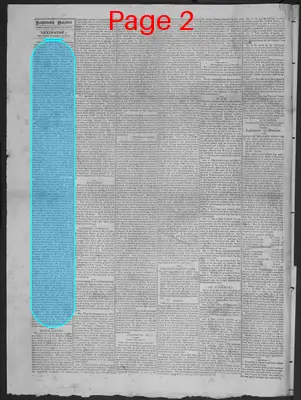
Kentucky Gazette
Lexington, Fayette County, Kentucky
What is this article about?
Editorial in Kentucky Gazette defends state rights against potential judicial overreach, urging limits on federal and state judiciary power. References cases like Mr. Smith's trial, opinions of Judges Trimble and Haywood, and laws in southern/western states including Kentucky, Missouri, and Tennessee to check judicial authority.
Merged-components note: Section title 'STATE RIGHTS.' directly precedes and titles the following editorial article on state rights and judiciary; sequential reading order.
Clipping

OCR Quality
Full Text
Kentucky Gazette.
THE DOLLARS PER ANNUM, IN ADVANCE.
LEXINGTON:
THURSDAY EVENING, JULY 26.
STATE RIGHTS.
The address taken from the Frankfort Argus to the voters of only two counties concerns the whole state—nay the United States. It is worthy of remark, as appears from a publication in this day's Gazette from a Washington City paper, that the defence of State Rights should be confined to the southern and western sections of the union. We trust this is not the case; the contest is too honorable for any one of the sister states to be mere spectators—it promises too many lasting advantages to this republic not to rouse every reflecting mind. It is time that the power of the judiciary should be fully known and understood. If there is to be no bounds or limits save the construction which the courts may give to the constitution, a union between the state judiciary and that of the general government may afford as much oppression as even a patient people are willing to bear. To avoid a state of things so disreputable in our government is what every good citizen must desire, and to do this there is no other way but a modest forbearance of encroaching in each branch. The people are too intelligent not to be jealous if any one of the departments (which were instituted for checks upon each other) attempts to usurp more than its share of power.
"Faith," as observed by the editor of Washington City Gazette, "is a laudable virtue in religion," but it is a villainous one in politics. Too much faith in men placed in power for life, as the Judges of our state and federal courts, will enslave any country. In law, it is a maxim founded on the soundest principles, that it is better for nine guilty to escape than that one innocent should be punished; but the case has been reversed: When Mr. Smith, of Ohio, was tried in the Senate of the United States the committee appointed to report on the case acknowledged that, although the evidence was not sufficient to convict him according to the rules of law; yet, in the affairs of state, it was better that nine innocent should lose their places than for one traitor to occupy a dangerous post. This doctrine, so well calculated to foster liberty, ought always to be made one of the unalterable political dogmas in all republics.
It appears in the remarks of the extract from the Washington City Gazette that the Judges of the supreme court of the United States undo some of their own doings; the same appears in the opinions of Judge Trimble. Indeed there is nothing the least strange in all this, when we reflect on the immutability of the human character always veering from one point to another. Let any one pay particular attention to the continual jarrings in court between the ablest members of the bar and the bench, and on the bench itself, and he must conclude that the science of law is in its infancy, or that it is never to settle down on any fixed and certain principles for the benefit of litigants. The labyrinths of the law may be incapable of improvement—omnipotence may have intended all the uncertainties as a just punishment for resorting to it; but surely the administrators of such laws and professors of such a science were never intended to preside uncontrolled over the destinies of a people who are equal in virtue and valuable attainments. We trust the time has arrived (a more fit occasion may never re-appear) to settle, by some well defined and unalterable boundary, the government of the judiciary.—Alabama, Missouri, Tennessee, Kentucky and Ohio have adopted laws nearly similar, differing a little in reverence and respect for the supremacy of the judiciary, which we believe has not interfered in any one of the states, in such a solemn manner as to leave no plea for the voice of reason or the interposition of plain common sense.—It is true that Judge Haywood, who forms but one-third of the supreme court of Tennessee, has given an opinion; but his condescension makes it, like Judge Trimble's pro and con decision, pass for nothing. It is also true that a portion of the members of the judiciary of Kentucky have threatened what they will do with a certain law of the state; but this threat disqualifies them from a seat according to rules of their own making. One of the acts of the legislature of Missouri, at the last session, proposes to change the constitution so that her Judges shall be elected annually by both branches of the legislature; this jealousy of Judges, is highly commendable, but we think the period of service might be extended; however, as the election is removed from the people, the apprehensions about the independence of the court is also removed.
What sub-type of article is it?
What keywords are associated?
What entities or persons were involved?
Editorial Details
Primary Topic
Defense Of State Rights Against Judicial Overreach
Stance / Tone
Advocating Limits On Judiciary Power And Checks On Federal Authority
Key Figures
Key Arguments