Thank you for visiting SNEWPapers!
Sign up free
Editorial
September 2, 1842
Southern Christian Advocate
Charleston, Charleston County, South Carolina
What is this article about?
The article critiques the influence of Puseyism on the Evangelical wing of the Church of England, citing the suppression of evangelical prayer meetings in Dublin by Archbishop Whately under church canons, as reported in the London Congregational Magazine for May.
Clipping
OCR Quality
98%
Excellent
Full Text
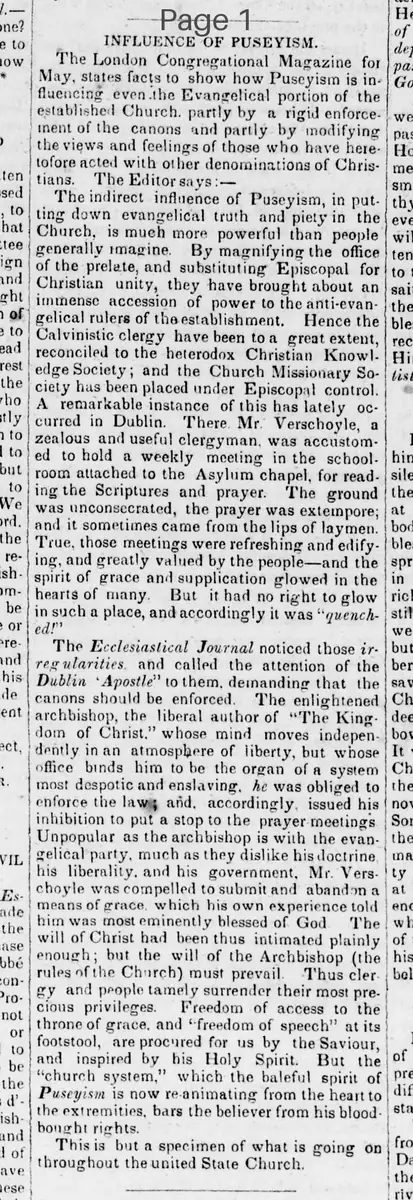
INFLUENCE OF PUSEYISM.
The London Congregational Magazine for May, states facts to show how Puseyism is influencing even the Evangelical portion of the established Church, partly by a rigid enforcement of the canons and partly by modifying the views and feelings of those who have heretofore acted with other denominations of Christians. The Editor says:--
The indirect influence of Puseyism, in putting down evangelical truth and piety in the Church, is much more powerful than people generally imagine. By magnifying the office of the prelate, and substituting Episcopal for Christian unity, they have brought about an immense accession of power to the anti-evangelical rulers of the establishment. Hence the Calvinistic clergy have been to a great extent reconciled to the heterodox Christian Knowledge Society; and the Church Missionary Society has been placed under Episcopal control. A remarkable instance of this has lately occurred in Dublin. There Mr. Verschoyle, a zealous and useful clergyman, was accustomed to hold a weekly meeting in the school room attached to the Asylum chapel, for reading the Scriptures and prayer. The ground was unconsecrated, the prayer was extempore; and it sometimes came from the lips of laymen. True, those meetings were refreshing and edifying, and greatly valued by the people--and the spirit of grace and supplication glowed in the hearts of many. But it had no right to glow in such a place, and accordingly it was "quenched!"
The Ecclesiastical Journal noticed those irregularities, and called the attention of the "Dublin Apostle" to them, demanding that the canons should be enforced. The enlightened archbishop, the liberal author of "The Kingdom of Christ," whose mind moves independently in an atmosphere of liberty, but whose office binds him to be the organ of a system most despotic and enslaving, he was obliged to enforce the law; and, accordingly, issued his inhibition to put a stop to the prayer meetings. Unpopular as the archbishop is with the evangelical party, much as they dislike his doctrine his liberality, and his government, Mr. Verschoyle was compelled to submit and abandon a means of grace, which his own experience told him was most eminently blessed of God. The will of Christ had been thus intimated plainly enough; but the will of the Archbishop (the rules of the Church) must prevail. Thus clergy and people tamely surrender their most precious privileges. Freedom of access to the throne of grace, and "freedom of speech" at its footstool, are procured for us by the Saviour, and inspired by his Holy Spirit. But the "church system," which the baleful spirit of Puseyism is now re-animating from the heart to the extremities, bars the believer from his blood-bought rights.
This is but a specimen of what is going on throughout the united State Church.
The London Congregational Magazine for May, states facts to show how Puseyism is influencing even the Evangelical portion of the established Church, partly by a rigid enforcement of the canons and partly by modifying the views and feelings of those who have heretofore acted with other denominations of Christians. The Editor says:--
The indirect influence of Puseyism, in putting down evangelical truth and piety in the Church, is much more powerful than people generally imagine. By magnifying the office of the prelate, and substituting Episcopal for Christian unity, they have brought about an immense accession of power to the anti-evangelical rulers of the establishment. Hence the Calvinistic clergy have been to a great extent reconciled to the heterodox Christian Knowledge Society; and the Church Missionary Society has been placed under Episcopal control. A remarkable instance of this has lately occurred in Dublin. There Mr. Verschoyle, a zealous and useful clergyman, was accustomed to hold a weekly meeting in the school room attached to the Asylum chapel, for reading the Scriptures and prayer. The ground was unconsecrated, the prayer was extempore; and it sometimes came from the lips of laymen. True, those meetings were refreshing and edifying, and greatly valued by the people--and the spirit of grace and supplication glowed in the hearts of many. But it had no right to glow in such a place, and accordingly it was "quenched!"
The Ecclesiastical Journal noticed those irregularities, and called the attention of the "Dublin Apostle" to them, demanding that the canons should be enforced. The enlightened archbishop, the liberal author of "The Kingdom of Christ," whose mind moves independently in an atmosphere of liberty, but whose office binds him to be the organ of a system most despotic and enslaving, he was obliged to enforce the law; and, accordingly, issued his inhibition to put a stop to the prayer meetings. Unpopular as the archbishop is with the evangelical party, much as they dislike his doctrine his liberality, and his government, Mr. Verschoyle was compelled to submit and abandon a means of grace, which his own experience told him was most eminently blessed of God. The will of Christ had been thus intimated plainly enough; but the will of the Archbishop (the rules of the Church) must prevail. Thus clergy and people tamely surrender their most precious privileges. Freedom of access to the throne of grace, and "freedom of speech" at its footstool, are procured for us by the Saviour, and inspired by his Holy Spirit. But the "church system," which the baleful spirit of Puseyism is now re-animating from the heart to the extremities, bars the believer from his blood-bought rights.
This is but a specimen of what is going on throughout the united State Church.
What sub-type of article is it?
Moral Or Religious
What keywords are associated?
Puseyism
Evangelical Church
Prayer Meetings
Church Canons
Archbishop Inhibition
Dublin
Religious Liberty
What entities or persons were involved?
Puseyism
London Congregational Magazine
Mr. Verschoyle
Archbishop Of Dublin
Ecclesiastical Journal
Dublin Apostle
Editorial Details
Primary Topic
Influence Of Puseyism On Evangelical Church Practices
Stance / Tone
Critical Of Puseyism And Church Enforcement
Key Figures
Puseyism
London Congregational Magazine
Mr. Verschoyle
Archbishop Of Dublin
Ecclesiastical Journal
Dublin Apostle
Key Arguments
Puseyism Indirectly Suppresses Evangelical Truth By Enforcing Canons And Centralizing Episcopal Power
Calvinistic Clergy Reconciled To Heterodox Societies Under Episcopal Control
Suppression Of Dublin Prayer Meetings Despite Their Spiritual Value
Archbishop Compelled To Inhibit Meetings, Prioritizing Church Rules Over Christian Liberty
Church System Bars Believers From Spiritual Freedoms Procured By Christ