Thank you for visiting SNEWPapers!
Sign up free
The New York Journal, And Daily Patriotic Register
New York, New York County, New York
What is this article about?
Excerpts from debates in the Massachusetts Convention on February 1, 2, and 4, 1788, covering discussions on proposing amendments to the US Constitution, arguments for its adoption benefiting commerce and union, and speeches by delegates like Widgery, Judge Dana, Mr. Russell, Mr. Strong, Gen. Thompson, and Rev. Mr. Thacher.
Clipping
OCR Quality
Full Text
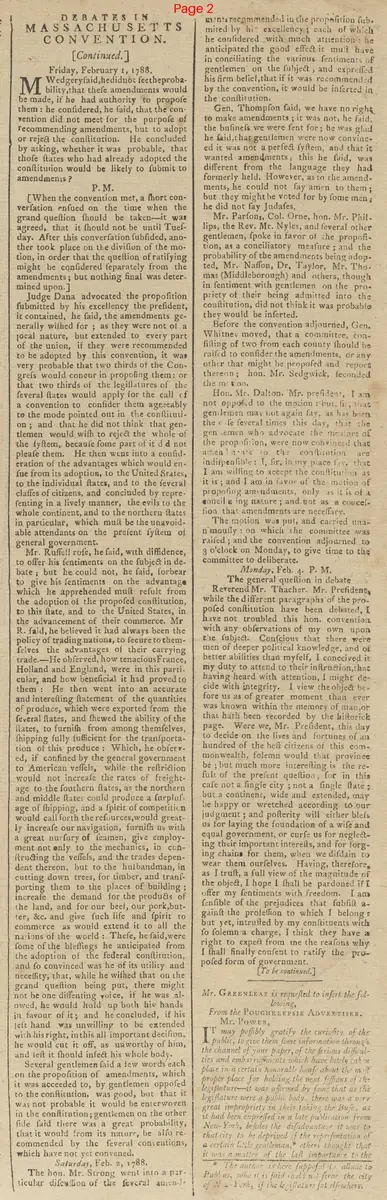
MASSACHUSETTS
CONVENTION.
[Continued.]
Friday, February 1, 1788.
Widgery said, he did not see the probability, that these amendments would
be made, if he had authority to propose them: he considered, he said, that the convention did not meet for the purpose of recommending amendments, but to adopt or reject the constitution. He concluded by asking, whether it was probable, that those states who had already adopted the constitution would be likely to submit to amendments?
P.M.
When the convention met, a short conversation ensued on the time when the grand question should be taken—it was agreed, that it should not be until Tuesday. After this conversation subsided, another took place on the division of the motion, in order that the question of ratifying might be considered separately from the amendments; but nothing final was determined upon.
Judge Dana advocated the proposition submitted by his excellency the president, it contained, he said, the amendments generally wished for; as they were not of a local nature, but extended to every part of the union. If they were recommended to be adopted by this convention, it was very probable that two thirds of the Congress would concur in proposing them: or that two thirds of the legislatures of the several states would apply for the call of a convention to consider them agreeably to the mode pointed out in the constitution; and that he did not think that gentlemen would wish to reject the whole of the system, because some part of it did not please them. He then went into a consideration of the advantages which would ensue from its adoption, to the United States, to the individual states, and to the several classes of citizens, and concluded by representing in a lively manner, the evils to the whole continent, and to the northern states in particular, which must be the unavoidable attendants on the present system of general government.
Mr. Russell rose, he said, with diffidence, to offer his sentiments on the subject in debate: but he could not, he said, forbear to give his sentiments on the advantages which he apprehended must result from the adoption of the proposed constitution, to this state, and to the United States, in the advancement of their commerce. Mr. R. said, he believed it had always been the policy of trading nations, to secure to themselves the advantages of their carrying trade.—He observed, how tenacious France, Holland and England, were in this particular, and how beneficial it had proved to them: He then went into an accurate and interesting statement of the quantities of produce, which were exported from the several states, and shewed the ability of the states, to furnish from among themselves, shipping fully sufficient for the transportation of this produce: Which, he observed, if confined by the general government to American vessels, while the restriction would not increase the rates of freightage to the southern states, as the northern and middle states could produce a surplus age of shipping, and a spirit of competition would call forth the resources, would greatly increase our navigation, furnish us with a great nursery of seamen, give employment not only to the mechanics, in constructing the vessels, and the trades dependent thereon, but to the husbandman, in cutting down trees, for timber, and transporting them to the places of building; increase the demand for the products of the land, and for our beef, our pork, butter, &c. and give such life and spirit to commerce as would extend it to all the nations of the world: These, he said, were some of the blessings he anticipated from the adoption of the federal constitution, and so convinced was he of its utility and necessity, that, while he wished that on the grand question being put, there might not be one dissenting voice, if he was allowed, he would hold up both his hands in favour of it: and he concluded, if his left hand was unwilling to be extended with his right, in this all important decision, he would cut it off, as unworthy of him, and lest it should infect his whole body.
Several gentlemen said a few words each on the proposition of amendments, which it was acceded to, by gentlemen opposed to the constitution, was good, but that it was not probable it would be interwoven in the constitution; gentlemen on the other side said there was a great probability, that it would from its nature, be also recommended by the several conventions, which have not yet convened.
Saturday, Feb. 2, 1788.
The hon. Mr. Strong went into a particular discussion of the several amendments recommended in the proposition submitted by his excellency; each of which he considered with much attention: he anticipated the good effect it must have in conciliating the various sentiments of gentlemen on the subject; and expressed his firm belief, that if it was recommended by the convention, it would be inserted in the constitution.
Gen. Thompson said, we have no right to make amendments; it was not, he said, the business we were sent for; he was glad he said, that gentlemen were now convinced it was not a perfect system, and that it wanted amendments; this he said, was different from the language they had formerly held. However, as to the amendments, he could not say amen to them; but they might be voted for by some men; he did not say Judases.
Mr. Parsons, Col. Orne, hon. Mr. Phillips, the Rev. Mr. Stiles, and several other gentlemen, spoke in favor of the proposition, as a conciliatory measure; and the probability of the amendments being adopted. Mr. Nason, Dr. Taylor, Mr. Thomas (Middleborough) and others, though in sentiment with gentlemen on the propriety of their being admitted into the constitution, did not think it was probable they would be inserted.
Before the convention adjourned, Gen. Whitney moved, that a committee, consisting of two from each county should be raised to consider the amendments, or any other that might be proposed and report thereon; hon. Mr. Sedgwick, seconded the motion.
Hon. Mr. Dalton. Mr. President, I am not opposed to the motion: but, sir, that gentlemen may not again say, as has been the case several times this day, that the gentlemen who advocate the measure of the proposition, were now convinced that amendments to the constitution are indispensable: I, sir, in my place avow that I am willing to accept the constitution as it is; and I am in favor of the motion of proposing amendments, only as it is of a conciliating nature; and not as a concession that amendments are necessary.
The motion was put, and carried unanimously: on which the committee was raised; and the convention adjourned to 3 o'clock on Monday, to give time to the committee to deliberate.
Monday, Feb. 4. P. M.
The general question in debate
Reverend Mr. Thacher. Mr. President.
while the different paragraphs of the proposed constitution have been debated. I have not troubled this hon. convention with any observations of my own upon the subject. Conscious that there were men of deeper political knowledge, and of better abilities than myself, I conceived it my duty to attend to their instruction, that having heard with attention, I might decide with integrity. I view the object before us as of greater moment than ever was known within the memory of man, or that hath been recorded by the historic page. Were we, Mr. President, this day to decide on the lives and fortunes of an hundred of the best citizens of this commonwealth, solemn would that province be; but much more interesting is the result of the present question, for in this case not a single city; not a single state; but a continent, wide and extended, may be happy or wretched according to our judgment; and posterity will either bless us for laying the foundation of a wise and equal government, or curse us for neglecting their important interests, and for forging chains for them, when we disdain to wear them ourselves. Having, therefore, as I trust, a full view of the magnitude of the object, I hope I shall be pardoned if I offer my sentiments with freedom. I am sensible of the prejudices that subsist against the profession to which I belong = but yet, intrusted by my constituents with so solemn a charge, I think they have a right to expect from me the reasons why I shall finally consent to ratify the proposed form of government.
[To be continued.]
What sub-type of article is it?
What themes does it cover?
What keywords are associated?
What entities or persons were involved?
Where did it happen?
Story Details
Key Persons
Location
Massachusetts Convention
Event Date
February 1 4, 1788
Story Details
Delegates debate the US Constitution's ratification, proposing amendments for general union benefits, arguing advantages to commerce and states, forming a committee to consider amendments, with speeches emphasizing adoption's necessity and evils of rejection.