Thank you for visiting SNEWPapers!
Sign up free
Story
January 4, 1862
Columbia Democrat And Bloomsburg General Advertiser
Bloomsburg, Columbia County, Pennsylvania
What is this article about?
In rural Fallowdale, cash-strapped farmers hire Rev. Abraham Surely as pastor on the condition he summons rain on demand, but their unanimous agreement requirement exposes divisions, teaching them to leave weather to God and value his spiritual guidance.
Merged-components note: Continuation of the same story across sequential reading orders.
Clipping
OCR Quality
98%
Excellent
Full Text
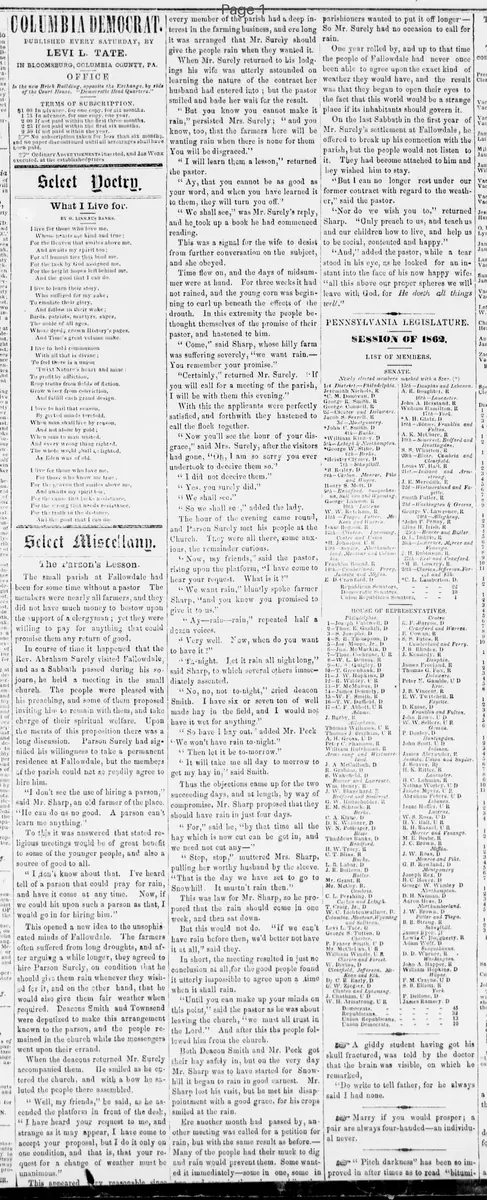
Select Miscellany.
The Parson's Lesson.
The small parish at Fallowdale had been for some time without a pastor. The members were nearly all farmers, and they did not have much money to bestow upon the support of a clergyman; yet they were willing to pay for anything that could promise them any return of good.
In course of time it happened that the Rev. Abraham Surely visited Fallowdale, and as a Sabbath passed during his sojourn, he held a meeting in the small church. The people were pleased with his preaching, and some of them proposed inviting him to remain with them, and take charge of their spiritual welfare. Upon the merits of this proposition there was a long discussion.
Parson Surely had signified his willingness to take a permanent residence at Fallowdale, but the members of the parish could not so readily agree to hire him.
"I don't see the use of hiring a parson," said Mr. Sharp, an old farmer of the place. "He can do us no good. A parson can't learn me anything."
To this it was answered that stated religious meetings would be of great benefit to some of the younger people, and also a source of good to all.
"I don't know about that. I've heard tell of a parson that could pray for rain, and have it come at any time. Now, if we could hit upon such a parson as that, I would go in for hiring him."
This opened a new idea to the unsophisticated minds of Fallowdale. The farmers often suffered from long droughts, and after arguing a while longer, they agreed to hire Parson Surely, on condition that he should give them rain whenever they wished for it, and on the other hand, that he would also give them fair weather when required. Deacons Smith and Townsend were deputized to make this arrangement known to the parson, and the people remained in the church while the messengers went upon their errand.
When the deacons returned Mr. Surely accompanied them. He smiled as he entered the church, and with a bow he saluted the people there assembled.
"Well, my friends," he said, as he ascended the platform in front of the desk, "I have heard your request to me, and strange as it may appear, I have come to accept your proposal, but I do it only on one condition, and that is, that your request for a change of weather must be unanimous."
every member of the parish had a deep interest in the farming business, and ere long it was arranged that Mr. Surely should give the people rain when they wanted it.
When Mr. Surely returned to his lodgings his wife was utterly astounded on learning the nature of the contract her husband had entered into; but the pastor smiled and bade her wait for the result.
"But you know you cannot make it rain," persisted Mrs. Surely; "and you know, too, that the farmers here will be wanting rain when there is none for them. You will be disgraced."
"I will learn them a lesson," returned the pastor.
"Ay, that you cannot be as good as your word, and when you have learned it to them, they will turn you off."
"We shall see," was Mr. Surely's reply, and he took up a book he had commenced reading.
This was a signal for the wife to desist from further conversation on the subject, and she obeyed.
Time flew on, and the days of midsummer were at hand. For three weeks it had not rained, and the young corn was beginning to curl up beneath the effects of the drouth. In this extremity the people bethought themselves of the promise of their pastor, and hastened to him.
"Come," said Sharp, whose hilly farm was suffering severely, "we want rain. You remember your promise."
"Certainly," returned Mr. Surely. "If you will call for a meeting of the parish, I will be with them this evening."
With this the applicants were perfectly satisfied, and forthwith they hastened to call the flock together.
"Now you'll see the hour of your disgrace," said Mrs. Surely, after the visitors had gone, "oh, I am so sorry you ever undertook to deceive them so."
"I did not deceive them."
"Yes, you surely did."
"We shall see."
"So we shall see," added the lady.
The hour of the evening came round, and Parson Surely met his people at the Church. They were all there, some anxious, the remainder curious.
"Now, my friends," said the pastor, rising upon the platform, "I have come to hear your request. What is it?"
"We want rain," bluntly spoke farmer Sharp, "and you know you promised to give it to us."
"Ay-rain-rain," repeated half a dozen voices.
"Very well. Now, when do you want to have it?"
"To-night. Let it rain all night long," said Sharp, to which several others immediately assented.
"No, no, not to-night," cried deacon Smith. "I have six or seven ton of well made hay in the field, and I would not have it wet for anything."
"So have I hay out," added Mr. Peck. "We won't have rain to-night."
"Then let it be to-morrow."
"It will take me all day to-morrow to get my hay in," said Smith.
Thus the objections came up for the two succeeding days, and at length, by way of compromise, Mr. Sharp proposed that they should have rain in just four days.
"For," said he, "by that time all the hay which is now cut can be got in, and we need not cut any-"
"Stop, stop," muttered Mrs. Sharp, pulling her worthy husband by the sleeve.
"That is the day we have set to go to Snowhill. It mustn't rain then."
This was law for Mr. Sharp, so he proposed that the rain should come in one week, and then sat down.
But this would not do.
"If we can't have rain before then, we'd better not have it at all," said they.
parishioners wanted to put it off longer.
So Mr. Surely had no occasion to call for rain.
One year rolled by, and up to that time the people of Fallowdale had never once been able to agree upon the exact kind of weather they would have, and the result was that they began to open their eyes to the fact that this world would be a strange place if its inhabitants should govern it.
On the last Sabbath in the first year of Mr. Surely's settlement at Fallowdale, he offered to break up his connection with the parish, but the people would not listen to it. They had become attached to him and they wished him to stay.
"But I can no longer rest under our former contract with regard to the weather," said the pastor.
"Nor do we wish you to," returned Sharp.
"Only preach to us, and teach us and our children how to live, and help us to be social, contented and happy."
"And," added the pastor, while a tear stood in his eye, as he looked for an instant into the face of his now happy wife, "all this above our proper spheres we will leave with God, for He doeth all things well."
The Parson's Lesson.
The small parish at Fallowdale had been for some time without a pastor. The members were nearly all farmers, and they did not have much money to bestow upon the support of a clergyman; yet they were willing to pay for anything that could promise them any return of good.
In course of time it happened that the Rev. Abraham Surely visited Fallowdale, and as a Sabbath passed during his sojourn, he held a meeting in the small church. The people were pleased with his preaching, and some of them proposed inviting him to remain with them, and take charge of their spiritual welfare. Upon the merits of this proposition there was a long discussion.
Parson Surely had signified his willingness to take a permanent residence at Fallowdale, but the members of the parish could not so readily agree to hire him.
"I don't see the use of hiring a parson," said Mr. Sharp, an old farmer of the place. "He can do us no good. A parson can't learn me anything."
To this it was answered that stated religious meetings would be of great benefit to some of the younger people, and also a source of good to all.
"I don't know about that. I've heard tell of a parson that could pray for rain, and have it come at any time. Now, if we could hit upon such a parson as that, I would go in for hiring him."
This opened a new idea to the unsophisticated minds of Fallowdale. The farmers often suffered from long droughts, and after arguing a while longer, they agreed to hire Parson Surely, on condition that he should give them rain whenever they wished for it, and on the other hand, that he would also give them fair weather when required. Deacons Smith and Townsend were deputized to make this arrangement known to the parson, and the people remained in the church while the messengers went upon their errand.
When the deacons returned Mr. Surely accompanied them. He smiled as he entered the church, and with a bow he saluted the people there assembled.
"Well, my friends," he said, as he ascended the platform in front of the desk, "I have heard your request to me, and strange as it may appear, I have come to accept your proposal, but I do it only on one condition, and that is, that your request for a change of weather must be unanimous."
every member of the parish had a deep interest in the farming business, and ere long it was arranged that Mr. Surely should give the people rain when they wanted it.
When Mr. Surely returned to his lodgings his wife was utterly astounded on learning the nature of the contract her husband had entered into; but the pastor smiled and bade her wait for the result.
"But you know you cannot make it rain," persisted Mrs. Surely; "and you know, too, that the farmers here will be wanting rain when there is none for them. You will be disgraced."
"I will learn them a lesson," returned the pastor.
"Ay, that you cannot be as good as your word, and when you have learned it to them, they will turn you off."
"We shall see," was Mr. Surely's reply, and he took up a book he had commenced reading.
This was a signal for the wife to desist from further conversation on the subject, and she obeyed.
Time flew on, and the days of midsummer were at hand. For three weeks it had not rained, and the young corn was beginning to curl up beneath the effects of the drouth. In this extremity the people bethought themselves of the promise of their pastor, and hastened to him.
"Come," said Sharp, whose hilly farm was suffering severely, "we want rain. You remember your promise."
"Certainly," returned Mr. Surely. "If you will call for a meeting of the parish, I will be with them this evening."
With this the applicants were perfectly satisfied, and forthwith they hastened to call the flock together.
"Now you'll see the hour of your disgrace," said Mrs. Surely, after the visitors had gone, "oh, I am so sorry you ever undertook to deceive them so."
"I did not deceive them."
"Yes, you surely did."
"We shall see."
"So we shall see," added the lady.
The hour of the evening came round, and Parson Surely met his people at the Church. They were all there, some anxious, the remainder curious.
"Now, my friends," said the pastor, rising upon the platform, "I have come to hear your request. What is it?"
"We want rain," bluntly spoke farmer Sharp, "and you know you promised to give it to us."
"Ay-rain-rain," repeated half a dozen voices.
"Very well. Now, when do you want to have it?"
"To-night. Let it rain all night long," said Sharp, to which several others immediately assented.
"No, no, not to-night," cried deacon Smith. "I have six or seven ton of well made hay in the field, and I would not have it wet for anything."
"So have I hay out," added Mr. Peck. "We won't have rain to-night."
"Then let it be to-morrow."
"It will take me all day to-morrow to get my hay in," said Smith.
Thus the objections came up for the two succeeding days, and at length, by way of compromise, Mr. Sharp proposed that they should have rain in just four days.
"For," said he, "by that time all the hay which is now cut can be got in, and we need not cut any-"
"Stop, stop," muttered Mrs. Sharp, pulling her worthy husband by the sleeve.
"That is the day we have set to go to Snowhill. It mustn't rain then."
This was law for Mr. Sharp, so he proposed that the rain should come in one week, and then sat down.
But this would not do.
"If we can't have rain before then, we'd better not have it at all," said they.
parishioners wanted to put it off longer.
So Mr. Surely had no occasion to call for rain.
One year rolled by, and up to that time the people of Fallowdale had never once been able to agree upon the exact kind of weather they would have, and the result was that they began to open their eyes to the fact that this world would be a strange place if its inhabitants should govern it.
On the last Sabbath in the first year of Mr. Surely's settlement at Fallowdale, he offered to break up his connection with the parish, but the people would not listen to it. They had become attached to him and they wished him to stay.
"But I can no longer rest under our former contract with regard to the weather," said the pastor.
"Nor do we wish you to," returned Sharp.
"Only preach to us, and teach us and our children how to live, and help us to be social, contented and happy."
"And," added the pastor, while a tear stood in his eye, as he looked for an instant into the face of his now happy wife, "all this above our proper spheres we will leave with God, for He doeth all things well."
What sub-type of article is it?
Curiosity
What themes does it cover?
Moral Virtue
Providence Divine
What keywords are associated?
Parson Lesson
Weather Contract
Farmers Dispute
Moral Teaching
Divine Providence
What entities or persons were involved?
Rev. Abraham Surely
Mrs. Surely
Mr. Sharp
Deacon Smith
Mr. Peck
Where did it happen?
Fallowdale
Story Details
Key Persons
Rev. Abraham Surely
Mrs. Surely
Mr. Sharp
Deacon Smith
Mr. Peck
Location
Fallowdale
Story Details
Farmers in Fallowdale hire Parson Surely to provide rain on unanimous request, but their conflicting interests prevent agreement, teaching them reliance on divine providence and appreciation for his pastoral role.