Thank you for visiting SNEWPapers!
Sign up free
The New Hampshire Gazette
Portsmouth, Rockingham County, New Hampshire
What is this article about?
A letter from Philadelphia in March argues that the U.S. national debt, despite potentially doubling from 80 million in 1790 to 160 million by 1808, will not increase in real burden due to population growth, enhanced national ability, and rising land values in the Western Territory allocated to the sinking fund, which could reduce the debt through sales or exchanges for certificates.
Clipping
OCR Quality
Full Text
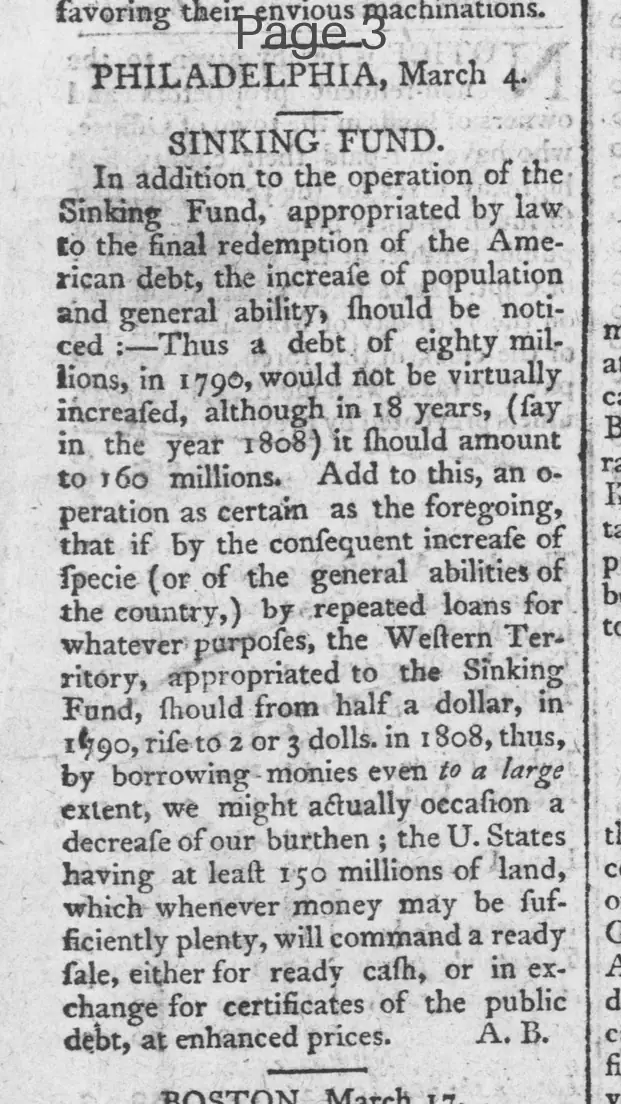
SINKING FUND.
In addition to the operation of the Sinking Fund, appropriated by law to the final redemption of the American debt, the increase of population and general ability, should be noticed:—Thus a debt of eighty millions, in 1790, would not be virtually increased, although in 18 years, (say in the year 1808) it should amount to 160 millions. Add to this, an operation as certain as the foregoing, that if by the consequent increase of specie (or of the general abilities of the country,) by repeated loans for whatever purposes, the Western Territory, appropriated to the Sinking Fund, should from half a dollar, in 1790, rise to 2 or 3 dolls. in 1808, thus, by borrowing-monies even to a large extent, we might actually occasion a decrease of our burthen; the U. States having at least 150 millions of land, which whenever money may be sufficiently plenty, will command a ready sale, either for ready cash, or in exchange for certificates of the public debt, at enhanced prices.
A. B.
What sub-type of article is it?
What themes does it cover?
What keywords are associated?
What entities or persons were involved?
Letter to Editor Details
Author
A. B.
Main Argument
the u.s. national debt will not become a greater burden over time due to population and economic growth, along with the sinking fund's use of appreciating western territory lands, allowing debt reduction through sales or certificate exchanges even with increased borrowing.
Notable Details