Thank you for visiting SNEWPapers!
Sign up free
Trainman News
Indianapolis, Marion County, Indiana
What is this article about?
Excerpt from the BRT's Negotiating Manual, prepared by C. W. Stanley, detailing the arbitration procedure under the Railway Labor Act, including board organization, hearings, subpoenas, awards, filing requirements, reconvening, and court challenges on specific grounds.
Clipping
OCR Quality
Full Text
Manual
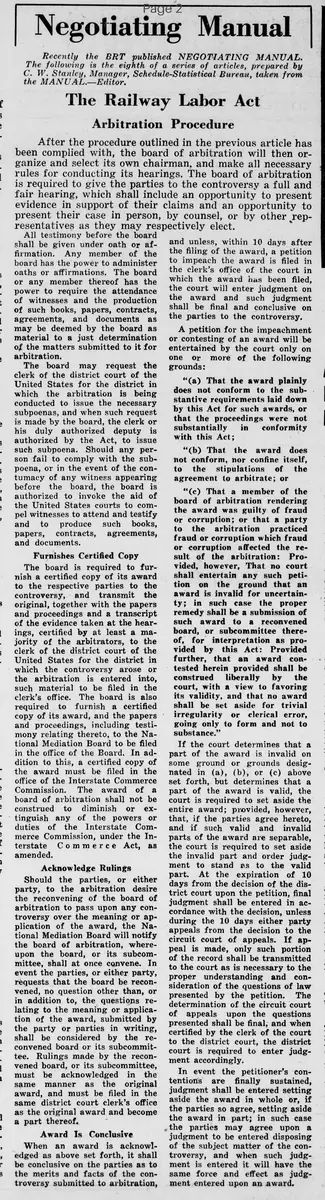
Recently the BRT published NEGOTIATING MANUAL.
The following is the eighth of a series of articles, prepared by C. W. Stanley, Manager, Schedule-Statistical Bureau, taken from the MANUAL. Editor.
The Railway Labor Act
Arbitration Procedure
After the procedure outlined in the previous article has been complied with, the board of arbitration will then organize and select its own chairman, and make all necessary rules for conducting its hearings. The board of arbitration is required to give the parties to the controversy a full and fair hearing, which shall include an opportunity to present evidence in support of their claims and an opportunity to present their case in person, by counsel, or by other representatives as they may respectively elect.
All testimony before the board shall be given under oath or affirmation. Any member of the board has the power to administer oaths or affirmations. The board or any member thereof has the power to require the attendance of witnesses and the production of such books, papers, contracts, agreements, and documents as may be deemed by the board as material to a just determination of the matters submitted to it for arbitration.
The board may request the clerk of the district court of the United States for the district in which the arbitration is being conducted to issue the necessary subpoenas, and when such request is made by the board, the clerk or his duly authorized deputy is authorized by the Act to issue such subpoena. Should any person fail to comply with the subpoena, or in the event of the contumacy of any witness appearing before the board, the board is authorized to invoke the aid of the United States courts to compel witnesses to attend and testify and to produce such books, papers, contracts, agreements, and documents.
Furnishes Certified Copy
The board is required to furnish a certified copy of its award to the respective parties to the controversy, and transmit the original, together with the papers and proceedings and a transcript of the evidence taken at the hearings, certified by at least a majority of the arbitrators, to the clerk of the district court of the United States for the district in which the controversy arose or the arbitration is entered into, such material to be filed in the clerk's office. The board is also required to furnish a certified copy of its award, and the papers and proceedings, including testimony relating thereto, to the National Mediation Board to be filed in the office of the Board. In addition to this, a certified copy of the award must be filed in the office of the Interstate Commerce Commission. The award of a board of arbitration shall not be construed to diminish or extinguish any of the powers or duties of the Interstate Commerce Commission, under the Interstate Commerce Act, as amended.
Acknowledge Rulings
Should the parties, or either party, to the arbitration desire the reconvening of the board of arbitration to pass upon any controversy over the meaning or application of the award, the National Mediation Board will notify the board of arbitration, whereupon the board, or its subcommittee, shall at once convene. In event the parties, or either party, requests that the board be reconvened, no question other than, or in addition to, the questions relating to the meaning or application of the award, submitted by the party or parties in writing, shall be considered by the reconvened board or its subcommittee. Rulings made by the reconvened board, or its subcommittee, must be acknowledged in the same manner as the original award, and must be filed in the same district court clerk's office as the original award and become a part thereof.
Award Is Conclusive
When an award is acknowledged as above set forth, it shall be conclusive on the parties as to the merits and facts of the controversy submitted to arbitration, and unless, within 10 days after the filing of the award, a petition to impeach the award is filed in the clerk's office of the court in which the award has been filed, the court will enter judgment on the award and such judgment shall be final and conclusive on the parties to the controversy.
A petition for the impeachment or contesting of an award will be entertained by the court only on one or more of the following grounds:
"(a) That the award plainly does not conform to the substantive requirements laid down by this Act for such awards, or that the proceedings were not substantially in conformity with this Act;
"(b) That the award does not conform, nor confine itself, to the stipulations of the agreement to arbitrate; or
"(c) That a member of the board of arbitration rendering the award was guilty of fraud or corruption; or that a party to the arbitration practiced fraud or corruption which fraud or corruption affected the result of the arbitration: Provided, however, That no court shall entertain any such petition on the ground that an award is invalid for uncertainty; in such case the proper remedy shall be a submission of such award to a reconvened board, or subcommittee thereof, for interpretation as provided by this Act: Provided further, that an award contested herein provided shall be construed liberally by the court, with a view to favoring its validity, and that no award shall be set aside for trivial irregularity or clerical error, going only to form and not to substance."
If the court determines that a part of the award is invalid on some ground or grounds designated in (a), (b), or (c) above set forth, but determines that a part of the award is valid, the court is required to set aside the entire award; provided, however, that, if the parties agree hereto, and if such valid and invalid parts of the award are separable, the court is required to set aside the invalid part and order judgment to stand as to the valid part. At the expiration of 10 days from the decision of the district court upon the petition, final judgment shall be entered in accordance with the decision, unless during the 10 days either party appeals from the decision to the circuit court of appeals. If appeal is made, only such portion of the record shall be transmitted to the court as is necessary to the proper understanding and consideration of the questions of law presented by the petition. The determination of the circuit court of appeals upon the questions presented shall be final; and when certified by the clerk of the court to the district court, the district court is required to enter judgment accordingly.
In event the petitioner's contentions are finally sustained, judgment shall be entered setting aside the award in whole or, if the parties so agree, setting aside the award in part; in such case the parties may agree upon a judgment to be entered disposing of the subject matter of the controversy, and when such judgment is entered it will have the same force and effect as judgment entered upon an award.
What sub-type of article is it?
What themes does it cover?
What keywords are associated?
What entities or persons were involved?
Where did it happen?
Story Details
Key Persons
Location
United States
Story Details
The article outlines the arbitration process under the Railway Labor Act: board organization and fair hearings with oaths, subpoenas, and evidence; filing awards with courts, National Mediation Board, and Interstate Commerce Commission; reconvening for interpretation; awards becoming conclusive unless impeached within 10 days on specific grounds like non-conformity or fraud; court procedures for partial validity and appeals.