Thank you for visiting SNEWPapers!
Sign up free
Atlanta Daily World
Atlanta, Fulton County, Georgia
What is this article about?
St. Juste Zamor from Birmingham, Ala., denounces a September 1 Life Magazine article for racist falsehoods belittling Haitian history and art, especially King Henry Christophe, and showcases Haiti's renowned artists like Normil Charles and Petion Savain to affirm its cultural legacy and counter prejudice.
Clipping
OCR Quality
Full Text
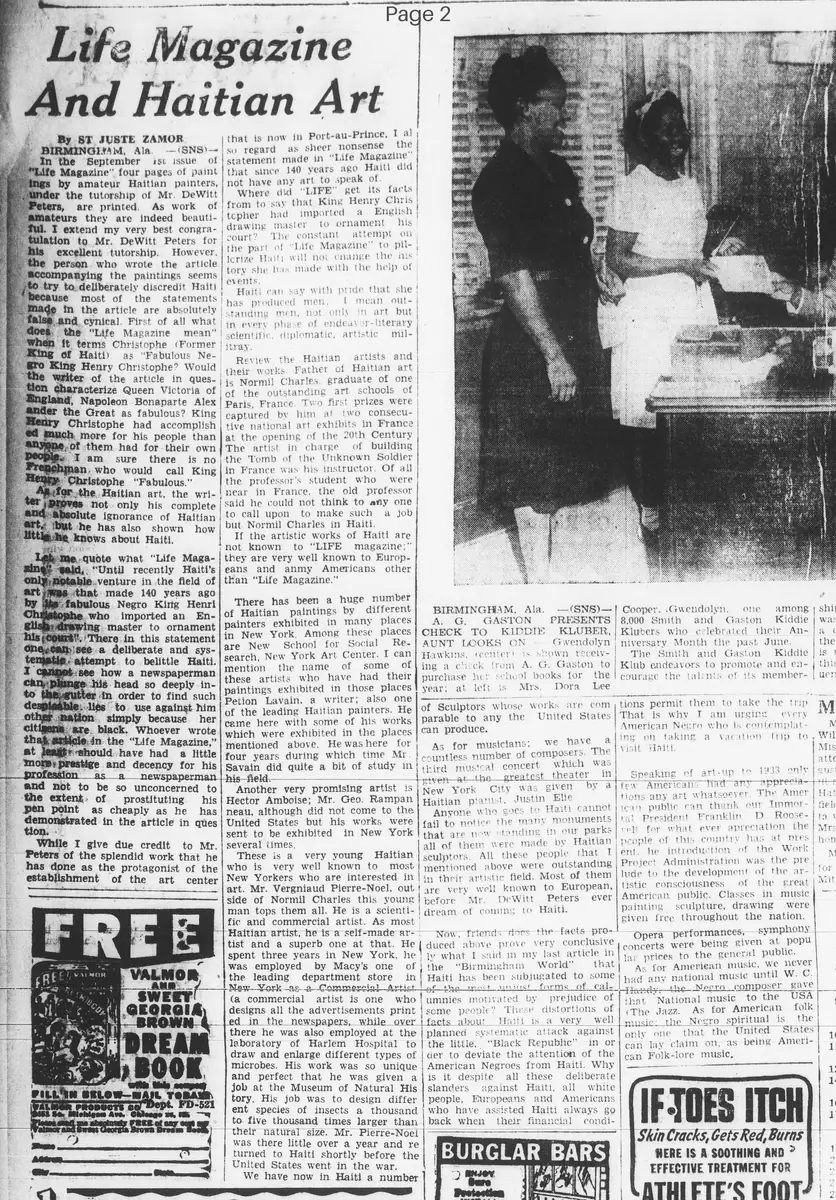
And Haitian Art
By ST. JUSTE ZAMOR
BIRMINGHAM, Ala.—(SNS)—
In the September 1st issue of "Life Magazine" four pages of paintings by amateur Haitian painters, under the tutorship of Mr. DeWitt Peters, are printed. As work of amateurs they are indeed beautiful. I extend my very best congratulation to Mr. DeWitt Peters for his excellent tutorship. However, the person who wrote the article accompanying the paintings seems to try to deliberately discredit Haiti because most of the statements made in the article are absolutely false and cynical. First of all what does the "Life Magazine" mean when it terms Christophe (Former King of Haiti) as "Fabulous Negro King Henry Christophe?" Would the writer of the article in question characterize Queen Victoria of England, Napoleon Bonaparte, Alexander the Great as fabulous? King Henry Christophe had accomplished much more for his people than any one of them had for their own people. I am sure there is no Frenchman who would call King Henry Christophe "Fabulous."
As for the Haitian art, the writer proves not only his complete and absolute ignorance of Haitian art, but he has also shown how little he knows about Haiti.
Let me quote what "Life Magazine" said, "Until recently Haiti's only notable venture in the field of art was that made 140 years ago by its fabulous Negro King Henri Christophe who imported an English drawing master to ornament his court." There in this statement one can see a deliberate and systematic attempt to belittle Haiti. I cannot see how a newspaperman can plunge his head so deeply into the gutter in order to find such despicable lies to use against another nation simply because her citizens are black. Whoever wrote that article in the "Life Magazine," at least, should have had a little more prestige and decency for his profession as a newspaperman and not to be so unconcerned to the extent of prostituting his pen point as cheaply as he has demonstrated in the article in question.
While I give due credit to Mr. Peters for the splendid work that he has done as the protagonist of the establishment of the art center that is now in Port-au-Prince. I also regard as sheer nonsense the statement made in "Life Magazine" that since 140 years ago Haiti did not have any art to speak of.
Where did "LIFE" get its facts from to say that King Henry Christophe had imported an English drawing master to ornament his court? The constant attempt on the part of "Life Magazine" to pillorize Haiti will not change the history she has made with the help of events.
Haiti can say with pride that she has produced men, I mean outstanding men, not only in art but in every phase of endeavor—literary, scientific, diplomatic, artistic, military.
Review the Haitian artists and their works. Father of Haitian art is Normil Charles graduate of one of the outstanding art schools of Paris, France. Two first prizes were captured by him at two consecutive national art exhibits in France at the opening of the 20th Century. The artist in charge of building the Tomb of the Unknown Soldier in France was his instructor. Of all the professor's students who were near in France, the old professor said he could not think to any one to call upon to make such a job but Normil Charles in Haiti.
If the artistic works of Haiti are not known to "LIFE magazine," they are very well known to Europeans and many Americans other than "Life Magazine."
There has been a huge number of Haitian paintings by different painters exhibited in many places in New York. Among these places are New School for Social Research, New York Art Center. I can mention the name of some of these artists who have had their paintings exhibited in those places. Petion Savain, a writer; also one of the leading Haitian painters. He came here with some of his works which were exhibited in the places mentioned above. He was here for four years during which time Mr. Savain did quite a bit of study in his field.
Another very promising artist is Hector Amboise; Mr. Geo. Hyppolite, although did not come to the United States but his works were sent to be exhibited in New York several times.
There is a very young Haitian who is very well known to most New Yorkers who are interested in art. Mr. Vergniaud Pierre-Noel, outside of Normil Charles this young man tops them all. He is a scientific and commercial artist. As most Haitian artists, he is a self-made artist and a superb one at that. He spent three years in New York. He was employed by Macy's one of the leading department store in New York—as a Commercial Artist (a commercial artist is one who designs all the advertisements printed in the newspapers), while over there he was also employed at the laboratory of Harlem Hospital to draw and enlarge different types of microbes. His work was so unique and perfect that he was given a job at the Museum of Natural History. His job was to design different species of insects a thousand to five thousand times larger than their natural size. Mr. Pierre-Noel was there little over a year and returned to Haiti shortly before the United States went in the war.
We have now in Haiti a number
of Sculptors whose works are comparable to any the United States can produce.
As for musicians: we have a countless number of composers. The third musical concert which was given at the greatest theater in New York City was given by a Haitian pianist, Justin Elie.
Anyone who goes to Haiti cannot fail to notice the many monuments that are now standing in our parks all of them were made by Haitian sculptors. All these people that I mentioned above were outstanding in their artistic field. Most of them are very well known to European, before Mr. DeWitt Peters ever dream of coming to Haiti.
Now, friends does the facts produced above prove very conclusively what I said in my last article in the "Birmingham World" that Haiti has been subjugated to some of the most unjust forms of calumnies motivated by prejudice of some people? These distortions of facts about Haiti is a very well planned systematic attack against the little, "Black Republic" in order to deviate the attention of the American Negroes from Haiti. Why is it despite all these deliberate slanders against Haiti, all white people, Europeans and Americans who have assisted Haiti always go back when their financial condition permits them?
That is why I am urging every American Negro who is contemplating on taking a vacation trip to visit Haiti.
Speaking of art—up to 1933 only few Americans had any appreciation any art whatsoever. The American public can thank our Immortal President Franklin D. Roosevelt for whatever appreciation the people of this country has at present. The introduction of the Work Project Administration was the prelude to the development of the artistic consciousness of the great American public. Classes in music, painting, sculpture, drawing were given free throughout the nation. Concerts were being given at popular prices to the general public. Opera performances, symphony.
As for American music, we never had any national music until W. C. Handy, the Negro composer gave that National music to the USA. (The Jazz. As for American folk music, the Negro spiritual is the only one that the United States can lay claim on, as being American Folk-lore music.
What sub-type of article is it?
What themes does it cover?
What keywords are associated?
What entities or persons were involved?
Letter to Editor Details
Author
St. Juste Zamor
Main Argument
the life magazine article deliberately discredits haiti and its history with false and cynical statements motivated by racial prejudice, particularly mischaracterizing king henry christophe and ignoring haiti's artistic achievements; the author counters this by highlighting haiti's outstanding artists, historical contributions, and cultural pride.
Notable Details