Thank you for visiting SNEWPapers!
Sign up free
Editorial
July 5, 1895
Staunton Vindicator
Staunton, Virginia
What is this article about?
Editorial refutes claims by Leesburg Washingtonian and Charlottesville Progress that more money (pre-1873 currency or free silver) would raise crop prices. Argues prices are determined by supply and demand, not money volume, citing US circulation stats from 1873-1895 showing low prices despite increased money.
Clipping
OCR Quality
95%
Excellent
Full Text
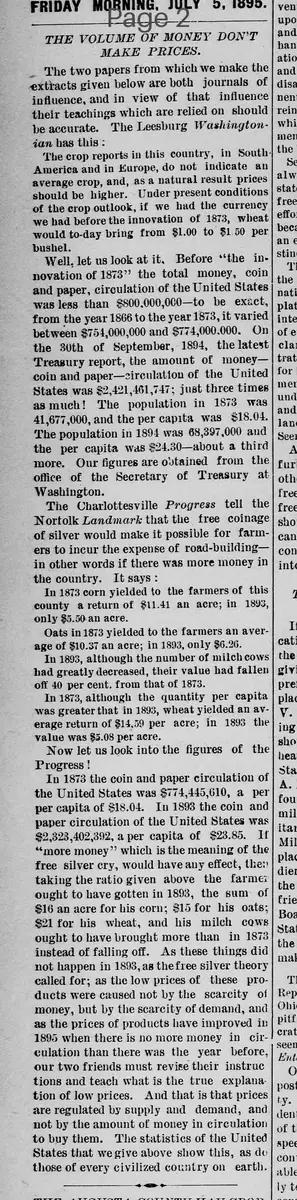
THE VOLUME OF MONEY DON'T MAKE PRICES.
The two papers from which we make the extracts given below are both journals of influence, and in view of that influence their teachings which are relied on should be accurate. The Leesburg Washingtonian has this:
The crop reports in this country, in South America and in Europe, do not indicate an average crop, and, as a natural result prices should be higher. Under present conditions of the crop outlook, if we had the currency we had before the innovation of 1873, wheat would to-day bring from $1.00 to $1.50 per bushel.
Well, let us look at it. Before "the innovation of 1873" the total money, coin and paper, circulation of the United States was less than $800,000,000-to be exact, from the year 1866 to the year 1873, it varied between $754,000,000 and $774,000,000. On the 30th of September, 1894, the latest Treasury report, the amount of money—coin and paper—circulation of the United States was $2,421,461,747; just three times as much! The population in 1873 was 41,677,000, and the per capita was $18.04. The population in 1894 was 68,397,000 and the per capita was $24.30—about a third more. Our figures are obtained from the office of the Secretary of Treasury at Washington.
The Charlottesville Progress tells the Norfolk Landmark that the free coinage of silver would make it possible for farmers to incur the expense of road-building—in other words if there was more money in the country. It says:
In 1873 corn yielded to the farmers of this county a return of $11.41 an acre; in 1893 only $5.50 an acre. Oats in 1873 yielded to the farmers an average of $10.37 an acre; in 1893, only $6.26. In 1893, although the number of milch cows had greatly decreased, their value had fallen off 40 per cent. from that of 1873. In 1873, although the quantity per capita was greater than in 1893, wheat yielded an average return of $14.59 per acre; in 1893 the value was $5.08 per acre.
Now let us look into the figures of the Progress!
In 1873 the coin and paper circulation of the United States was $774,445,610, a per capita of $18.04. In 1893 the coin and paper circulation of the United States was $2,323,402,392, a per capita of $23.85. If "more money" which is the meaning of the free silver cry, would have any effect, there taking the ratio given above the farmer ought to have gotten in 1893, the sum of $16 an acre for his corn; $15 for his oats; $21 for his wheat, and his milch cows ought to have brought more than in 1873 instead of falling off. As these things did not happen in 1893, as the free silver theory called for: as the low prices of these products were caused not by the scarcity of money, but by the scarcity of demand, and as the prices of products have improved in 1895 when there is no more money in circulation than there was the year before our two friends must revise their instructions and teach what is the true explanation of low prices. And that is that prices are regulated by supply and demand, and not by the amount of money in circulation to buy them. The statistics of the United States that we give above show this, as do those of every civilized country on earth.
The two papers from which we make the extracts given below are both journals of influence, and in view of that influence their teachings which are relied on should be accurate. The Leesburg Washingtonian has this:
The crop reports in this country, in South America and in Europe, do not indicate an average crop, and, as a natural result prices should be higher. Under present conditions of the crop outlook, if we had the currency we had before the innovation of 1873, wheat would to-day bring from $1.00 to $1.50 per bushel.
Well, let us look at it. Before "the innovation of 1873" the total money, coin and paper, circulation of the United States was less than $800,000,000-to be exact, from the year 1866 to the year 1873, it varied between $754,000,000 and $774,000,000. On the 30th of September, 1894, the latest Treasury report, the amount of money—coin and paper—circulation of the United States was $2,421,461,747; just three times as much! The population in 1873 was 41,677,000, and the per capita was $18.04. The population in 1894 was 68,397,000 and the per capita was $24.30—about a third more. Our figures are obtained from the office of the Secretary of Treasury at Washington.
The Charlottesville Progress tells the Norfolk Landmark that the free coinage of silver would make it possible for farmers to incur the expense of road-building—in other words if there was more money in the country. It says:
In 1873 corn yielded to the farmers of this county a return of $11.41 an acre; in 1893 only $5.50 an acre. Oats in 1873 yielded to the farmers an average of $10.37 an acre; in 1893, only $6.26. In 1893, although the number of milch cows had greatly decreased, their value had fallen off 40 per cent. from that of 1873. In 1873, although the quantity per capita was greater than in 1893, wheat yielded an average return of $14.59 per acre; in 1893 the value was $5.08 per acre.
Now let us look into the figures of the Progress!
In 1873 the coin and paper circulation of the United States was $774,445,610, a per capita of $18.04. In 1893 the coin and paper circulation of the United States was $2,323,402,392, a per capita of $23.85. If "more money" which is the meaning of the free silver cry, would have any effect, there taking the ratio given above the farmer ought to have gotten in 1893, the sum of $16 an acre for his corn; $15 for his oats; $21 for his wheat, and his milch cows ought to have brought more than in 1873 instead of falling off. As these things did not happen in 1893, as the free silver theory called for: as the low prices of these products were caused not by the scarcity of money, but by the scarcity of demand, and as the prices of products have improved in 1895 when there is no more money in circulation than there was the year before our two friends must revise their instructions and teach what is the true explanation of low prices. And that is that prices are regulated by supply and demand, and not by the amount of money in circulation to buy them. The statistics of the United States that we give above show this, as do those of every civilized country on earth.
What sub-type of article is it?
Economic Policy
Agriculture
What keywords are associated?
Currency Circulation
Crop Prices
Free Silver
Supply And Demand
Money Volume
Agricultural Yields
What entities or persons were involved?
Leesburg Washingtonian
Charlottesville Progress
Norfolk Landmark
Secretary Of Treasury
Editorial Details
Primary Topic
Volume Of Money Does Not Determine Prices
Stance / Tone
Critical Of Currency Based Price Theories, Advocates Supply And Demand Regulation
Key Figures
Leesburg Washingtonian
Charlottesville Progress
Norfolk Landmark
Secretary Of Treasury
Key Arguments
Crop Reports Indicate Below Average Yields, Yet Prices Not Higher As Expected Under Pre 1873 Currency
Money Circulation Tripled From 1873 To 1894, Per Capita Increased, But Prices Low
Free Silver Would Not Raise Farm Product Prices, As Shown By 1893 Data
Low Prices Due To Scarcity Of Demand, Not Money Scarcity
Prices Regulated By Supply And Demand, Not Money Volume
Statistics From Us And Other Countries Confirm This