Thank you for visiting SNEWPapers!
Sign up free
Southern Christian Advocate
Charleston, Charleston County, South Carolina
What is this article about?
Mrs. Wilkins reports from Millsburgh on her small school in the African Mission, struggling to enroll native girls due to cultural barriers, family excuses, and prejudices against female education linked to the 'devil-bush' ceremonies, where women face ritual abuse.
Clipping
OCR Quality
Full Text
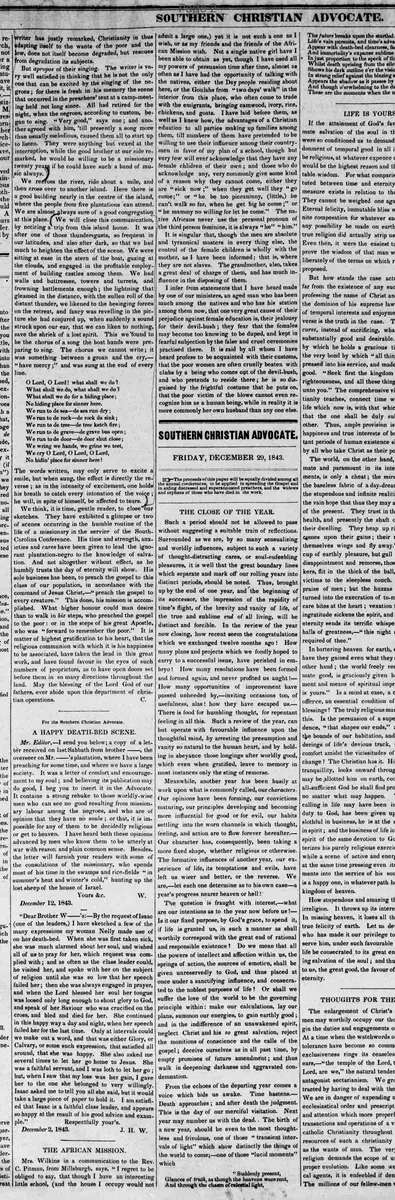
Mrs. Wilkins in a communication to the Rev. C. Pitman, from Millsburgh, says, 'I regret to be obliged to say, that though I have an interesting little school, (and the house I occupy would not admit a large one,) yet it is not such a one as I wish, or as my friends and the friends of the African Mission wish. Not a single native girl have I been able to obtain as yet, though I have used all my powers of persuasion time after time, almost as often as I have had the opportunity of talking with the natives, either the Dey people residing about here, or the Goulahs from "two days' walk" in the interior from this place, who often come to trade with the emigrants, bringing camwood, ivory, rice, chickens, and goats. I have laid before them, as well as I knew how, the advantages of a Christian education to all parties making up families among them, till numbers of them have pretended to be willing to use their influence among their countrymen in favor of my plan of a school, though but very few will ever acknowledge that they have any female children of their own; and those who do acknowledge any, very commonly give some kind of a reason why they cannot come, either they are "sick now;" when they get well they "go come;" or "he be too piccaninny, (little,) he can't walk so far, when he get big he come;" or "he mainmy no willing for let he come." The native Africans never use the personal pronoun of the third person feminine, it is always "he" "him." It is singular that, though the men are absolute and tyrannical masters in every thing else, the control of the female children is wholly with the mother, as I have been informed; that is, where they are not slaves. The grandmother, also, takes a great deal of charge of them, and has much influence in the disposing of them. I infer from statements that I have heard made by one of our ministers, an aged man who has been much among the natives and who has his station among them now, that one very great cause of their prejudice against female education is, their jealousy for their devil-bush; they fear that the females may become too knowing to be duped, and kept in fearful subjection by the false and cruel ceremonies practised there. It is said by all whom I have heard profess to be acquainted with their customs, that the poor women are often cruelly beaten with clubs by a being who comes out of the devil-bush, and who pretends to reside there; he is so disguised by the frightful costume that he puts on, that the poor victim of the blows cannot even recognize him as a human being, while in reality it is more commonly her own husband than any one else.'
What sub-type of article is it?
What keywords are associated?
What entities or persons were involved?
Where did it happen?
Foreign News Details
Primary Location
Millsburgh
Key Persons
Outcome
challenges in enrolling native girls in school due to cultural prejudices and family reluctance; insights into local customs including maternal control over female children and ritual abuses in the devil-bush.
Event Details
Mrs. Wilkins describes her small school in Millsburgh and efforts to persuade Dey and Goulah natives to send girls, facing excuses and resistance; notes linguistic quirks, family dynamics, and fears that education might undermine the devil-bush ceremonies where women are beaten by disguised figures, often their husbands.