Thank you for visiting SNEWPapers!
Sign up free
Alexandria Daily Advertiser
Alexandria, Virginia
What is this article about?
Court proceedings in the District of Columbia Circuit Court on January 24 and 29, 1807, involving Erick Bollman and Samuel Swartwout, arrested for treason linked to Aaron Burr's conspiracy. Motions for witnesses, habeas corpus petition, arguments on commitment, and eventual order for commitment without bail.
Clipping
OCR Quality
Full Text
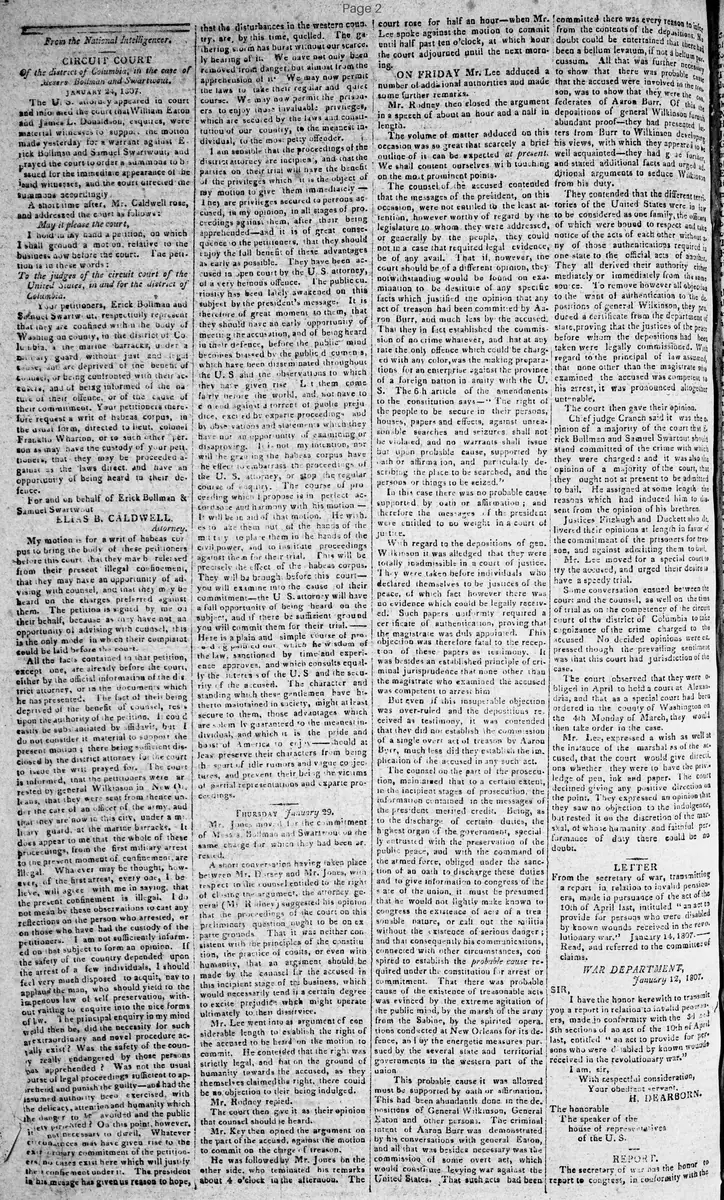
CIRCUIT COURT
Of the district of Columbia, in the case of
Messrs. Bollman and Swartwout.
JANUARY 24, 1807.
The U. S. attorney appeared in court
and informed the court that William Eaton
and James L. Donaldson, Esquires, were
material witnesses to support the motion
made yesterday for a warrant against E.
Bollman and Samuel Swartwout; and
prayed the court to order a summons to be
issued for the immediate appearance of the
said witnesses, and the court directed a
summons accordingly.
A short time after, Mr. Caldwell rose,
and addressed the court as follows:
May it please the court,
I hold in my hand a petition, on which
I shall ground a motion, relative to the
business now before the court. The peti-
tion is in these words:
To the judges of the circuit court of the
United States, in and for the district of
Columbia.
Your petitioners, Erick Bollman and
Samuel Swartwout, respectfully represent
that they are confined within the body of
Washington county, in the district of Co-
lumbia, at the marine barracks, under a
military guard, without just and legal
cause, and are deprived of the benefit of
counsel, or being confronted with their ac-
users, and of being informed of the na-
ture of their offence, or of the cause of
their commitment. Your petitioners there-
fore request a writ of habeas corpus, in
the usual form, directed to Lieut. colonel
Franklin Wharton, or to such other per-
son as may have the custody of your peti-
tioners, that they may be proceeded a-
gainst as the laws direct, and have an
opportunity of being heard in their de-
fence.
For and on behalf of Erick Bollman &
Samuel Swartwout,
ELIAS B. CALDWELL.
Attorney.
My motion is for a writ of habeas cor-
pus to bring the body of these petitioners
before this court that they may be released
from their present illegal confinement,
that they may have an opportunity of ad-
vising with counsel, and that they may be
heard on the charges preferred against
them. The petition is signed by me on
their behalf, because as they have not an
opportunity of advising with counsel, this
is the only mode in which their complaint
could be laid before the court.
All the facts contained in that petition,
except one, are already before the court,
either by the official information of the dis-
strict attorney, or in the documents which
he has presented. The act of their being
deprived of the benefit of counsel, rests
upon the authority of the petition. It could
not be substantiated by affidavit, but I
do not consider it material to support the
present motion; there being sufficient dis-
closed by the district attorney for the court
to be informed, that the petitioners were ar-
rested at New Orleans by general Wilkinson
and sent from thence under the care of an officer of the army, and military guard, to the marine barracks. It does appear to me that the whole of these proceedings, from the first military arrest to the present moment of confinement, are illegal. Whatever may be thought, however, of the first arrest, every one, I believe, will agree with me in saying, that the present confinement is illegal. I do not mean by these observations to cast any reflections on the person who arrested, or on those who have had the custody of the petitioners. I am not sufficiently informed on that subject to form an opinion. If the safety of the country depended upon the arrest of a few individuals, I should feel very much disposed to acquit, nay to applaud the man, who should yield to the impetuous law of self preservation, without waiting to enquire into the nice forms of law. The principal enquiry in my mind would then be, did the necessity for such extraordinary and novel procedure actually exist? Was the safety of the country really endangered by those persons who had assumed authority? Had not the usual course of legal proceedings sufficient to apprehend and punish the guilty -- and had the danger to be avoided and the public safety permitted? On this point, however, it is not necessary to dwell. Whatever circumstances may have given rise to the extraordinary commitment of the petitioners no cases exist here which will justify the confinement under it. The president in his message has given us reason to hope, that the disturbances in the western country, are, by this time, quelled. The gathering storm has burst without our scarcely hearing of it. We have not only been removed from danger, but almost from the apprehension of it We may now permit the laws to take their regular and quiet course. We may now permit the prisoners to enjoy those invaluable privileges, which are secured by the laws and constitution of our country, to the meanest individual, to the most petty offender.
I am sensible that the proceedings of the district attorney are incipient, and that the parties on their trial will have the benefit of the privileges which it is the object of my motion to give them immediately They are privileges secured to persons accused, in my opinion, in all stages of proceedings against them, after their being apprehended -- and it is of great consequence to the petitioners, that they should enjoy the full benefit of these advantages as early as possible. They have been accused in open court by the U. S. attorney, of a very heinous offence. The public curiosity has been lately awakened on this subject by the president's message. It is therefore of great moment to them, that they should have an early opportunity of meeting the accusation, and of being heard in their defence, before the public mind becomes biassed by the public documents, which have been disseminated throughout the U. S. and the observations to which they have given rise Let them come fairly before the world, and not have to contend against a torrent of public prejudice, excited by ex parte proceedings and by observations and statements which they have not an opportunity of examining or disapproving. It is not my intention, nor will be granting the habeas corpus have the effect to embarrass the proceedings of the U. S. attorney, or stop the regular course of enquiry. The course of proceeding which I propose is in perfect accordance and harmony with his motion -- It will be in aid of that motion. He wishes to take them out of the hands of the military to place them in the hands of the civil power, and to institute proceedings against them for their trial. This will be precisely the effect of the habeas corpus. They will be brought before this court-- you will examine into the cause of their commitment--the U S. attorney will have a full opportunity of being heard on the subject, and if there be sufficient ground you will commit them for their trial.
Here is a plain and simple course of proceeding pointed out, which the wisdom of the law, sanctioned by time and experience approves, and which consults equally the interests of the U. S. and the security of the accused. The character and standing which these gentlemen have hitherto maintained in society, might at least secure to them, those advantages which are solemnly guaranteed to the meanest individual, and which it is the pride and boast of America to enjoy--should at least preserve their characters from being the sport of idle rumors and vague conjectures, and prevent their being the victims of partial representations and ex parte proceedings.
Thursday January 29.
Mr. Jones moved for the commitment of Messrs. Bollman and Swartwout on the same charge for which they had been arrested.
A short conversation having taken place between Mr. Rodney and Mr. Jones, with respect to the counsel entitled to the right of closing the argument, the attorney general (Mr. Rodney) suggested his opinion that the proceedings of the court on this preliminary question ought to be on ex parte grounds That it was neither consistent with the principles of the constitution, the practice of courts, or even with humanity, that an argument should be made by the counsel for the accused in this incipient stage of the business, which would necessarily tend in a certain degree to excite prejudice which might operate ultimately to their disservice.
Mr. Lee went into an argument of considerable length to establish the right of the accused to be heard on the motion to commit. He contended that the right was strictly legal, and that on the ground of humanity towards the accused, as they themselves claimed the right, there could be no objection to their being indulged.
Mr. Rodney replied.
The court then gave it as their opinion that counsel should be heard.
Mr. Key then opened the argument on the part of the accused, against the motion to commit on the charge of treason.
He was followed by Mr. Jones on the other side, who terminated his remarks about 4 o'clock in the afternoon. The court rose for half an hour when Mr. Lee spoke against the motion to commit until half past ten o'clock, at which hour the court adjourned until the next morning.
ON FRIDAY Mr. Lee adduced a number of additional authorities and made some further remarks.
Mr. Rodney then closed the argument in a speech of about an hour and a half in length.
The volume of matter adduced on this occasion was so great that scarcely a brief outline of it can be expected at present. We shall content ourselves with touching on the most prominent points.
The counsel of the accused contended that the messages of the president, on this occasion, were not entitled to the least attention, however worthy of regard by the legislature to whom they were addressed, or generally by the people, they could not in a case that required legal evidence, be of any avail. That if, however, the court should be of a different opinion, they would notwithstanding be found on examination to be destitute of any specific facts which justified the opinion that any act of treason had been committed by Aaron Burr, and much less by the accused. That they in fact established the commission of no crime whatever, and that at any rate the only offence which could be charged with any color, was the making preparations for an enterprise against the province of a foreign nation in amity with the U. S. The 4th article of the amendments to the constitution says-- "The right of the people to be secure in their persons, houses, papers and effects, against unreasonable searches and seizures, shall not be violated, and no warrants shall issue but upon probable cause, supported by oath or affirmation, and particularly describing the place to be searched, and the persons or things to be seized."
In this case there was no probable cause supported by oath or affirmation; and therefore the messages of the president were not entitled to any weight in a court of justice.
With regard to the depositions of gen. Wilkinson it was alleged that they were totally inadmissible in a court of justice. They were taken before individuals who declared themselves to be justices of the peace, of which fact however there was no evidence which could be legally received. Such papers uniformly required a certificate of authentication, proving that the magistrate was duly appointed. This objection was therefore fatal to the reception of these papers as testimony. It was besides an established principle of criminal jurisprudence that none other than the magistrate who examined the accused was competent to arrest him
But even if this insuperable objection was over-ruled and the depositions received as testimony, it was contended that they did not establish the commission of a single overt act of treason by Aaron Burr. much less did they establish the implication of the accused in any such act.
The counsel on the part of the prosecution, maintained that to a certain extent, in the incipient stages of prosecution, the information contained in the messages of the president merited credit. Being, as he is to the discharge of certain duties, the highest organ of the government, specially entrusted with the preservation of the public peace, and with the command of the armed force, obliged under the sanction of an oath to discharge these duties and to give information to congress of the state of the union, it must be presumed that he would not lightly make known to congress the existence of acts of a treasonable nature, or call out the militia without the existence of serious danger; and that consequently his communications, connected with other circumstances, conspired to establish the probable cause required under the constitution for arrest or commitment. That there was probable cause of the existence of treasonable acts was evinced by the extreme agitation of the public mind, by the march of the army from the Sabine, by the spirited operations conducted at New Orleans for its defence, and by the energetic measures pursued by the several state and territorial governments in the western part of the union
This probable cause it was allowed must be supported by oath or affirmation. This had been abundantly done in the depositions of General Wilkinson, General Eaton and other persons. The criminal intent of Aaron Burr was demonstrated by the conversations with general Eaton, and all that was besides necessary was the commission of some overt act, which would constitute levying war against the United States. That such acts had been committed there was every reason to infer from the contents of the depositions that there had been a bellum levatum if not a bellum commissum.
All that was further necessary to show that there was probable cause that the accused were involved in the treason was to show that they were the confederates of Aaron Burr.
Of this the depositions of general Wilkinson furnish abundant proof—they had presented letters from Burr to Wilkinson developing his views, with which they appeared well acquainted—they had gone further, and stated additional facts and urged additional arguments to seduce Wilkinson from his duty.
They contended that the different territories of the United States were to be considered as one family, the officers of which were bound to respect and take notice of the acts of each other without any of those authentications required in one state to the official acts of another They all derived their authority either mediately or immediately from the same source. To remove however all objection to the want of authentication to the depositions of general Wilkinson, they produced a certificate from the department of state, proving that the justices of the peace before whom the depositions had been taken were legally commissioned. With regard to the principle of law assumed, that none other than the magistrate who examined the accused was competent to his arrest, it was pronounced altogether untenable.
The court then gave their opinion.
Chief Judge Cranch said it was the opinion of a majority of the court that Erick Bollman and Samuel Swartwout should stand committed of the crime with which they were charged: and it was also the opinion of a majority of the court, that they ought not at present to be admitted to bail. He assigned at some length the reasons which had induced him to dissent from the opinion of his brethren.
Justices Fitzhugh and Duckett also delivered their opinions at length in favor of the commitment of the prisoners for treason, and against admitting them to bail.
Mr. Lee moved for a special court to try the accused, and urged their desire to have a speedy trial.
Some conversation ensued between the court and the counsel, as well on the time of trial as on the competency of the circuit court of the district of Columbia to take cognizance of the crime charged to the accused No decided opinions were expressed though the prevailing sentiment was that this court had jurisdiction of the case.
The court observed that they were obliged in April to hold a court at Alexandria, and that as a special court had been ordered in the county of Washington on the 4th Monday of March, they would then take order in the case.
Mr. Lee, expressed a wish as well at the instance of the marshal as of the accused, that the court would give directions whether they were to have the privilege of pen, ink and paper. The court declined giving any positive direction on the point. They expressed an opinion that they saw no objection to the indulgence but rested it on the discretion of the marshal, of whose humanity and faithful performance of duty there could be no doubt.
What sub-type of article is it?
What themes does it cover?
What keywords are associated?
What entities or persons were involved?
Where did it happen?
Story Details
Key Persons
Location
District Of Columbia, Washington County, Marine Barracks
Event Date
January 24, 1807; January 29, 1807
Story Details
Proceedings in the U.S. Circuit Court for the District of Columbia regarding the arrest and confinement of Erick Bollman and Samuel Swartwout on treason charges connected to Aaron Burr's conspiracy. Includes summons for witnesses, habeas corpus petition by their attorney Elias B. Caldwell, arguments on legality of military arrest and commitment, debates on evidence from presidential messages and depositions, and court's decision to commit them without bail pending trial.