Thank you for visiting SNEWPapers!
Sign up free
Lynchburg Virginian
Lynchburg, Virginia
What is this article about?
Albert Pike's letter in the New England Magazine describes the Arkansas Territory's geography, fertile river bottoms ideal for poor settlers to prosper, political elections, devastating 1833 flood, and his perilous return trip during inundation.
Clipping
OCR Quality
Full Text
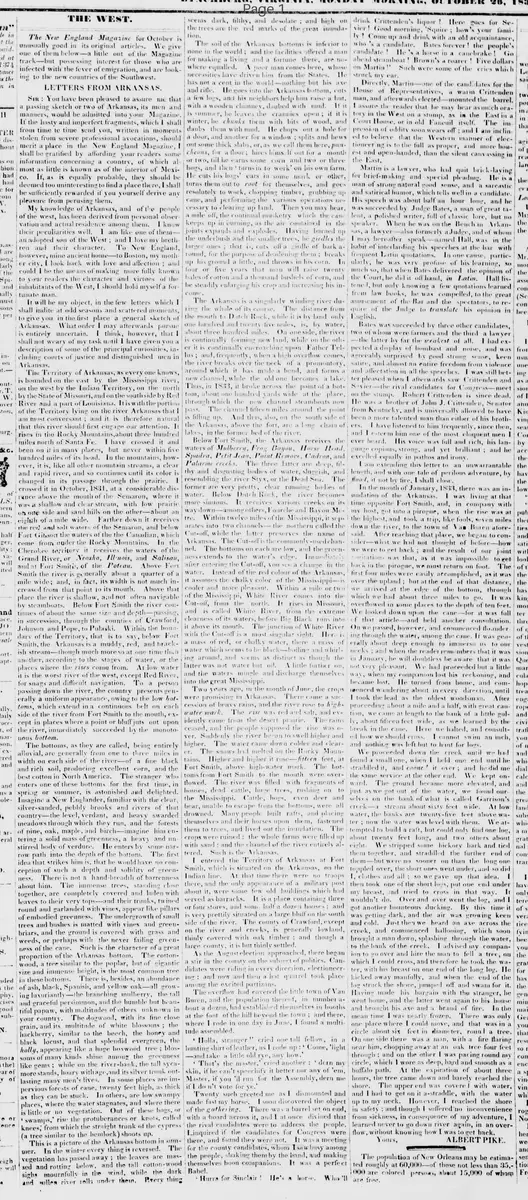
LETTERS FROM ARKANSAS.
Sir: You have been pleased to assure me that a passing sketch or two of Arkansas, its men and manners, would be admitted into your Magazine. If the hasty and imperfect fragments, which I shall from time to time send you, written in moments stolen from severe professional avocations, should merit a place in the New England Magazine, I shall be gratified by affording your readers some information concerning a country, of which almost as little is known as of the interior of Mexico. If, as is equally probable, they should be deemed too uninteresting to find a place there, I shall be sufficiently rewarded if you yourself derive any pleasure from perusing them.
My knowledge of Arkansas, and of the people of the west, has been derived from personal observation and actual residence among them. I know their peculiarities well. I am like one of them—an adopted son of the West: and I love my brethren and their character. To New England however, mine ancient home—to Boston, my mother city, I look back with love and affection; and could I be the means of making more fully known to your readers the character and virtues of the inhabitants of the West, I should hold myself a fortunate man.
It will be my object, in the few letters which I shall indite at odd seasons and scattered moments, to give you in the first place a general sketch of Arkansas. What order I may afterwards pursue is entirely uncertain. I think, however, that I shall not weary of my task until I have given you a description of some of the principal curiosities, including courts of justice and distinguished men in Arkansas.
The Territory of Arkansas, as every one knows, is bounded on the east by the Mississippi river, on the west by the Indian Territory, on the north by the State of Missouri, and on the south side by Red River and a part of Louisiana. It is with the portion of the Territory lying on the river Arkansas that I am most conversant; and it is therefore natural that this river should first engage our attention. It rises in the Rocky Mountains, about three hundred miles north of Santa Fe. I have crossed it and been on it in many places, but never within five hundred miles of its head. In the mountains, however, it is, like all other mountain streams, a clear and rapid river, and so continues until its color is changed in its passage through the prairie. I crossed it in October, 1831, at a considerable distance above the mouth of the Semaron, where it was a shallow and clear stream, with low prairie on one side and sand hills on the other—about an eighth of a mile wide. Farther down it receives the red and salt waters of the Semaron, and below Fort Gibson the waters of the Canadian, which come from under the Rocky Mountains. In the Cherokee territory it receives the waters of the Grand River, or Neosho, Illinois, and Saline, and at Fort Smith, of the Poteau. Above Fort Smith the river is generally about a quarter of a mile wide; and, in fact, its width is not much increased from that point to its mouth. Above that place the river is shallow, and not often navigable by steamboats. Below Fort Smith the river continues of about the same size and depth—passing, in succession, through the counties of Crawford, Johnson and Pope, to Pulaski. Within the boundary of the Territory, that is to say, below Fort Smith, the Arkansas is a muddy, red, and brackish stream—though much more so at one time than another, according to the stages of water, or the places where the rises come from. At low water it is the worst river of the west, except Red River, for snags and difficult navigation. To a person passing down the river, the country presents generally a uniform appearance, owing to the low bottoms, which extend in a continuous belt on each side of the river from Fort Smith to the mouth, except in places where a point or bluff juts out upon the river, immediately succeeded by the monotonous bottom.
The bottoms, as they are called, being entirely alluvial, are generally from one to three miles in width on each side of the river—of a fine black and rich soil, producing excellent corn, and the best cotton in North America. The stranger who enters one of these bottoms for the first time, in spring or summer, is astonished and delighted. Imagine a New Englander, familiar with the clear, silver-sanded, pebbly brooks and rivers of that country—the level, verdant, and heavy swarded meadows through which they run, and the forests of pine, oak, maple, and birch—imagine him entering a solid mass of greenness, a heavy and unstirred body of verdure. He enters by some narrow path into the depth of the bottom. The first idea that strikes him is, that he would have no conception of such a depth and solidity of greenness. There is not a hand-breadth of barrenness about him. The immense trees, standing close together, are completely covered and laden with leaves to their very tops—and their trunks, twined round and garlanded with vines, appear like pillars of embodied greenness. The undergrowth of small trees and bushes is matted with vines and green briars, and the ground is covered with grass and weeds, or perhaps with the never failing greenness of the cane. Such is the character of a great proportion of the Arkansas bottom. The cottonwood, a tree similar to the poplar, but of gigantic size and immense height, is the most common tree in these bottoms. There is, besides, an abundance of ash, black, Spanish, and yellow oak—all growing luxuriantly—the branching mulberry, the tall and graceful persimmon, and the humble but beautiful papaw, with multitudes of others unknown in your country. The dogwood, with its fine close grain, and its multitude of white blossoms; the hackberry, similar to the beech, the honey and black locust, and that splendid evergreen, the holly, appearing like a huge boxwood tree: blossoms of many kinds shine among the greenness like gems; while on the river-bank, the tall sycamore stands, hoary with age, and its silver trunk outlasting many men's lives. In some places are impervious forests of cane, twenty feet high, as thick as they can be stuck. In others, are low swampy places, where the water stagnates, and where there is little or no vegetation. Out of these bogs, or 'swamps,' rise the protuberances or knots, called knees; from which the straight trunk of the cypress (a tree similar to the hemlock) shoots up.
This is a picture of the Arkansas bottom in summer. In the winter every thing is reversed. The vegetation has passed away; the leaves are massed and rotting below, and the tall cottonwood sighs mournfully in the wind, while the dark and sullen river rolls under them. Every thing seems dark, filthy, and desolate; and high on the trees are the red marks of the great inundation.
The soil of the Arkansas bottoms is inferior to none in the world; and the facilities offered a man for making a living and a fortune there, are nowhere equalled. A poor man comes here, whose necessities have driven him from the States. He has not a cent in the world—nothing but his axe and rifle. He goes into the Arkansas bottom, cuts a few logs, and his neighbors help him raise a hut, with a wooden chimney, daubed with mud. If it is summer, he leaves the crannies open; if it is winter, he chunks them with bits of wood, and daubs them with mud. He chops out a hole for a door, and another for a window; splits and hews out some thick slabs, or, as we call them here, puncheons, for a floor; hires himself out for a month or two, till he earns some corn and two or three hogs, and then 'turns in to work' on his own farm. He cuts his logs' ears in some mark or other, turns them out to root for themselves, and goes resolutely to work, chopping timber, grubbing up cane, and performing the various operations necessary to clearing up land. Then you may hear, a mile off, the continual musketry which the cane keeps up in burning, as the air contained in the joints expands and explodes. Having burned up the under bush and the smaller trees, he girdles the larger ones; that is, cuts off a girdle of bark around, for the purpose of deadening them; breaks up his ground a little, and throws in his corn. In four or five years that man will raise twenty bales of cotton and a thousand bushels of corn, and be steadily enlarging his crop and increasing his income.
The Arkansas is a singularly winding river during the whole of its course. The distance from the mouth to Dutch Rock, while it is by land only one hundred and twenty five miles, is, by water, about three hundred miles. On one side, the river is continually forming new land, while on the other it is continually encroaching upon rather tell us; and, frequently, when a high overflow comes, the river breaks over the neck of a promontory, around which it has made a bend, and forms a new channel, while the old one becomes a lake. Thus, in 1833, it broke across the point of a bottom, about one hundred yards wide at the place, through which the new channel steamboats now pass. The channel fifteen miles around the point is filling up. And thus, also, on the south side of the Arkansas, above the fort, are a long chain of lakes, in the former bed of the river.
Below Fort Smith, the Arkansas receives the waters of Mulberry, Frog Bayou, Horse Head, Spadra, Petit Jean, Point Remove, Cadron, and Palarm creeks. The three latter are deep, filthy and disgusting bodies of water, sluggish, and resembling the river Styx, or the Dead Sea. The former are very pretty, clear running bodies of water. Below Dutch Rock, the river becomes more sinuous. It receives various creeks on its way down—among others, Fourche and Bayou Metre. Within twelve miles of the Mississippi, it separates into two channels—the northern called the Cut-off, while the latter preserves the name of Arkansas. The Cut-off is the commonly-used channel. The bottoms on each are low, and the greenness extends to the water's edge. Immediately after entering the Cut-off, you see a change in the water. Instead of the red colour of the Arkansas, it assumes the chalky color of the Mississippi—is cooler and more pleasant. Within a mile or two of the Mississippi, White River comes into the Cut-off, from the north. It rises in Missouri, and is called White River, from the extreme clearness of its waters, before Big Black runs into it above its mouth. The junction of White River with the Cut-off is a most singular sight. Here is a mass of red, or chalky water, there a mass of water which seems to be black—boiling and whirling around, and seems as distinct as though the latter was not water but oil. A little further on, and the waters mingle and discharge themselves into the great Mississippi.
Two years ago, in the month of June, the crops were promising in Arkansas. There came a succession of heavy rains, and the river rose to high water mark. The rise was red and salt, and evidently came from the desert prairie. The rain ceased, and the people supposed the rise was over. Suddenly the river began to swell higher and higher. The water came down colder and clearer. The snows had melted on the Rocky Mountains. Higher and higher it rose—fifteen feet, at Fort Smith, above high-water mark. The bottoms from Fort Smith to the mouth were overflowed. The river was filled with fragments of houses, dead cattle, huge trees, rushing on to the Mississippi. Cattle, hogs, even deer and bear, unable to escape from the bottoms, were all drowned. Many people built rafts, and placing themselves and their horses upon them, fastened them to trees, and lived out the inundation. The crops were ruined: the whole farms were filled up with sand: and the channel of the river entirely altered. Such is the Arkansas.
I entered the Territory of Arkansas at Fort Smith, which is situated on the Arkansas, on the Indian line. At that time there were no troops there, and the only appearance of a military post about it, were some few old buildings which had served as barracks. It is a place containing three or four stores, and some half a dozen houses; and is very prettily situated on a large bluff on the south side of the river. The county of Crawford, except on the river and creeks, is generally lowland, thinly covered with oak timber; and though a large county, it is but thinly settled.
As the August election approached, there began a stir in the county on the subject of politics. Candidates were riding in every direction, electioneering: and now and then a hot quarrel took place among the excited partisans.
The overflow had covered the little town of Van Buren, and the population thereof, in number about a dozen, had established themselves in booths at the foot of the hill beyond the town; and there, where I rode in one day in June, I found a multitude assembled.
'Holla, stranger!' cried one tall fellow, in a hunting shirt of leather, as I rode up: 'Come, 'light—and take a little old rye, any how.'
'That's the master,' cried another: 'dern my skin, if he can't speechify it better nor any of 'em.'
'Master, if you'll run for the Assembly, dern me if I don't vote for ye.'
Twenty such greeted me as I dismounted and made fast my horse. I soon discovered the object of the gathering. There was a barrel set on end, with a board across it, and I at once divined that the rival candidates were to address the people. I inquired if the candidates for Congress were there, and found they were not. It was a meeting for the county candidates, whom I saw busy among the people, shaking them by the hand, and making themselves boon companions. It was a perfect Babel.
'Hurra for Sinclair! He's a hor-e. Who'll drink Crittenden's liquor? Here goes for Sevier! Good morning, 'Squire; how's your family? Come up and drink with an old acquaintance, who's a candidate. Bates forever! the people's candidate! He's a horse in a canebrake! Go ahead steamboat! Brown's a roarer! Five dollars on Martin!' Such were some of the cries which struck my ear.
Directly, Martin—one of the candidates for the House of Representatives, a warm Crittenden man, and afterwards elected—mounted the barrel. I assure the reader that he may hear as much oratory in the West on a stump, as in the East in a Court House, or in old Faneuil itself. The impression of oddity soon wears off; and I am inclined to believe that the Western manner of electioneering is to the full as proper, and more honest and open-handed, than the silent canvassing in the East.
Martin is a lawyer, who had quit brick-laying for brief-making and special pleading. He is a man of strong natural good sense, and a sarcastic and satirical humor, which tells well in a candidate. His speech was about half an hour long, and he was succeeded by Judge Bates, a man of great talent, a polished writer, full of classic lore, but no speaker. When he was on the Bench in Arkansas, a lawyer—also formerly a Judge, and of whom I may hereafter speak—named Hall, was in the habit of interlarding his speeches at the bar with frequent Latin quotations. In one cause, particularly, he was very profuse of his learning, so much so, that when Bates delivered the opinion of the Court, he did it off hand, in Latin. Hall listened, but only knowing a few quotations learned from law books, he was compelled, to the great amusement of the Bar and the spectators, to require of the Judge to translate his opinion in English.
Bates was succeeded by three other candidates, two of whom were farmers and the third a lawyer—the latter by far the weakest of all. I had expected a display of bombast and noise, and was agreeably surprised by good strong sense, keen satire, and almost an entire freedom from violence and affectation in all the speeches. I was still better pleased when I afterwards saw Crittenden and Sevier—the rival candidates for Congress—meet on the stump. Robert Crittenden is since dead. He was a brother of John J. Crittenden, Senator from Kentucky, and is universally allowed to have been a more talented man than either of his brothers. I have listened to him frequently, since then, and I esteem him one of the most eloquent men I ever heard. His voice was full and rich, his language copious, strong, and yet brilliant; and he excelled equally in pathos and irony.
I am extending this letter to an unwarrantable length, and with one tale of perilous adventure, by flood, if not by fire, I shall close.
In the month of January, 1833, there was an inundation of the Arkansas. I was living at that time opposite Fort Smith, and, in company with my host, got into a pirogue, when the rise was at the highest, and took a trip, like fools, seven miles down the river, to the town of Van Buren aforesaid. After reaching that place, we began to consider—what we had not thought of before—how we were to get back; and the result of our joint deliberations was that, as it was impossible to get back in the pirogue, we must return on foot. The first four miles were easily accomplished, as it was over the upland; but at the end of that distance, we arrived at the edge of the bottom, through which we had about three miles to go. It was overflowed in some places to the depth of ten feet. We looked down upon the cane—for it was full of that article—and held another consultation. On we passed, however, and commenced floundering through the water, among the cane. It was generally about deep enough to immerse us to our necks; and when the reader remembers that it was in January, he will doubtless be aware that it was not very pleasant. We had proceeded but a little way, when my companion lost his reckoning, and became lost. He turned from home, and commenced wandering about in every direction, until I took the lead as the oldest woodsman. After proceeding about a mile and a half, with great caution, we came at length to the bank of a little gully, about fifteen feet wide, as we learned by the break in the cane. Here we halted, and consulted how we should cross. I cannot swim an inch, and nothing was left but to hunt for logs. We proceeded down the creek until we had found a small one, when I held one end until he straddled it, and cooned it over; and he did me the same service at the other end. We kept onward. The ground became more elevated, and just as we got out of the water, we found ourselves on the bank of what is called Garrison's creek—a stream about sixty feet wide. At low water, the banks are twenty-five feet above water; now the water was level with them. We attempted to build a raft, but could only find one log, about twenty feet long, and two others about eight. We stripped some hickory bark and tied them together, and straddled the further end of them—but were no sooner on than the long one toppled over, the short ones went under, and so did I, clothes and all; so we gave up that idea. I then took one of the short logs, put one end under my breast, and tried to cross in that way. It wouldn't do. Over and over went the log, and I got another bounteous ducking. By this time it was getting dark, and the air was growing keen and cold. Just then we heard an axe across the creek, and commenced hallooing, which soon brought a man down, splashing through the water, to the bank of the creek. I advised my companion to go over and hire the man to fell a tree, on which I could cross, and therefore he took the water, with his breast on one end of the long log. He kicked away manfully, and when the end of the log struck the shore, jumped off and swam for it. Having made his bargain with the stranger, he went home, and the latter went again to his house and brought his axe and a brand of fire. In the mean time I was nearly frozen. There was only one place where I could move, and that was in a circle about six feet in diameter, round a tree. On one side there was a man, with a fire flaring near him, chopping away at an oak tree four feet through; and on the other I was pacing round my circle, which I wore as deep, hard and smooth as a buffalo path. At the expiration of about three hours, the tree came down and barely reached the shore. The upper end was covered with water, and I had to get on it a-straddle, with the water up to my neck. However, I reached the shore in safety; and though I suffered no inconvenience from sickness, in consequence of my adventure, I learned never to go down river again, in an overflow, without knowing how I was to get back.
Yours,
ALBERT PIKE.
What sub-type of article is it?
What keywords are associated?
What entities or persons were involved?
Where did it happen?
Domestic News Details
Primary Location
Territory Of Arkansas
Event Date
1831 1833
Key Persons
Outcome
cattle, hogs, deer, and bear drowned in 1833 flood; crops ruined; farms filled with sand; river channel altered. pike and companion survived perilous return trip without sickness.
Event Details
Albert Pike describes the Arkansas River's course, fertile alluvial bottoms supporting settlement and cotton production, 1833 inundation from Rocky Mountain snowmelt overflowing bottoms, local politics including August election speeches by candidates Martin, Bates, Crittenden, and Sevier in Crawford County near Fort Smith and Van Buren, and his January 1833 adventure crossing flooded areas on foot and logs to return from Van Buren.