Thank you for visiting SNEWPapers!
Sign up free
The Spirit Of Democracy
Woodsfield, Monroe County, Ohio
What is this article about?
In an 1848 Ohio legislative debate, Mr. Pugh contends that the recent apportionment bill illegally splits Hamilton County into electoral districts, breaching the state constitution's rule for county-wide voting on representatives. He references history, law, and criticizes the Attorney General's view. (248 characters)
Merged-components note: Continuation of Mr. Pugh's speech on the bill to repeal the apportionment act dividing Hamilton County, spanning pages 1 and 2.
Clippings
1 of 2
OCR Quality
Full Text
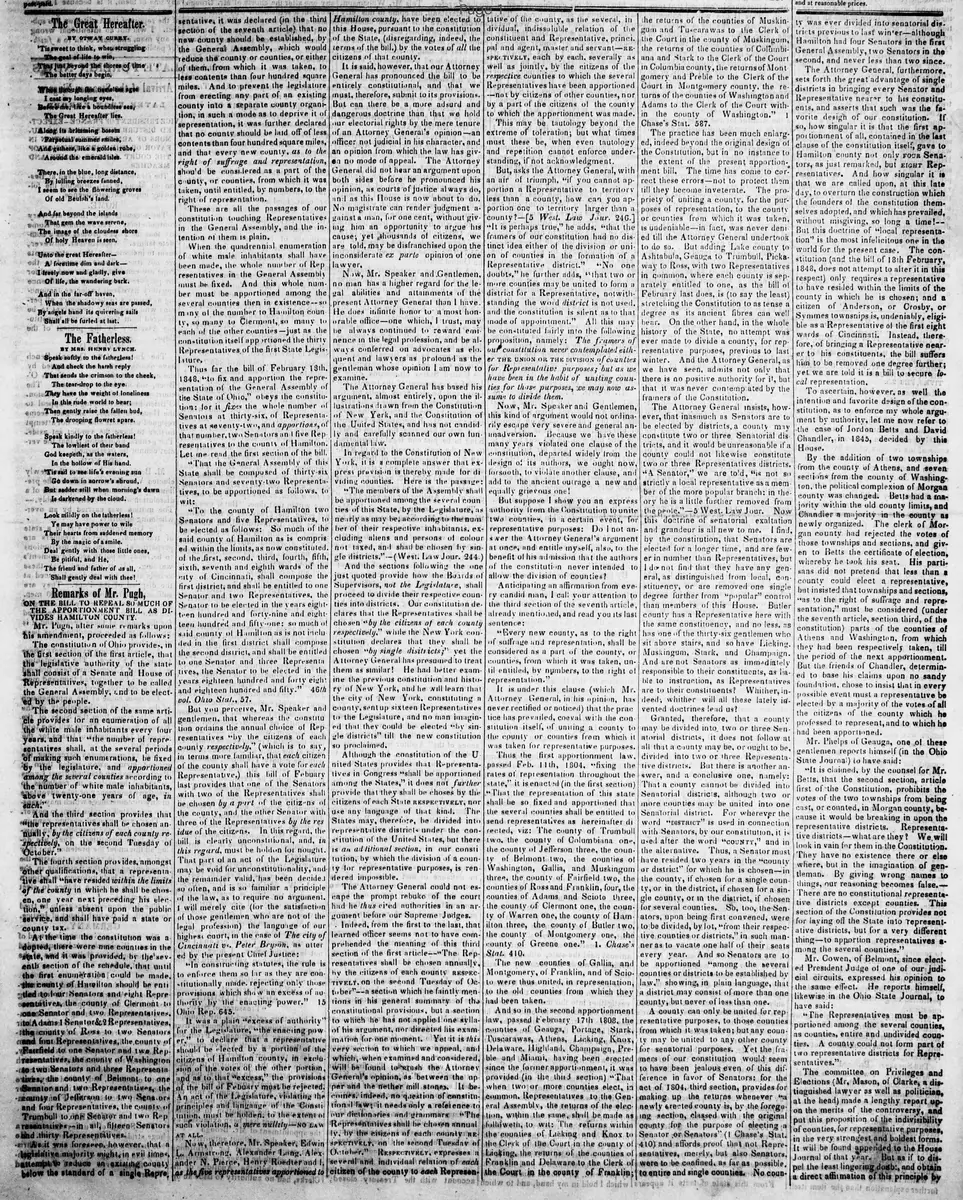
THE APPORTIONMENT BILL AS DIVIDES HAMILTON COUNTY.
Mr. Pugh, after some remarks upon his amendment, proceeded as follows:
The constitution of Ohio provides, in the first section of the first article, that the legislative authority of the state shall consist of a Senate and House of Representatives, together to be called the General Assembly, and to be elected by the people.
The second section of the same article provides for an enumeration of all the white male inhabitants every four years, and that "the number of representatives shall, at the several periods of making such enumerations, be fixed by the legislature, and apportioned among the several counties according to the number of white male inhabitants, above twenty-one years of age, in each."
And the third section provides that the representatives shall be chosen annually, by the citizens of each county respectively, on the second Tuesday of October.
The fourth section provides, amongst other qualifications, that a representative shall "have resided within the limits of the county in which he shall be chosen, one year next preceding his election," unless absent upon the public service, and shall have paid a state or county tax.
At the time the constitution was adopted, there were nine counties in the state, and it was provided, by the seventh section of the schedule, that until the first enumeration could be made, the county of Hamilton should be entitled to four Senators and eight Representatives, the county of Clermont to one Senator and two Representatives, to Adams one Senator & 2 Representatives, the county of Ross to two Senators and four Representatives, the county of Fairfield to one Senator and two Representatives, the county of Washington to two Senators and three Representatives, the county of Belmont to one Senator and two Representatives, the county of Jefferson as one Senator and four Representatives, the county of Trumbull to one Senator and two Representatives.
As it was foreseen, however, that a legislative majority might in evil times attempt to reduce any existing county below the standard of a single Representative, it was declared (in the third section of the seventh article) that no new county should be established, by the General Assembly, which would reduce the county or counties, or either of them, from which it was taken, to less contents than four hundred square miles. And to prevent the legislature from erecting any part of an existing county into a separate county organization, in such a mode as to deprive it of representation, it was further declared that no county should be laid off of less contents than four hundred square miles, and that every new county, as to the right of suffrage and representation, should be considered as a part of the county, or counties, from which it was taken, until entitled, by numbers, to the right of representation.
These are all the passages of our constitution touching Representatives in the General Assembly, and the intention of them is plain.
When the quadrennial enumeration of white male inhabitants shall have been made, the whole number of Representatives in the General Assembly must be fixed. And this whole number must be apportioned among the several counties then in existence—so many of the number to Hamilton county, so many to Clermont, so many to each of the other counties—just as the constitution itself apportioned the thirty Representatives of the first State Legislature.
Thus far the bill of February 13th, 1848, "to fix and apportion the representation of the General Assembly of the State of Ohio," obeys the constitution: for it fixes the whole number of Senators at thirty-six, of Representatives at seventy-two, and apportions, of that number, two Senators and five Representatives to the county of Hamilton.
Let me read the first section of the bill.
"That the General Assembly of this State shall be composed of thirty-six Senators and seventy-two Representatives, to be apportioned as follows, to wit:
"To the county of Hamilton two Senators and five Representatives, to be elected as follows: So much of the said county of Hamilton as is comprised within the limits, as now constituted, of the first, second, third, fourth, fifth, sixth, seventh and eighth wards of the city of Cincinnati, shall compose the first district, and shall be entitled to one Senator and two Representatives, the Senator to be elected in the years eighteen hundred and forty-nine and eighteen hundred and fifty-one: so much of said county of Hamilton as is not included in the first district shall compose the second district, and shall be entitled to one Senator and three Representatives, the Senator to be elected in the years eighteen hundred and forty-eight and eighteen hundred and fifty." 46th vol. Ohio Stat., 57.
But you perceive, Mr. Speaker and gentlemen, that whereas the constitution ordains the annual choice of Representatives "by the citizens of each county respectively." (which is to say, in terms more familiar, that each citizen of the county shall have a vote for each Representative,) this bill of February last provides that one of the Senators with two of the Representatives shall be chosen by a part of the citizens of the county, and the other Senator with three of the Representatives by the residue of the citizens. In this regard, the bill is clearly unconstitutional, and, in this regard, must be holden for nought.
That part of an act of the Legislature may be void for unconstitutionality, and the remainder valid, has been decided so often, and is so familiar a principle of the law, as to require no argument. I will merely cite (for the satisfaction of those gentlemen who are not of the legal profession) the language of our highest court, in the case of The city of Cincinnati vs. Peter Bryson, as cited by the present Chief Justice:
"In constructing statutes, the rule is to enforce them so far as they are constitutionally made, rejecting only those provisions which show an excess of authority by the enacting power."
15 Ohio Rep. 645.
It was a plain "excess of authority" for the Legislature, the enacting power, to declare that a representative should be elected by a portion of the citizens of Hamilton county, in exclusion of the votes of the other portion; and as to that "excess," the provisions of the bill of February must be rejected.
An act of the Legislature, violating the principles and language of the Constitution, must be holden, to the extent of such violation, a mere nullity. No LAW AT ALL.
Now, therefore, Mr. Speaker, Edwin L. Armstrong, Alexander Lang, Alexander N. Pierce, Henry Roedler and J. [illegible] have been elected Representatives apportioned to Hamilton county, have been elected to this House, pursuant to the constitution of the State, (disregarding, indeed, the terms of the bill,) by the votes of all the citizens of that county.
It is said, however, that our Attorney General has pronounced the bill to be entirely constitutional, and that we must, therefore, submit to its provisions. But can there be a more absurd and dangerous doctrine than that we hold our electoral rights by the mere tenure of an Attorney General's opinion—an officer not judicial in his character, and an opinion from which the law has given no mode of appeal. The Attorney General did not hear an argument upon both sides before he pronounced his opinion, as courts of justice always do, and as this House is now about to do. No magistrate can render judgment against a man, for one cent, without giving him an opportunity to argue his cause; yet thousands of citizens, we are told, may be disfranchised upon the inconsiderate ex parte opinion of one lawyer.
Now, Mr. Speaker and Gentlemen, no man has a higher regard for the legal abilities and attainments of the present Attorney General than I have. He does infinite honor to a most honorable office—one which, I trust, may be always continued to reward eminence in the legal profession, and be always conferred on advocates as eloquent and lawyers as profound as the gentleman whose opinion I am now to examine.
The Attorney General has based his argument, almost entirely, upon the illustrations drawn from the Constitution of New York, and the Constitution of the United States, and has not candidly and carefully scanned our own fundamental law.
In regard to the Constitution of New York, it is a complete answer that express provision is thereby made for dividing counties. Here is the passage:
"The members of the Assembly shall be apportioned among the several counties of this State, by the Legislature, as nearly as may be, according to the number of their respective inhabitants, excluding aliens and persons of colour not taxed, and shall be chosen by single districts."
—(West. Law Jour. 244.)
And the sections following the one just quoted provide how the Boards of Supervisors, not the Legislature, shall proceed to divide their respective counties into districts. Our constitution declares that the Representatives shall be chosen "by the citizens of each county respectively," while the New York constitution declares that they shall be chosen "by single districts;" yet the Attorney General has presumed to treat them as similar! He had better examine the previous constitution and history of New York, and he will learn that the city of New York, constituting a county, sent up sixteen Representatives to the Legislature, and no man imagined that they could be elected "by single districts" till the new constitution so proclaimed.
Although the constitution of the United States provides that Representatives in Congress "shall be apportioned among the States," it does not further provide that they shall be chosen by the citizens of each State respectively, nor use any language of that kind. The States may, therefore, be divided into representative districts under the constitution of the United States, but there is an additional section, in our constitution, by which the division of a county for representative purposes, is rendered impossible.
The Attorney General could not escape the prompt rebuke of the court had he thus cited authorities in an argument before our Supreme Judges. Indeed, from the first to the last, that learned officer seems not to have comprehended the meaning of this third section of the first article—"The Representatives shall be chosen annually, by the citizens of each county respectively, on the second Tuesday of October"—a section which he faintly mentions in his general summary of the constitutional provisions, but a section to which he has not applied one syllable of his argument, nor directed his examination for one moment. Yet it is this very section to which we appeal, and which, when examined and considered, will be found to crush the Attorney General's opinion, as between the upper and the nether mill-stones. It becomes, indeed, no question of constitutional law; it needs only a reference to our dictionaries and grammars. The Representatives shall be chosen annually, by the citizens of each county respectively, on the second Tuesday of October—respectively, expresses in several and individual relation of each citizen of the county to each Representative of the county, as the several, individual, indissoluble relation of the constituent and Representative, principal and agent, master and servant—RESPECTIVELY, each by each, severally as well as jointly, by the citizens of the respective counties to which the several Representatives have been apportioned—not by citizens of other counties, nor by a part of the citizens of the county to which the apportionment was made.
This may be tautology beyond the extreme of toleration; but what times must these be, when even tautology and repetition cannot enforce understanding, if not acknowledgment.
But, asks the Attorney General, with an air of triumph, "if you cannot apportion a Representative to territory less than a county, how can you apportion one to territory larger than a county?"
—[5 West. Law Jour. 246.]
"It is perhaps true," he adds, "that the framers of our constitution had no distinct idea either of the division or union of counties in the formation of a Representative district." "No one doubts," he further adds, "that two or more counties may be united to form a district for a Representative, notwithstanding the word district is not used, and the constitution is silent as to that mode of appointment." All this may be conceded fairly into the following proposition, namely: The framers of our constitution never contemplated either THE UNION OR THE DIVISION OF COUNTIES for Representative purposes; but as we have been in the habit of uniting counties for those purposes, we may now assume to divide them.
Now, Mr. Speaker and Gentlemen, this kind of argument would not ordinarily escape very severe and general animadversion. Because we have these many years violated one clause of the constitution, departed widely from the design of its authors, we ought now, forsooth, to violate another clause, and add to the ancient outrage a new and equally grievous one!
But suppose I show you an express authority from the Constitution to unite two counties, in a certain event, for representative purposes: Do I not answer the Attorney General's argument at once, and entitle myself, also, to the benefit of his admission that the authors of the constitution never intended to allow the division of counties?
Anticipating an affirmation from every candid man, I call your attention to the third section of the seventh article, already mentioned, and read you its last sentence:
"Every new county, as to the right of suffrage and representation, shall be considered as a part of the county, or counties, from which it was taken, until entitled, by numbers, to the right of representation."
It is under this clause (which Mr. Attorney General, in his opinion, has never rectified or noticed) that the practice has prevailed, coeval with the constitution itself, of uniting a county to the county or counties from which it was taken for representative purposes.
Thus the first apportionment law, passed Feb. 11th, 1804, "fixing the rates of representation throughout the state," it is enacted (in the first section) "That the representation of this state shall be so fixed and apportioned that the several counties shall be entitled to send representatives as hereinafter directed, viz: The county of Trumbull two, the county of Columbiana one, the county of Jefferson three, the county of Belmont two, the counties of Washington, Gallia, and Muskingum three, the county of Fairfield two, the counties of Ross and Franklin, four, the counties of Adams and Scioto three, the county of Clermont one, the county of Warren one, the county of Hamilton three, the county of Butler two, the county of Montgomery one, the county of Greene one." 1. Chase's Stat. 410.
The new counties of Gallia, and Montgomery, of Franklin, and of Scioto, were thus united, in representation, to the old counties from which they had been taken.
And so in the second apportionment law, passed February 17th 1808, the counties of Geauga, Portage, Stark, Tuscarawas, Athens, Licking, Knox, Delaware, Highland, Champaign, Preble and Miami, having been erected since the former apportionment, it was provided (in the third section) "That when two or more counties elect, in common, Representatives to the General Assembly, the returns of the election, within the same, shall be made as followeth, to wit: The returns within the counties of Licking and Knox to the Clerk of the Court in the county of Licking, the returns of the counties of Franklin and Delaware to the Clerk of the Court in the county of Franklin; the returns of the counties of Muskingum and Tuscarawas to the Clerk of the Court in the county of Muskingum, the returns of the counties of Columbiana and Stark to the Clerk of the Court in Columbia county, the returns of Montgomery and Preble to the Clerk of the Court in Montgomery county, the returns of the counties of Washington and Adams to the Clerk of the Court within the county of Washington." Chase's Stat. 587.
The practice has been much enlarged, indeed beyond the original design of the Constitution, but in no instance to the extent of the present apportionment bill. The time has come to correct these errors—not to protect them till they become inveterate. The propriety of uniting a county, for the purposes of representation, to the county or counties from which it was taken, is undeniable—in fact, was never denied till the Attorney General undertook to do so. But adding Lake county to Ashtabula, Geauga to Trumbull, Pickaway to Ross, with two Representatives in common, where each county is separately entitled to one, as the bill of February last does, is (to say the least) stretching the Constitution to as tense a degree as its ancient fibres can well bear. On the other hand, in the whole history of the State, no attempt was ever made to divide a county, for representative purposes, previous to last winter. And the Attorney General, as we have seen, admits not only that there is no positive authority for it, but that it was never contemplated by the framers of the Constitution.
The Attorney General insists, however, that inasmuch as Senators are to be elected by districts, a county may constitute two or three Senatorial districts, and it would be unreasonable if a county could not likewise constitute two or three Representatives districts. "A Senator," we are told, "is not so strictly a local representative as a member of the more popular branch: in theory he is a little further removed from the people."
—5 West. Law Jour. Now this doctrine of senatorial exaltation and grandeur is all new to me. I find, by the constitution, that Senators are elected for a longer time, and are fewer in number than Representatives, but I do not find that they have any general, as distinguished from local, constituency, or are removed one single degree further from "popular" control than members of this House. Butler county has a Representative here with the same constituency, and no less, as has one of the thirty-six gentlemen who sit above stairs, and so have Licking, Muskingum, Stark, and Champaign. And are not Senators as immediately responsible to their constituents, as liable to instruction, as Representatives are to their constituents? Whither, indeed; whither will all these lately invented doctrines lead us?
Granted, therefore, that a county may be divided into two or three Senatorial districts, it does not follow at all that a county may be, or ought to be, divided into two or three Representative districts. But there is another answer, and a conclusive one, namely: That a county cannot be divided into Senatorial districts, although two or more counties may be united into one Senatorial district. For wherever the word "DISTRICT" is used in connection with Senators, by our constitution, it is used after the word "county," and in the alternative. Thus, a Senator must have resided two years in the "county or district" for which he is chosen—in the county, if chosen for a single county, or in the district, if chosen for several counties. So, too, the Senators, upon being first convened, were to be divided, by lot, "from their respective counties or districts," in such manner as to vacate one half of their seats every year. And so Senators are to be apportioned "among the several counties or districts to be established by law." showing, in plain language, that a district may consist of more than one county, but never of less than one.
A county can only be united for representative purposes, to those counties from which it was taken; but any county may be united to any other county for senatorial purposes. Yet the framers of our constitution would seem to have been jealous even of this difference in favor of Senators: for the act of 1804, third section, provides for making up the returns whenever a newly erected county is, by the foregoing section, classed with the original county for the purpose of electing a Senator or Senators" (1 Chase's Stat. 410) and affords proof that not Representatives, merely, but also Senators were to be confined, as far as possible, to entire and single counties. No county was ever divided into senatorial districts previous to last winter—although Hamilton had four Senators in the first General Assembly, two Senators in the second, and never less than two since.
The Attorney General, furthermore, sets forth the great advantage of single districts in bringing every Senator and Representative nearer to his constituents, and asserts that such was the favorite design of our constitution. If so, how singular it is that the first apportionment of all, contained in the last clause of the constitution itself, gave to Hamilton county not only four Senators, as just remarked, but eight Representatives. And how singular it is that we are called upon, at this late day, to overturn the construction which the founders of the constitution themselves adopted, and which has prevailed, without misgiving, so long a time!
—
But this doctrine of "local representation" is the most infelicitous one in the world for the present case. The constitution (and the bill of 18th February, 1848, does not attempt to alter it in this respect) only requires a representative to have resided within the limits of the county in which he is chosen; and a citizen of Anderson, or Crosby, or Symmes townships is, undeniably, eligible as a Representative of the first eight wards of Cincinnati. Instead, therefore, of bringing a Representative nearer to his constituents, the bill suffers him to be removed one degree further; yet we are told it is a bill to secure local representation.
To ascertain, however, as well the intention and favorite design of the constitution, as to enforce my whole argument by authority, let me now refer to the case of Jordon Betts and David Chandler, in 1845, decided by this House.
By the addition of two townships from the county of Athens, and seven sections from the county of Washington, the political complexion of Morgan county was changed. Betts had a majority within the old county limits, and Chandler a majority in the county as newly organized. The clerk of Morgan county had rejected the votes of those townships and sections, and given to Betts the certificate of election, whereby he took his seat. His partisans did not pretend that less than a county could elect a representative, but insisted that townships and sections, "as to the right of suffrage and representation," must be considered (under the seventh article, section third, of the constitution) parts of the counties of Athens and Washington, from which they had been respectively taken, till the period of the next apportionment.
But the friends of Chandler, determined to base his claims upon no sandy foundation, chose to insist that in every possible event must a representative be elected by a majority of the votes of all the citizens of the county which he professed to represent, and to which he had been apportioned.
Mr. Ihelps of Geauga, one of these gentlemen reports himself (in the Ohio State Journal) to have said:
…It is claimed, by the counsel for Mr. Betts, that the second section, article first of the Constitution, prohibits the votes of the two townships from being cast, or counted, in Morgan county, because it would be breaking in upon the representative districts. Representative districts—what are they? We will look in vain for them in the Constitution. They have no existence there or elsewhere, but in the imagination of gentleman. By giving wrong names to things, our reasoning becomes false. There are no constitutional representative districts except counties. This section of the Constitution provides not for laying off the State into representative districts, but for a very different thing—to apportion representatives among the several counties."
Mr. Cowen, of Belmont, since elected President Judge of one of our judicial circuits, expressed his opinion to the same effect. He reports himself, likewise in the Ohio State Journal, to have said:
"The Representatives must be apportioned among the several counties, as counties, entire and undivided counties. A county could not form part of two representative districts for Representatives."
The committee on Privileges and Elections (Mr. Mason, of Clarke, a distinguished lawyer as well as politician, at the head) made a lengthy report upon the merits of the controversy, and put this proposition of the indivisibility of counties, for representative purposes, in the very strongest and boldest forms. It will be found appended to the House Journal of that year. But as if to dispel the least lingering doubt, and obtain a direct affirmation of this principle by
In the House, the committee asked and obtained leave to amend the report (just as the case was taken up for division) by inserting a long paragraph from which (64th House Journal, 154) I have selected the following passages:
"Counties are expressly made election districts by the third section of the first article of the constitution. To suppose that the territory of a county may be more or less in extent than election district, is to suppose a constitutional impossibility; for wherever there is a county, there is also an election district bearing the same name, and having the same extent of territory. Whatever territory may be included within the limits established of the county, at any time, that county, so formed, is an election district."
"Counties, as such, are election districts according to the constitution."
And the House of Representatives, sitting to judge of the election of its members, confirmed every word of this report by deciding that Jordon Betts was no longer entitled to sit, and that Daniel Chandler was entitled to admission." 64th House Journal, 164. Are precedents and adjudged cases of no value? Must it go forth to the people that our law changes with every change of the moon—at least that it is, to-day, expounded thus for partisan aggrandizement, and to-morrow, for a like purpose, differently expounded? Is justice, by respecting persons, to become injustice—to give one rule to the democrats, and another rule, less burdensome, to the whigs?
At this point Mr. Pugh gave way for a recess.
[TO BE CONTINUED.]
What sub-type of article is it?
What themes does it cover?
What keywords are associated?
What entities or persons were involved?
Where did it happen?
Story Details
Key Persons
Location
Hamilton County, Ohio
Event Date
1848
Story Details
Mr. Pugh argues in the Ohio legislature that the February 13, 1848, apportionment bill unconstitutionally divides Hamilton County into two districts for electing senators and representatives, violating the Ohio Constitution's requirement that representatives be chosen by all citizens of each county respectively. He cites constitutional provisions, historical apportionments, judicial precedents, and refutes the Attorney General's opinion supporting the bill.