Thank you for visiting SNEWPapers!
Sign up free
Literary
May 24, 1787
The New York Journal, And Weekly Register
New York, New York County, New York
What is this article about?
At a February 23, 1787, meeting of the Society for Constitutional Information in London, they resolve to record and publish an extract from John Adams's 'Defence of the Constitutions of Government of the United States of America' (1787), which argues the superiority of free governments over simple monarchies due to better communication, checks on power, and national energy.
Clipping
OCR Quality
97%
Excellent
Full Text
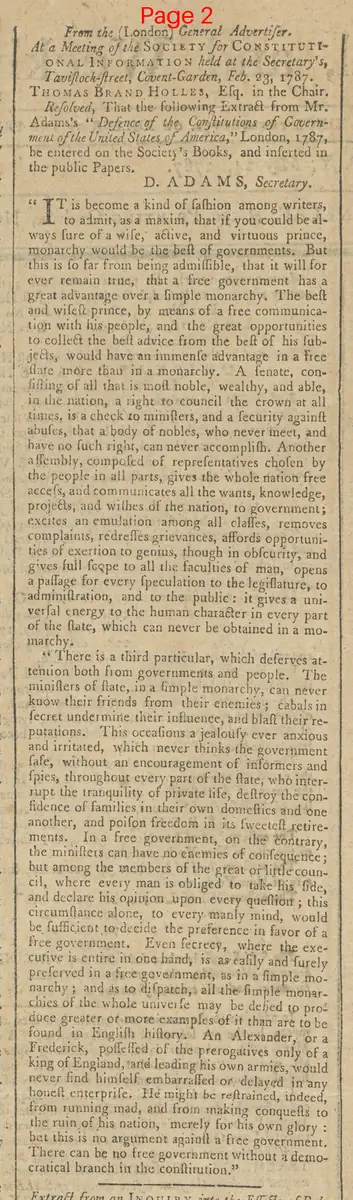
From the (London) General Advertiser.
At a Meeting of the SOCIETY for CONSTITUTIONAL INFORMATION held at the Secretary's, Tavistock-street, Covent-Garden, Feb. 23, 1787.
THOMAS BRAND HOLLES, Esq. in the Chair.
Resolved, That the following Extract from Mr. Adams's "Defence of the Constitutions of Government of the United States of America," London, 1787, be entered on the Society's Books, and inserted in the public Papers.
D. ADAMS, Secretary.
"IT is become a kind of fashion among writers, to admit, as a maxim, that if you could be always sure of a wise, active, and virtuous prince, monarchy would be the best of governments. But this is so far from being admissible, that it will for ever remain true, that a free government has a great advantage over a simple monarchy. The best and wisest prince, by means of a free communication with his people, and the great opportunities to collect the best advice from the best of his subjects, would have an immense advantage in a free state more than in a monarchy. A senate, consisting of all that is most noble, wealthy, and able, in the nation, a right to council the crown at all times, is a check to ministers, and a security against abuses, that a body of nobles, who never meet, and have no such right, can never accomplish. Another assembly, composed of representatives chosen by the people in all parts, gives the whole nation free access, and communicates all the wants, knowledge, projects, and wishes of the nation, to government; excites an emulation among all classes, removes complaints, redresses grievances, affords opportunities of exertion to genius, though in obscurity, and gives full scope to all the faculties of man, opens a passage for every speculation to the legislature, to administration, and to the public: it gives a universal energy to the human character in every part of the state, which can never be obtained in a monarchy.
"There is a third particular, which deserves attention both from governments and people. The ministers of state, in a simple monarchy, can never know their friends from their enemies; cabals in secret undermine their influence, and blast their reputations. This occasions a jealousy ever anxious and irritated, which never thinks the government safe, without an encouragement of informers and spies, throughout every part of the state, who interrupt the tranquility of private life, destroy the confidence of families in their own domestics and one another, and poison freedom in its sweetest retirements. In a free government, on the contrary, the ministers can have no enemies of consequence; but among the members of the great or little council, where every man is obliged to take his side, and declare his opinion upon every question; this circumstance alone, to every manly mind, would be sufficient to decide the preference in favor of a free government. Even secrecy, where the executive is entire in one hand, is as easily and surely preserved in a free government, as in a simple monarchy; and as to dispatch, all the simple monarchies of the whole universe may be defied to produce greater or more examples of it than are to be found in English history. An Alexander, or a Frederick, possessed of the prerogatives only of a king of England, and leading his own armies, would never find himself embarrassed or delayed in any honest enterprize. He might be restrained, indeed, from running mad, and from making conquests to the ruin of his nation, merely for his own glory: but this is no argument against a free government. There can be no free government without a democratical branch in the constitution."
At a Meeting of the SOCIETY for CONSTITUTIONAL INFORMATION held at the Secretary's, Tavistock-street, Covent-Garden, Feb. 23, 1787.
THOMAS BRAND HOLLES, Esq. in the Chair.
Resolved, That the following Extract from Mr. Adams's "Defence of the Constitutions of Government of the United States of America," London, 1787, be entered on the Society's Books, and inserted in the public Papers.
D. ADAMS, Secretary.
"IT is become a kind of fashion among writers, to admit, as a maxim, that if you could be always sure of a wise, active, and virtuous prince, monarchy would be the best of governments. But this is so far from being admissible, that it will for ever remain true, that a free government has a great advantage over a simple monarchy. The best and wisest prince, by means of a free communication with his people, and the great opportunities to collect the best advice from the best of his subjects, would have an immense advantage in a free state more than in a monarchy. A senate, consisting of all that is most noble, wealthy, and able, in the nation, a right to council the crown at all times, is a check to ministers, and a security against abuses, that a body of nobles, who never meet, and have no such right, can never accomplish. Another assembly, composed of representatives chosen by the people in all parts, gives the whole nation free access, and communicates all the wants, knowledge, projects, and wishes of the nation, to government; excites an emulation among all classes, removes complaints, redresses grievances, affords opportunities of exertion to genius, though in obscurity, and gives full scope to all the faculties of man, opens a passage for every speculation to the legislature, to administration, and to the public: it gives a universal energy to the human character in every part of the state, which can never be obtained in a monarchy.
"There is a third particular, which deserves attention both from governments and people. The ministers of state, in a simple monarchy, can never know their friends from their enemies; cabals in secret undermine their influence, and blast their reputations. This occasions a jealousy ever anxious and irritated, which never thinks the government safe, without an encouragement of informers and spies, throughout every part of the state, who interrupt the tranquility of private life, destroy the confidence of families in their own domestics and one another, and poison freedom in its sweetest retirements. In a free government, on the contrary, the ministers can have no enemies of consequence; but among the members of the great or little council, where every man is obliged to take his side, and declare his opinion upon every question; this circumstance alone, to every manly mind, would be sufficient to decide the preference in favor of a free government. Even secrecy, where the executive is entire in one hand, is as easily and surely preserved in a free government, as in a simple monarchy; and as to dispatch, all the simple monarchies of the whole universe may be defied to produce greater or more examples of it than are to be found in English history. An Alexander, or a Frederick, possessed of the prerogatives only of a king of England, and leading his own armies, would never find himself embarrassed or delayed in any honest enterprize. He might be restrained, indeed, from running mad, and from making conquests to the ruin of his nation, merely for his own glory: but this is no argument against a free government. There can be no free government without a democratical branch in the constitution."
What sub-type of article is it?
Essay
What themes does it cover?
Political
Liberty Freedom
What keywords are associated?
Free Government
Simple Monarchy
Senate
Assembly
Political Liberty
Constitutional Defense
What entities or persons were involved?
Mr. Adams
Literary Details
Title
Defence Of The Constitutions Of Government Of The United States Of America
Author
Mr. Adams
Subject
Advantages Of Free Government Over Simple Monarchy
Key Lines
It Is Become A Kind Of Fashion Among Writers, To Admit, As A Maxim, That If You Could Be Always Sure Of A Wise, Active, And Virtuous Prince, Monarchy Would Be The Best Of Governments.
But This Is So Far From Being Admissible, That It Will For Ever Remain True, That A Free Government Has A Great Advantage Over A Simple Monarchy.
There Can Be No Free Government Without A Democratical Branch In The Constitution.