Thank you for visiting SNEWPapers!
Sign up free
Atlanta Daily World
Atlanta, Fulton County, Georgia
What is this article about?
U.S. Supreme Court hears cases from Georgia and Louisiana challenging systematic exclusion of Black men from juries in rape trials leading to death sentences, focusing on fair trial rights and jury commissioner selection.
Merged-components note: Continuation of the story 'Cases Heard Involve Georgia, Louisiana' from page 1 to page 2.
Clippings
1 of 2
OCR Quality
Full Text
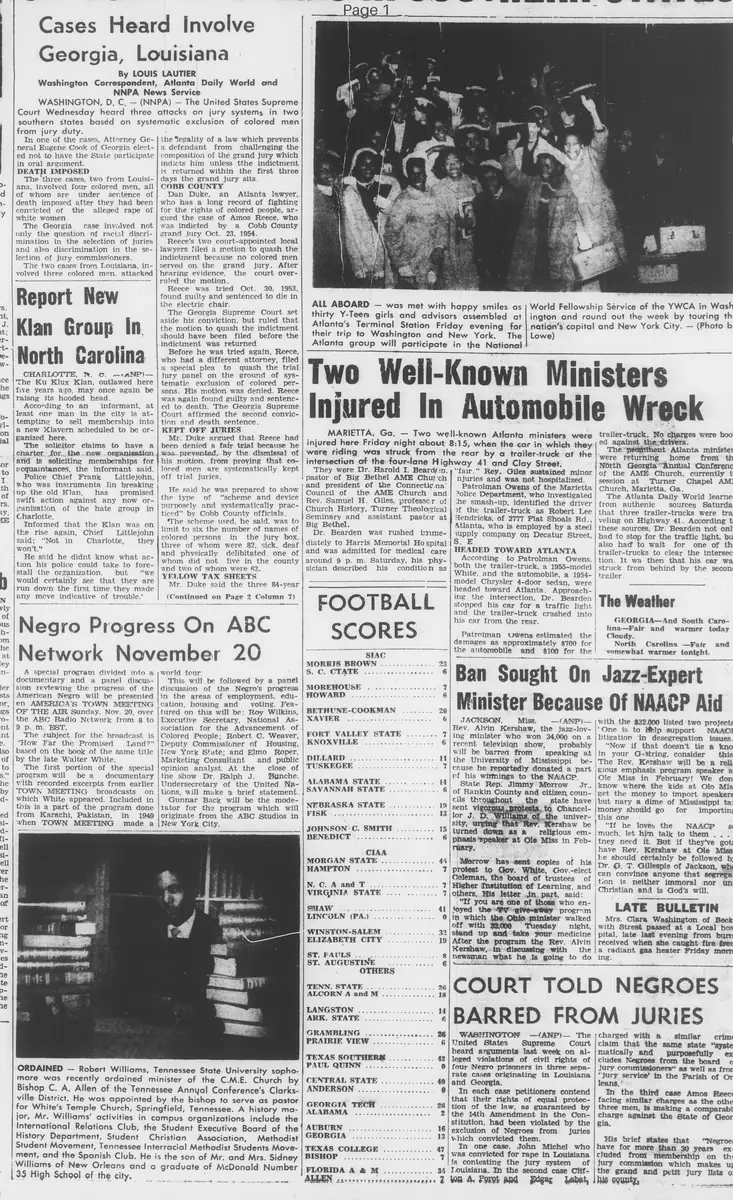
By LOUIS LAUTIER
Washington Correspondent, Atlanta Daily World and NNPA News Service
WASHINGTON, D. C. - (NNPA) - The United States Supreme Court Wednesday heard three attacks on jury systems in two southern states based on systematic exclusion of colored men from jury duty.
In one of the cases, Attorney General Eugene Cook of Georgia elected not to have the State participate in oral argument.
DEATH IMPOSED
The three cases, two from Louisiana, involved four colored men, all of whom are under sentence of death imposed after they had been convicted of the alleged rape of white women.
The Georgia case involved not only the question of racial discrimination in the selection of juries and also discrimination in the selection of jury commissioners.
The two cases from Louisiana, involved three colored men, attacked the legality of a law which prevents a defendant from challenging the composition of the grand jury which indicts him unless the indictment is returned within the first three days the grand jury sits.
COBB COUNTY
Dan Duke, an Atlanta lawyer, who has a long record of fighting for the rights of colored people, argued the case of Amos Reece, who was indicted by a Cobb County grand jury Oct. 23, 1954.
Reece's two court-appointed local lawyers filed a motion to quash the indictment because no colored men served on the grand jury. After hearing evidence, the court overruled the motion.
Reece was tried Oct. 30, 1953, found guilty and sentenced to die in the electric chair.
The Georgia Supreme Court set aside his conviction, but ruled that the motion to quash the indictment should have been filed before the indictment was returned.
Before he was tried again, Reece, who had a different attorney, filed a special plea to quash the trial jury panel on the ground of systematic exclusion of colored persons. His motion was denied. Reece was again found guilty and sentenced to death. The Georgia Supreme Court affirmed the second conviction and death sentence.
KEPT OFF JURIES
Mr. Duke argued that Reece had been denied a fair trial because he was prevented, by the dismissal of his motion, from proving that colored men are systematically kept off trial juries.
He said he was prepared to show the type of "scheme and device purposely and systematically practiced" by Cobb County officials.
The scheme used, he said, was to limit to six the number of names of colored persons in the jury box, three of whom were 82, sick, deaf and physically debilitated, one of whom did not live in the county and two of whom were 62.
YELLOW TAX SHEETS
Mr. Duke said the three 84-year (Continued on Page 2 Column 7)
Cases Heard (Continued From Page One)
old colored men were selected by the jury commissioners from the yellow tax sheets in the tax collector's office, on which tax returns of colored people are kept. The jury box contained 2,500 names.
In a brief filed in the case, Cook and his assistants called "novel" the contention that Reece should have been permitted to prove as an element in the pattern of discrimination that there were at least 100 colored persons qualified to act as jury commissioners.
Mr. Duke argued that the presence of qualified colored persons on jury commissions in areas where colored people constitute a large segment of the population will obtain an objective compliance with the legal requirement of no racial discrimination in the selection of juries.
The mores of the people and the patterns of thought in the South, he said, will prevent objective selection of colored persons for participation in the administration of justice as jurors and grand jurors so long as qualified colored persons are excluded from member on jury commissions.
What sub-type of article is it?
What themes does it cover?
What keywords are associated?
What entities or persons were involved?
Where did it happen?
Story Details
Key Persons
Location
Washington, D.C.; Cobb County, Georgia; Louisiana
Event Date
Oct. 23, 1954; Oct. 30, 1953
Story Details
The U.S. Supreme Court heard three cases challenging racial discrimination in jury selection in Georgia and Louisiana. In the Georgia case, Amos Reece, convicted of rape and sentenced to death, argued systematic exclusion of colored men from juries and jury commissioners. Louisiana cases involved similar issues for three colored men under death sentences for rape.