Thank you for visiting SNEWPapers!
Sign up free
Phenix Gazette
Alexandria, Virginia
What is this article about?
Reports from Paris, October 1830, detail crowds demanding death to ex-Ministers, dispersed by National Guard. King Louis Philippe addresses crowds and Guard, praising their role in maintaining order amid post-revolution unrest. Prefect urges calm; 136 arrested.
Clipping
OCR Quality
Full Text
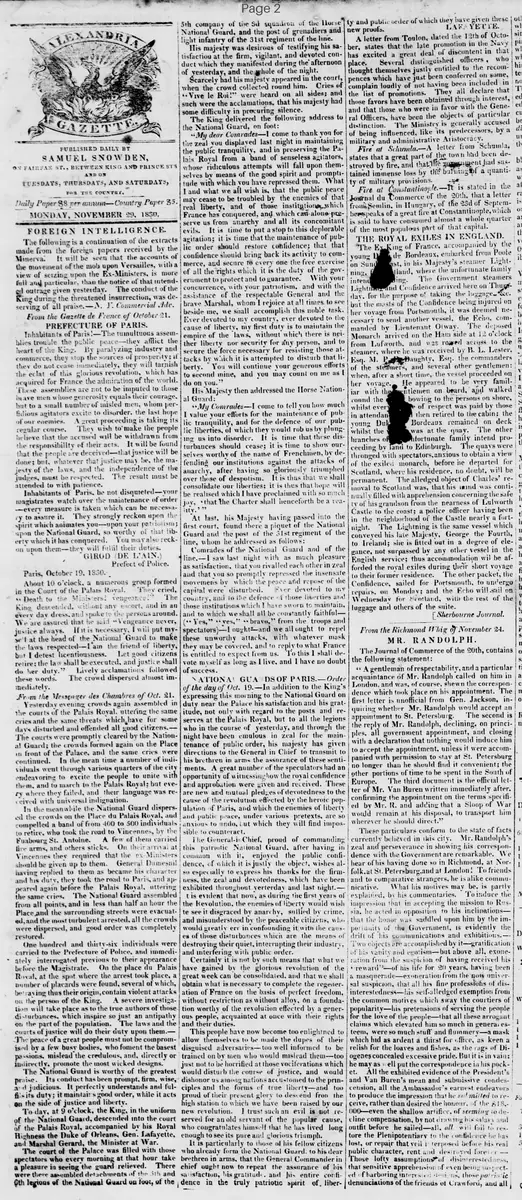
The following is a continuation of the extracts made from the foreign papers received by the Minerva.
It will be seen that the accounts of the movement of the mob upon Versailles, with a view of seizing upon the Ex-Ministers, is more full and particular, than the notice of that intended outrage given yesterday. The conduct of the King during the threatened insurrection, was deserving of all praise.—N. Y. Commercial Adv.
From the Gazette de France of October 21.
PREFECTURE OF PARIS.
Inhabitants of Paris!—The tumultuous assemblies trouble the public peace—they afflict the heart of the King. By paralyzing industry and commerce, they stop the sources of prosperity; if they do not cease immediately, they will tarnish the eclat of this glorious revolution, which has acquired for France the admiration of the world.
These assemblies are not to be imputed to those brave men whose generosity equals their courage, but to a small number of misled men, whom perfidious agitators excite to disorder, the last hope of our enemies. "A great proceeding is taking its regular course. They wish to make the people believe that the accused will be withdrawn from the responsibility of their acts. It will be found that the people are deceived—that justice will be done: but, whatever that justice may be, the majesty of the laws, and the independence of the judges, must be respected. The result must be attended to with patience."
Inhabitants of Paris, be not disquieted—your magistrates watch over the maintenance of order—every measure is taken which can be necessary to assure it. They strongly reckon upon the spirit which animates you—upon your patriotism; upon the National Guard, so worthy of that liberty which it has conquered. You may also reckon on upon them—they will fulfil their duties.
GIROD (DE L'AIN.)
Prefect of Police.
Paris, October 19, 1830.
About 10 o'clock, a numerous group formed in the Court of the Palais Royal. They cried, "Death to the Ministers! vengeance!" The King descended, without any escort, and in an every day dress, and spoke to the persons around. We are assured that he said "Vengeance never, justice always. If it is necessary, I will put myself at the head of the National Guard to make the laws respected—I am the friend of liberty, but I detest licentiousness. Let good citizens retire: the law shall be executed, and justice shall do her duty."
Lively acclamations followed these words. The crowd dispersed almost immediately.
From the Messenger des Chambres of Oct. 21.
Yesterday evening crowds again assembled in the courts of the Palais Royal, uttering the same cries and the same threats which have for some days disturbed and offended all good citizens.—The courts were promptly cleared by the National Guard; the crowds formed again on the Place in front of the Palace, and the same cries were continued. In the mean time a number of individuals went through various quarters of the city endeavoring to excite the people to unite with them, and to march to the Palais Royal; but every where they failed, and their language was received with universal indignation.
In the mean while the National Guard dispersed the crowds on the Place du Palais Royal, and compelled a band of from 400 to 500 individuals to retire, who took the road to Vincennes, by the Faubourg St. Antoine. A few of them carried fire arms, and others sticks. On their arrival at Vincennes they required that the ex-Ministers should be given up to them. General Dumesnil having replied to them as became his character and his duty, they took the road to Paris, and appeared again before the Palais Royal, uttering the same cries. The National Guard assembled from all points, and in less than half an hour the Place and the surrounding streets were evacuated, and the most turbulent arrested, all the crowds were dispersed, and good order was completely restored.
One hundred and thirty-six individuals were carried to the Prefecture of Police, and immediately interrogated previous to their appearance before the Magistrate. On the place du Palais Royal, at the spot where the arrest took place, a number of placards were found, several of which, betraying thus their origin, contain violent attacks on the person of the King. A severe investigation will take place as to the true authors of those disturbances, which inspire so just an antipathy on the part of the population. The laws and the courts of justice will do their duty upon them.—The peace of a great people must not be compromised by a few busy bodies, who foment the basest passions, mislead the credulous, and, directly or indirectly, promote the most wicked designs.
The National Guard is worthy of the greatest praise. Its conduct has been prompt, firm, wise, and judicious. It perfectly understands and fulfils its duty: it maintains good order, while it acts on the side of justice and liberty.
To-day, at 9 o'clock, the King, in the uniform of the National Guard, descended into the court of the Palais Royal, accompanied by his Royal Highness the Duke of Orleans, Gen. Lafayette, and Marshal Gerard, the Minister at War.
The court of the Palace was filled with those spectators who every morning at that hour take a pleasure in seeing the guard relieved. There were there assembled detachments of the 5th and 6th legions of the National Guard on foot, of the 5th company of the 2d squadron of the Horse National Guard, and the post of grenadiers and light infantry of the 31st regiment of the line.
His majesty was desirous of testifying his satisfaction at the firm, vigilant, and devoted conduct which they manifested during the afternoon of yesterday, and the whole of the night.
Scarcely had his majesty appeared in the court, when the crowd collected round him. Cries of "Vive le Roi!" were heard on all sides; and such were the acclamations, that his majesty had some difficulty in procuring silence.
The King delivered the following address to the National Guard, on foot:
"My dear Comrades—I come to thank you for the zeal you displayed last night in maintaining the public tranquility, and in preserving the Palais Royal from a band of senseless agitators, whose ridiculous attempts will fall upon themselves by means of the good spirit and promptitude with which you have repressed them. What I and what we all wish is, that the public peace may cease to be troubled by the enemies of that real liberty, and of those institutions which France has conquered, and which can alone preserve us from anarchy and all its concomitant evils. It is time to put a stop to this deplorable agitation; it is time that the maintenance of public order should restore confidence; that that confidence should bring back its activity to commerce, and secure to every one the free exercise of all the rights which it is the duty of the government to protect and to guarantee. With your concurrence, with your patriotism, and with the assistance of the respectable General and the brave Marshal, whom I rejoice at all times to see beside me, we shall accomplish this noble task. Ever devoted to my country, ever devoted to the cause of liberty, my first duty is to maintain the empire of the laws, without which there is neither liberty nor security for any person, and to secure the force necessary for resisting those attacks by which it is attempted to disturb that liberty. "You will continue your generous efforts to second mine, and you may count on me as I do on you."
His Majesty then addressed the Horse National Guard:
"My Comrades—I come to tell you how much I value your efforts for the maintenance of public tranquility, and for the defence of our public liberties, of which they would rob us by plunging us into disorder. It is time that these disturbances should cease: it is time to show ourselves worthy of the name of Frenchmen, by defending our institutions against the attacks of anarchy, after having so gloriously triumphed over those of despotism. It is thus that we shall consolidate our liberties: it is thus that hope will be realized which I have proclaimed with so much joy, that the Charter shall henceforth be a reality."
At last, his Majesty having passed into the first court, found there a piquet of the National Guard and the post of the 31st regiment of the line, whom he addressed as follows:
"Comrades of the National Guard and of the line.—I saw last night with as much pleasure as satisfaction, that you rivalled each other in zeal and that you so promptly repressed the insensate movements by which the peace and repose of the capital were disturbed. Ever devoted to my country, and to the defence of those liberties and those institutions which I have sworn to maintain, and to which we shall all be constantly faithful—("Yes," "yes," "bravo," from the troops and spectators)—I ought—and we all ought to repel these unworthy attacks, with whatever mask they may be covered, and to reply to what France is entitled to expect from us. To this I shall devote myself as long as I live, and I have no doubt of success."
NATIONAL GUARDS OF PARIS.—Order of the day of Oct. 19.—In addition to the King's expressing this morning to the National Guard on duty near the Palace his satisfaction and his gratitude, not only with regard to the posts and reserves at the Palais Royal, but to all the legions who in the course of yesterday, and through the night have been emulous in zeal for the maintenance of public order, his majesty has given directions to the General in Chief to transmit to his brethren in arms the assurance of these sentiments. A great number of the speculators had an opportunity of witnessing how the royal confidence and approbation were given and received. These are new and mutual pledges of devotedness to the cause of the revolution effected by the heroic population of Paris, and which the enemies of liberty and public peace, under various pretexts, are so anxious to undo, but which they will find impossible to counteract.
The General-in-Chief, proud of commanding this patriotic National Guard, after having in common with it, enjoyed the public confidence, of which it is justly the object, wishes also especially to express his thanks for the firmness, the zeal and devotedness, which have been exhibited throughout yesterday and last night.—It is evident that now, as during the first years of the Revolution, the enemies of liberty would wish to see it disgraced by anarchy, sullied by crime, and misunderstood by the peaceable citizens, who would greatly err in confounding it with the causes of those disturbances which are the means of destroying their quiet, interrupting their industry, and interfering with public order.
Certainly it is not by such means that what we have gained by the glorious revolution of the great week can be consolidated, and that we shall obtain what is necessary to complete the regeneration of France on the basis of perfect freedom, without restriction as without alloy, on a foundation worthy of the revolution effected by a generous people, acquainted at once with their rights and their duties.
This people have now become too enlightened to allow themselves to be made the dupes of their disguised adversaries—too well informed to be trained on by men who would mislead them—too just not to be horrified at those vociferations which would disturb the course of justice, and would dishonor us among nations accustomed to the principles and the forms of true liberty—and too proud of their present glory to descend from the high station to which we have been raised by our new revolution. I trust such an evil is not reserved for an old servant of the popular cause, who congratulates himself that he has lived long enough to see its pure and glorious triumph.
It is particularly to those of his fellow citizens who already form the National Guard, to his dear brethren in arms, that the General Commander in chief ought now to repeat the assurance of his satisfaction, his gratitude, and his entire confidence in the truly patriotic spirit of, liberty and public order of which they have given these new proofs.
LAFAYETTE.
What sub-type of article is it?
What keywords are associated?
What entities or persons were involved?
Where did it happen?
Foreign News Details
Primary Location
Paris
Event Date
October 19, 1830
Key Persons
Outcome
crowds dispersed by national guard; 136 individuals arrested and interrogated; order restored; investigation into disturbances and placards attacking the king.
Event Details
Crowds assembled at Palais Royal demanding death to ex-Ministers; King addressed them promoting justice over vengeance, leading to dispersal. Later crowds reformed, marched to Vincennes seeking ex-Ministers but were repelled; returned to Paris and dispersed again by National Guard. King praised Guard's conduct in addresses on October 20. Prefect's proclamation urged calm and respect for law.