Thank you for visiting SNEWPapers!
Sign up free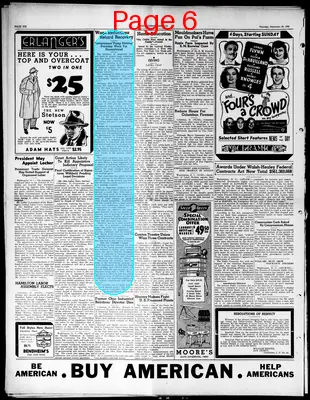
Editorial
September 29, 1938
The Potters Herald
East Liverpool, Columbiana County, Ohio
What is this article about?
The American Federation of Labor editorial warns against wage reductions as a hindrance to business recovery, highlighting how maintained workers' income and timely government 'pump priming' spending have created jobs for 1.54 million and boosted buying power during the 1937-38 depression.
Clipping

OCR Quality
98%
Excellent
Full Text
Wage Reductions Retard Recovery
Government 'Pump Priming' Provides Work For Unemployed
The tendency of employers here and there to impose wage reductions and thus lower the buying power of their employes warrants repeating the strong warning in the American Federation of Labor Monthly Survey of Business against this subversive practice as a definite hindrance to business recovery.
Any movement to slash pay envelope contents, the Federation said, would be thoroughly "against the public interest."
Stressing the fact that although during this depression "business activity fell back to within 18 per cent of the lowest depression level, workers' income has fallen far less and at its lowest 1938 point was still 53 per cent higher than its depression bottom," the Federation added:
"For this we may thank the wage increase of 1937 and the absence of widespread wage cutting in 1938. This reserve of buying power has been a bulwark against further decline. It has taken retailers' stocks of goods off the market and created a healthy basis for the revival now starting * * * The present high level of workers' income will prove a powerful lifting force."
Benefits of Government Spending
Emphasizing the importance of the Government spending program in providing jobs and purchasing power for the unemployed. the Federation said:
"The influence of Federal Government action in stopping the 1937-38 depression is important and because our Government may be of great service to its citizens in preventing future business depressions. it is well worth while to examine its actions and their results in the present circumstances.
"To union members. any action to prevent business depressions and lessen their effects is most important; for in addition to throwing millions of our members out of work, depressions may destroy the wage standard built up through years of careful negotiation and gradual gains.
"Past experience has shown us that 'pump priming' is not effective unless well timed. In the present case however the pump priming seemed to come at a strategic moment.
"Due in important measure to the maintenance of workers' buying power business in early June, 1938, had recovered from much of its depression ill-health and seemed close to the time when it could resume an upward climb toward prosperity. Inventories had been worked off to a large extent, prices were stabilizing. there was no serious price or credit inflation.
"Because our statistics are inadequate however, it was not possible for business men in general to know the state of business health; an atmosphere of gloom had predominated and many had advocated wage cuts.
"Business was as it were poised at the edge of a precipice; widespread wage cuts could have plunged it into further abysses of depression; or growing confidence and the certainty that buying would increase could lift it upward toward prosperity.
"The Government spending program was launched at this critical moment."
Jobs for 1,540,000 Created
Pointing out that although the first effect of the "pump priming" program was reflected in higher stock market prices, the survey said the increasing spirit of optimism in business circles released buying orders and checked the "talk of wage cutting," adding:
"Surveying the progress thus far made in the Government program to create employment. we find that funds have already been allotted which will provide 9,237,000 man-months of employment before July 1. 1939. This is equivalent to full-year jobs for nearly 770,000 persons, or half-year jobs for 1,540,000, a very important addition to the nation's employment and buying power.
"No recovery can be made without increased buying power." the Federation's survey concluded. "Wage cutting at the present time is against the public interest."
Government 'Pump Priming' Provides Work For Unemployed
The tendency of employers here and there to impose wage reductions and thus lower the buying power of their employes warrants repeating the strong warning in the American Federation of Labor Monthly Survey of Business against this subversive practice as a definite hindrance to business recovery.
Any movement to slash pay envelope contents, the Federation said, would be thoroughly "against the public interest."
Stressing the fact that although during this depression "business activity fell back to within 18 per cent of the lowest depression level, workers' income has fallen far less and at its lowest 1938 point was still 53 per cent higher than its depression bottom," the Federation added:
"For this we may thank the wage increase of 1937 and the absence of widespread wage cutting in 1938. This reserve of buying power has been a bulwark against further decline. It has taken retailers' stocks of goods off the market and created a healthy basis for the revival now starting * * * The present high level of workers' income will prove a powerful lifting force."
Benefits of Government Spending
Emphasizing the importance of the Government spending program in providing jobs and purchasing power for the unemployed. the Federation said:
"The influence of Federal Government action in stopping the 1937-38 depression is important and because our Government may be of great service to its citizens in preventing future business depressions. it is well worth while to examine its actions and their results in the present circumstances.
"To union members. any action to prevent business depressions and lessen their effects is most important; for in addition to throwing millions of our members out of work, depressions may destroy the wage standard built up through years of careful negotiation and gradual gains.
"Past experience has shown us that 'pump priming' is not effective unless well timed. In the present case however the pump priming seemed to come at a strategic moment.
"Due in important measure to the maintenance of workers' buying power business in early June, 1938, had recovered from much of its depression ill-health and seemed close to the time when it could resume an upward climb toward prosperity. Inventories had been worked off to a large extent, prices were stabilizing. there was no serious price or credit inflation.
"Because our statistics are inadequate however, it was not possible for business men in general to know the state of business health; an atmosphere of gloom had predominated and many had advocated wage cuts.
"Business was as it were poised at the edge of a precipice; widespread wage cuts could have plunged it into further abysses of depression; or growing confidence and the certainty that buying would increase could lift it upward toward prosperity.
"The Government spending program was launched at this critical moment."
Jobs for 1,540,000 Created
Pointing out that although the first effect of the "pump priming" program was reflected in higher stock market prices, the survey said the increasing spirit of optimism in business circles released buying orders and checked the "talk of wage cutting," adding:
"Surveying the progress thus far made in the Government program to create employment. we find that funds have already been allotted which will provide 9,237,000 man-months of employment before July 1. 1939. This is equivalent to full-year jobs for nearly 770,000 persons, or half-year jobs for 1,540,000, a very important addition to the nation's employment and buying power.
"No recovery can be made without increased buying power." the Federation's survey concluded. "Wage cutting at the present time is against the public interest."
What sub-type of article is it?
Labor
Economic Policy
What keywords are associated?
Wage Reductions
Business Recovery
Pump Priming
Government Spending
Workers Income
Unemployment
Buying Power
What entities or persons were involved?
American Federation Of Labor
Federal Government
Editorial Details
Primary Topic
Wage Reductions Hindering Recovery And Benefits Of Government Pump Priming
Stance / Tone
Strongly Against Wage Cuts And Supportive Of Government Spending For Recovery
Key Figures
American Federation Of Labor
Federal Government
Key Arguments
Wage Reductions Lower Buying Power And Hinder Business Recovery
Workers' Income Has Declined Less Than Business Activity, Providing A Bulwark Against Further Decline
Government Pump Priming Spending Was Timely And Stopped The 1937 38 Depression
The Spending Program Created Jobs Equivalent To Half Year Employment For 1,540,000 People
No Recovery Possible Without Increased Buying Power