Thank you for visiting SNEWPapers!
Sign up free
The Indian Leader
Lawrence, Douglas County, Kansas
What is this article about?
Oklahoma Assistant Attorney General W. C. Lewis issues opinion that large tracts of Indian land from the Five Civilized Tribes, specifically surplus and homestead allotments of mixed-blood Indians, will become taxable on January 1, 1928, after 21 years from patent dates, mainly 1905. Full-blood and higher mixed-blood homesteads remain non-taxable until 1932.
Clipping
OCR Quality
Full Text
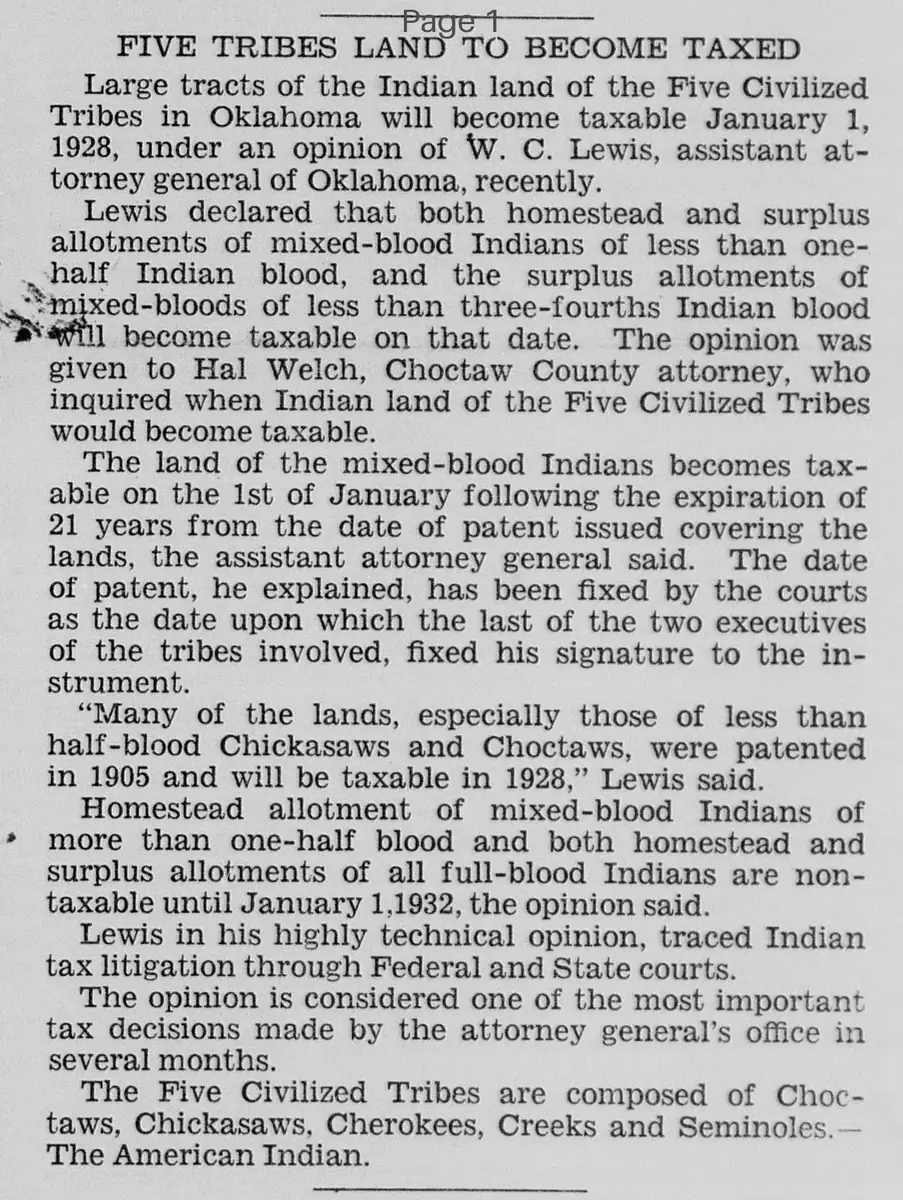
Large tracts of the Indian land of the Five Civilized Tribes in Oklahoma will become taxable January 1, 1928, under an opinion of W. C. Lewis, assistant attorney general of Oklahoma, recently.
Lewis declared that both homestead and surplus allotments of mixed-blood Indians of less than one-half Indian blood, and the surplus allotments of mixed-bloods of less than three-fourths Indian blood will become taxable on that date. The opinion was given to Hal Welch, Choctaw County attorney, who inquired when Indian land of the Five Civilized Tribes would become taxable.
The land of the mixed-blood Indians becomes taxable on the 1st of January following the expiration of 21 years from the date of patent issued covering the lands, the assistant attorney general said. The date of patent, he explained, has been fixed by the courts as the date upon which the last of the two executives of the tribes involved, fixed his signature to the instrument.
"Many of the lands, especially those of less than half-blood Chickasaws and Choctaws, were patented in 1905 and will be taxable in 1928," Lewis said.
Homestead allotment of mixed-blood Indians of more than one-half blood and both homestead and surplus allotments of all full-blood Indians are non-taxable until January 1,1932, the opinion said.
Lewis in his highly technical opinion, traced Indian tax litigation through Federal and State courts.
The opinion is considered one of the most important tax decisions made by the attorney general's office in several months.
The Five Civilized Tribes are composed of Choctaws, Chickasaws, Cherokees, Creeks and Seminoles.
The American Indian.
What sub-type of article is it?
What keywords are associated?
What entities or persons were involved?
Where did it happen?
Domestic News Details
Primary Location
Oklahoma
Event Date
January 1, 1928
Key Persons
Outcome
certain mixed-blood indian allotments become taxable january 1, 1928; full-blood and higher mixed-blood homesteads non-taxable until january 1, 1932.
Event Details
Assistant Attorney General W. C. Lewis opines that homestead and surplus allotments of mixed-blood Indians of less than one-half blood, and surplus of less than three-fourths blood, in the Five Civilized Tribes, become taxable after 21 years from 1905 patents. Opinion given to Choctaw County attorney Hal Welch; traces tax litigation history.