Thank you for visiting SNEWPapers!
Sign up free
Nashville Union And American
Nashville, Davidson County, Tennessee
What is this article about?
U.S. Senate debates on February 9 include adoption of Sumner's civil rights amendment by Vice President Colfax's tie-breaking vote, failure of amnesty bill due to Ku-Klux exceptions, and discussions on Alabama Claims treaty. House passes bills on tax abatement, bond replacement, Arkansas election, Revolutionary claims, and considers William and Mary College compensation.
Merged-components note: These components form a continuous narrative report on Congressional proceedings in Washington, including Senate and House sessions, with sequential reading orders and coherent topic flow.
Clipping
OCR Quality
Full Text
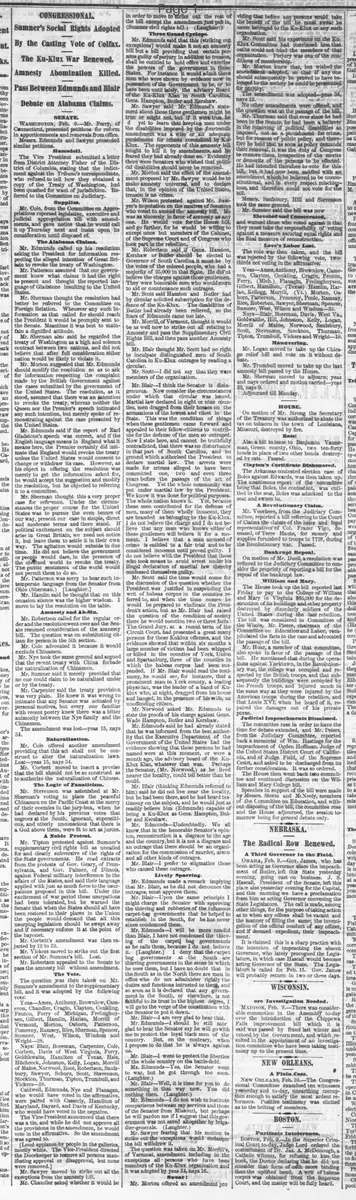
Sumner's Social Rights Adopted By the Casting Vote of Colfax
The Ku-Klux War Renewed,
Amnesty Abomination Killed
Pass Between Edmunds and Blair
Debate on Alabama Claims.
WASHINGTON, Feb. 9.—Mr. Ferry, of Connecticut, presented petitions for reform in apportionments and removals from office. Messrs. Edmunds and Sawyer presented similar petitions. Ramsdell.
The Vice President submitted a letter from District Attorney Fisher of the District of Columbia, stating that the indictment against the Tribune's correspondents, who refused to tell how they obtained a copy of the Treaty of Washington, had been quashed for want of jurisdiction. Referred to the Committee on Judiciary.
Supplies.
Mr. Cole, from the Committee on Appropriations reported legislative, executive and judicial appropriation bill with amendments, and gave notice that he would call it up Thursday next and insist upon its consideration until disposed of.
The Alabama Claims.
Mr. Edmunds called up his resolution asking the President for information respecting the alleged intention of Great Britain to revoke the treaty of Washington.
Mr. Patterson assumed that our government knew what claims it had the right to present and thought the reported language of Gladstone insulting to the United States.
Mr. Sherman thought the resolution had better be referred to the Committee on Foreign Relations. Whenever any such information as that called for should reach the President it would be promptly sent to the Senate. Meantime it was best to maintain a dignified attitude.
Mr. Sherman also said he regarded the treaty of Washington as a high and solemn contract between two nations, and did not believe that after full consideration either nation would be likely to violate it.
Mr. Morton suggested that Mr. Edmunds should modify the resolution so as to ask for information respecting the complaint made by the British Government against the cases submitted by the government of the United States. The resolution, as it stood, assumed that there was an intention to revoke the treaty, whereas neither the Queen nor the Premier's speech intimated any such intention, but merely spoke of remonstrating against the case presented by the United States.
Mr. Edmunds said if the report of Earl Gladstone's speech was correct, and if the English language means in England what it means here, the Premier certainly did intimate that England would revoke the treaty unless the United States would consent to change or withdraw its case. However, as his object in offering the resolution was merely to get the information asked for, he would accept the suggestion and modify the resolution, but he objected to referring it to a committee.
Mr. Sherman thought this a very proper case for reference. Under the circumstances the proper course for the United States was to pursue the even tenure of our way, present our case in simple, direct and moderate terms and there stand. If political excitement on the subject should arise in Great Britain, we need not notice it, but leave them to settle it in their own way. The agitation would subside in due time. He did not believe the government or people would dare, in the presence of the civilized world to revoke the treaty. The public sentiment of the world would not permit them to do so.
Mr. Patterson was sorry to hear such intemperate language from the Senator from Ohio (Sherman.) [Laughter.]
Mr. Hamlin said he thought that on this occasion silence was the higher wisdom.
Mr. Hamlin made a motion to lay the resolution on the table.
Amnesty and Ah-Sin.
Mr. Robertson called for the regular order and the resolution went over and the Senate resumed consideration of the amnesty bill. The question was on substituting citizen for person in the 5th section.
Mr. Cole advocated it because it would exclude Chinamen.
Mr. Nye took the same ground and argued that the recent treaty with China forbade the naturalization of Chinamen.
Mr. Sumner said it merely provided that no one could claim to be naturalized under or by the treaty.
Mr. Carpenter said the treaty provision was very plain. He knew it was wrong to intimate that any Senator was actuated by personal motives, but every one familiar with recent poetry knew there was a bitter animosity between the Nye family and the Chinamen.
The amendment was lost—yeas 15, nays 34.
Naturalization.
Mr. Cole offered another amendment providing that this act shall not be construed to alter the naturalization laws. Lost—yeas 15, nays 34.
Mr. Corbett moved to insert a proviso that the bill should not be so construed as to authorize the naturalization of Chinese.
The Logic of Fanaticism.
Mr. Stevenson was astonished at Mr. Sherman's voting to place the peaceful Chinamen on the Pacific Coast at the mercy of their enemies in the jury-box, when he had declared by his previous votes that negroes at the South, ignorant, superstitious, and utterly unconscious that there is a God above them, were fit to act as jurors.
A Noble Protest.
Mr. Tipton protested against Sumner's supplementary civil rights bill as uncalled for and clearly subversive of the rights of the State governments. He read extracts from the protests of Gov. Geary, of Pennsylvania, and Gov. Palmer, of Illinois, against Federal military interference in the affairs of the States, and said their language applied with just as much force to the usurpations proposed in this bill. Under the excitement of war period these usurpations had been tolerated, but he warned the Senate that when the States should all have been restored to their places in the Union the people would demand that all this usurping legislation should be swept away and if necessary enforce it at the point of the bayonet.
Mr. Corbett's amendment was then rejected by 12 to 32.
Mr. Vickers moved to strike out the first section of Mr. Sumner's bill. Lost.
Mr. Robertson appealed to the Senate to pass the amnesty bill without amendment.
The Vote.
The question was then taken on Mr. Sumner's amendment to the supplementary bill, and it was adopted by the following vote:
Yeas—Ames, Anthony, Brownlow, Cameron, Chandler, Cragin, Clayton, Conkling, Fenton, Ferry of Michigan, Frelinghuysen, Gilbert, Hamlin, Harlan, Morrill of Vermont, Morton, Osborn, Patterson, Pomeroy, Ramsey, Rice, Sherman, Spencer, Sumner, West, Wilson, Windom and Wright—28.
Nays: Blair, Boreman, Carpenter, Cole, Corbett, Davis of West Virginia, Ferry, Goldthwaite, Hamilton of Texas, Hale, Hitchcock, Johnston, Kelly, Logan, Morrill of Maine, Norwood, Root, Robertson, Saulsbury, Sawyer, Schurz, Scott, Stevenson, Stockton, Thurman, Tipton, Trumbull, and Vickers—28.
Caldwell, Edmunds, Nye and Flanagan, who would have voted in the affirmative, were paired with Casserly, Hamilton of Maryland, Bayard, and Davis of Kentucky who would have voted in the negative.
The Vice-President announced that there was a tie, and while he did not approve all the provisions in the amendment, he would vote in the affirmative. So the amendment was agreed to.
[Loud applause by people in the galleries mostly white. The Vice-President directed the Doorkeeper to remove all persons manifesting approval or disapproval, but none were removed.]
Mr. Sawyer moved to strike out all the exceptions from the amnesty bill.
Mr. Chandler asked whether it would be in order to move to strike out the rest of the bill except the amendment just put in (Sumner civil rights bill.)—[Laughter.]
The Grand Creiom
Mr. Edmunds said that this [striking out exceptions] would make it not an amnesty bill but a bill providing that certain persons guilty of perjury in addition to treason, shall be entitled to hold office and exercise the powers of the government in those States. For instance it would admit three men who were shown by evidence now in possession of the Government to be, or to have been until lately, the advisory Board of the Ku-Klux Klan in South Carolina, Gens. Hampton, Butler and Kershaw.
Mr. Sawyer said Mr. Edmunds' statement about those three gentlemen might be true or might not, but if it were true, he did yet to learn that keeping men under the disabilities imposed by the fourteenth amendment was a wise or an adequate punishment for crimes committed by Ku-Klux. The opponents of this amnesty bill sought to kill it by amendments, and he feared they had already done so. Evidently there were Senators who wished that political disabilities should never be removed.
Mr. Morton said the effect of the amendment proposed by Mr. Sawyer would be to make amnesty universal, and to declare that, in the opinion of the United States, treason is no crime.
Mr. Wilson protested against Mr. Sawyer's imputation on the motives of Senators who voted to amend the amnesty bill. He was as sincerely in favor of amnesty as any one. He would vote for the House bill and go further, for he would be willing to except none but members of the Cabinet, of the Supreme Court and of Congress who took part in the rebellion.
Mr. Robertson said if Gens. Hampton, Kershaw or Butler should be elected to Governor of South Carolina it must be by the votes of the colored people, who had a majority of 25,000 in that State. He didn't believe the charges against those gentlemen. They were honorable men who would scorn to aid or countenance such outrages.
Mr. Scott said Hampton and Butler had by circular solicited subscription for the defense of the Ku-Klux. The disabilities of Butler had already been relieved, so the fears of Edmunds came too late.
Mr. Morrill, of Vermont, thought it would be as well now to strike out all relating to Amnesty and pass the Supplementary Civil Rights Bill, and then pass another Amnesty bill.
Mr. Blair thought Mr. Scott had no right to inculpate distinguished men of South Carolina in Ku-Klux outrages by reading a circular.
Mr. Scott—I did not say that they were members of the organization.
Mr. Blair—I think the Senator is disingenuous. Now consider the circumstances under which that circular was issued. Martial law declared in eight or nine counties, men dragged from their homes on the accusations of the lowest and vilest in the State. This was the condition of things when these gentlemen came forward and appealed to their fellow-citizens to contribute for the defense of the men so outraged. Now I state here, and cannot be truthfully contradicted, that there was no disturbance in that part of South Carolina, and no ground which authorized the President to declare martial law. The arrests were made for crimes alleged to have been committed one, two and even three years before the passage of the act of Congress. Yet the whole community was put under martial law by the President. We know it was done for political purposes. The whole nation knows it. Yet, because these men contributed for the defense of men, many of them wholly innocent, they are branded as belonging to the Ku-Klux. I do not believe the charge and I do not believe that any man who knows either of these gentlemen will believe it for a moment. I believe that a man accused of crime is entitled to a fair trial and to be considered innocent until proved guilty. I do not believe with the President that those who took means to avoid arrest under his illegal declaration of martial law thereby confessed themselves guilty.
Mr. Scott said the time would come for the discussion of the question whether the President was justified in suspending the writ of habeas corpus in the counties referred to, and when the time comes he would be prepared to vindicate the President's action, but, as Mr. Blair had raised the question of the condition of society there he would mention two or three facts: The Grand Jury, at a recent term of the Circuit Court, had presented a great many persons for these Ku-Klux offenses, and the evidence showed that within six months a large number of victims had been whipped or killed in the counties of York, Union and Spartanburg, three of the counties in which the habeas corpus had been suspended. If Mr. Blair would read the testimony, he would see, for instance, that a prominent man in York county, a leading physician, was the leader of a band of Ku-Klux who, at night, dragged from his house and hanged, in the presence of his wife, an unoffending citizen.
Mr. Norwood asked Mr. Edmunds to state the proofs of his charge against Gens. Wade Hampton, Butler and Kershaw.
Mr. Edmunds said he had already stated that he was informed from the best authority that the Executive Department of the Government of the United States had the evidence showing that those persons he had named were at this moment, or were a month ago, the advisory board of the Ku-Klux Klan, whatever that was. Perhaps the Senator, (Mr. Norwood,) as he lived nearer the locality, could tell better than he could.
Mr. Blair (thinking Edmunds referred to him) said he did not live near the locality but he had been there, and he had heard testimony on the subject, and he would just as readily believe him (Edmunds) capable of being a Ku-Klux as Gens. Hampton, Butler and Kershaw.
Mr. Edmunds—Undoubtedly. We all know that in the honorable Senator's opinion, reconstruction is a disgrace to the age and the country, but it is not a disgrace and an outrage that there should be an organization for the commission of murder, arson and all other kinds of outrages.
Mr. Blair—I prefer to stigmatize those who caused these outrages.
Lively Sparring.
Mr. Edmunds made a remark implying that Mr. Blair, as he did not denounce the outrages, must approve them.
Mr. Blair—Upon the same principle I might charge the Senator with approving the thieving and robberies of the infamous carpet-bag governments that he helped to establish in the South, for he has never since condemned them.
Mr. Edmunds—I will be more candid than Blair, I have not condemned the thieving of the carpet bag governments as he calls them, because I do not believe it. [Laughter.] I deny that the carpet bag governments at the South are thieving governments in the sense in which he uses them, but I have no doubt that in the South as in the North there are men in office who do not administer rightly the duties and functions intrusted to them, and so soon as it is declared that any government in the South, or elsewhere, is not faithful to its trust in the highest degree, I will go to the verge of the constitution with the Senator to put it down.
Mr. Blair—I am very glad to hear that.
Mr. Edmunds—I should be still more glad to hear the Senator say he will go with me to protect the loyal black men of the country. But, on the contrary, when I propose to do that he is always against us.
Mr. Blair—I went to protect the liberties of the whole country on the battle-field.
Mr. Edmunds—Yes, the Senator went to war, but he got through too soon. (Laughter.)
Mr. Blair—Well, it is time for you to do something in that way now. You did nothing then. (Laughter.)
Mr. Edmunds—I do not wish to institute comparisons between my services and those of the Senator from Missouri, but perhaps he will pardon me if I suggest that this government was not saved altogether by brigadier-generals. (Laughter.)
Mr. Sawyer fearing that his motion to strike out the exceptions would endanger the bill withdrew it.
The question was taken on Mr. Morrill's, of Vermont, amendment including in the exceptions all persons who have been members of the Ku-Klux organization and it was adopted by yeas 34, nays 16.
Swear!
Mr. Morton offered an amendment providing that before any persons could take the benefit of the bill he must swear he never belonged to the Ku-Klux or any such organization.
Mr. Scott said his experience on the Ku-Klux Committee had convinced him that oaths could not bind the members of that organization. Perjury was one of the conditions of membership.
Mr. Morton knew that, but wished the amendment adopted, so that if any one should subsequently be proved to have belonged to the society he could be prosecuted for perjury.
The amendment was adopted—yeas 34, nays 12.
No other amendments were offered, and the question was on the passage of the bill.
Mr. Thurman said that ever since he had been in the Senate, he had been a believer in the removing of political disabilities as imposed, not as a punishment for crime, but for reasons of public policy, and therefore he held that as soon as policy demands their removal, it was the duty of Congress to remove them, irrespective of the merits or demerits of the persons to be affected. He had intended therefore to vote for this bill, but it had now been saddled with an amendment which he believed to be unconstitutional, and in every respect mischievous, and therefore could not vote for the bill.
Messrs. Saulsbury, Hill and Stevenson took the same ground.
Mr. Sumner said the bill was now Elevated and Consecrated, and warned those who voted against it that they must take the responsibility of voting against a measure securing equal rights and the final measure of reconstruction.
Love's Labor Lost.
The vote was then taken, and the bill was rejected by the following vote, two-thirds not voting in the affirmative:
Yeas—Ames, Anthony, Brownlow, Cameron, Clayton, Conkling, Cragin, Fenton, Ferry, (Mich.) Flanagin, Frelinghuysen, Gilbert, Hamilton, (Texas) Hamlin, Harlan, Kellogg, Morrill, (Vt.) Morton, Osborn, Patterson, Pomeroy, Poole, Ramsay, Rice, Robertson, Sawyer, Sherman, Spencer, Sumner, West, Wilson and Windom—33.
Nays—Blair, Boreman, Davis, West Va., Goldthwaite, Hill, Johnston, Kelly, Logan, Morrill of Maine, Norwood, Saulsbury, Scott, Stevenson, Stockton, Thurman, Tipton, Trumbull, Vickers and Wright—19.
Manuvering.
Mr. Logan moved to take up the Chicago relief bill and vote on it without debate.
Mr. Trumbull moved to take up the last amnesty bill passed by the House.
Mr. Sherman moved to adjourn; yeas and nays ordered and motion carried—yeas 59, nays 9.
Adjourned till Monday.
HOUSE.
On motion of Mr. Strong the Secretary of the Treasury was authorized to abate the tax on tobacco in the town of Louisiana Missouri, destroyed by fire.
Rats!
Also a bill to issue to Benjamin Vauneman, Green county, Ohio, two ten-forty bonds in place of two other bonds destroyed by rats. Passed.
Clayton's Certificate Dishonored.
The Arkansas contested election case of Boles against Edwards, was then taken up. The unanimous report of the committee being that Boles, the contestant, was entitled to the seat, Boles was admitted to the seat and sworn in.
A Revolutionary Claim.
Mr. Voorhees, from the Judiciary Committee, reported a bill referring to the Court of Claims the claims of the heirs and legal representatives of Col. Frazer Vigo, deceased, of Terre Haute, for money and supplies furnished to troops in 1778, during the Revolutionary war. Passed.
Bankrupt Repeal.
On motion of Mr. Duell, a resolution was referred to the Judiciary Committee to consider the propriety of reporting a bill for the repeal of the bankrupt law.
William and Mary.
The House took up the bill reported last Friday to pay to the College of William and Mary in Virginia $65,000 for the destruction of its buildings and other property destroyed by disorderly soldiers of the United States during the late rebellion.
The bill was considered in Committee of the Whole, Mr. Pierce, chairman of the Committee on Education and Labor, recapitulated the facts in the case and advocated the passage of the bill.
Mr. Hoar, a member of that committee, also spoke in favor of the passage of the bill. He mentioned that during the operations against Yorktown, in the Revolutionary war, the college was occupied and respected by the British troops, and that subsequently the buildings were occupied by the French troops, and injured much in the same way as they were injured by the American troops during the rebellion, and that Louis XVI, when he heard of it, repaired the damages out of his private purse.
Judicial Impeachments Dismissed.
The committee rose in order to have the time for debate extended, and Mr. Peters, from the Judiciary Committee, reported back a memorial of Wm. Hastings for the impeachment of Ogden Hoffman, Judge of the United States District Court of California, and of Judge Field, of the Supreme Court, and asked to be discharged from its further consideration. It was so ordered.
The House then went back into committee and continued discussion on the William and Mary College bill.
Speeches in support of the bill were made by Messrs. Storm and McNeely, members of the Committee on Education, and without disposing of the bill, the committee rose and the House adjourned, the session to morrow being for general debate only.
What sub-type of article is it?
What themes does it cover?
What keywords are associated?
What entities or persons were involved?
Where did it happen?
Story Details
Key Persons
Location
Washington
Event Date
Feb. 9
Story Details
Senate adopts Sumner's civil rights amendment by Colfax's casting vote amid debates on excluding Chinese from naturalization and protesting state rights interference; amnesty bill fails after adding Ku-Klux exceptions and oath requirements, with heated exchanges accusing Southern leaders of Klan ties; resolution on British intent to revoke Washington Treaty modified and tabled; House passes bills on tax relief, bond replacement, election seating, Revolutionary claims, refers bankrupt repeal, debates compensation for William and Mary College damage.