Thank you for visiting SNEWPapers!
Sign up free
Richmond Palladium
Richmond, Wayne County, Indiana
What is this article about?
A letter from Joseph Crossfield dated December 9, 1846, details severe famine distress in Irish poor-houses at Castlerea and Carrick-on-Shannon. Overcrowded facilities lack bedding and supplies, leading to disease outbreaks, child malnutrition, and deaths from starvation; applicants beg for admission amid desperate conditions.
Clipping
OCR Quality
Full Text
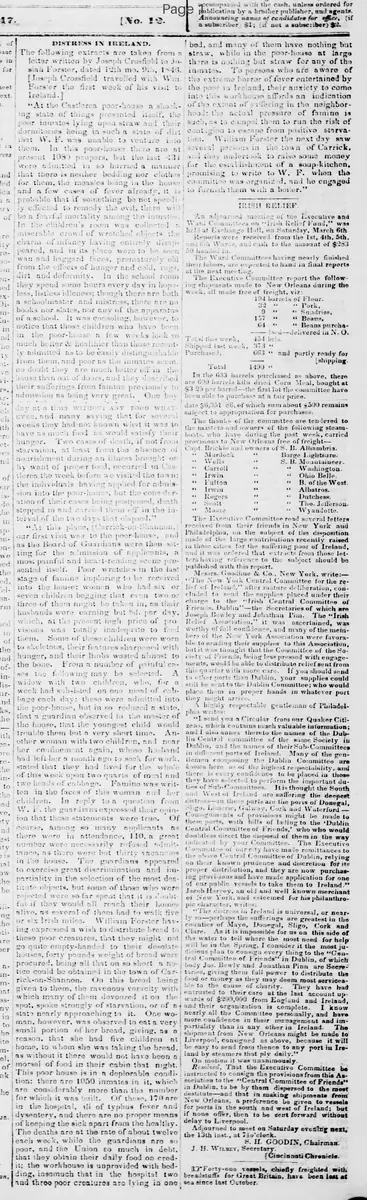
The following extracts are taken from a letter written by Joseph Crossfield to Josiah Forster, dated 12th mo. 9th, 1846.
[Joseph Crossfield travelled with Wm. Forster the first week of his visit to Ireland.]
"At the Castlerea poor-house a shocking state of things presented itself, the poor inmates lying upon straw and their dormitories being in such a state of dirt that W. F. was unable to venture into them. In this poor-house there are at present 1050 paupers, but the last 431 were admitted in so hurried a manner that there is neither bedding nor clothes for them, the measles being in the house and a few cases of fever already, it is probable that if something be not speedily effected to remedy the evil, there will be a fearful mortality among the inmates. In the children's room was collected a miserable crowd of wretched objects the charm of infancy having entirely disappeared, and in its place were to be seen wan and haggard faces, prematurely old from the effects of hunger and cold, rags, dirt and deformity. In the school room they spend some hours every day in hopeless, listless idleness; though there are both a schoolmaster and mistress, there are no books nor slates, nor any of the apparatus of a school. It was consoling, however, to notice that those children who have been in the poor-house a few weeks look so much better & healthier than those recently admitted as to be easily distinguishable from them, and poor as the inmates seem, no doubt they are much better off in the house than out of doors, and they described their sufferings from famine previously to admission as being very great. One boy stated that for three weeks he had not had any food what-ever, and many saying that for several weeks they had not known what it was to have as much food as would satisfy their hunger. Two cases of death, if not from starvation, at least from the absence of nourishment during an illness brought on by want of proper food, occurred in Castlerea the week before we visited the town: the individuals having applied for admission into the poor-house, but the consideration of their cases being postponed, death stepped in and carried them off in the interval of the two days that elapsed."
"At this place, (Carrick-on-Shannon,) our first visit was to the poor-house, and as the Board of Guardians were then sitting for the admission of applicants, a most painful and heart-rending scene presented itself. Poor wretches in the last stage of famine imploring to be received into the house: women who had six or seven children begging that even two or three of them might be taken in, as their husbands were earning but 6d. per day, which, at the present high price of provisions was totally inadequate to feed them. Some of these children were worn to skeletons, their features sharpened with hunger, and their limbs wasted almost to the bone. From a number of painful cases the following may be selected. A widow with two children, who, for a week had subsisted on one meal of cabbage each day: these were admitted into the poor-house, but in so reduced a state, that a guardian observed to the master of the house, that the youngest child would trouble them but a very short time. Another woman with two children, and near her confinement again, whose husband had left her a month ago to seek for work, stated that they had lived for the whole of this week upon two quarts of meal and two heads of cabbage. Famine was written in the faces of this woman and her children. In reply to a question from W. F. the guardians expressed their opinion that these statements were true. Of course, among so many applicants as there were in attendance, 110, a great number were necessarily refused admittance, as there were but thirty vacancies in the house. The guardians appeared to exercise great discrimination and impartiality in the selection of the most destitute objects, but some of those who were rejected were so far spent that it is doubtful if they would all reach their homes alive, as several of them had to walk five or six Irish miles. William Forster having expressed a wish to distribute bread to these poor creatures, that they might not go quite empty-handed to their desolate houses, forty pounds weight of bread were procured, being all that on so short a notice could be obtained in the town of Carrick-on-Shannon. On this bread being given to them, the ravenous voracity with which many of them devoured it on the spot, spoke strongly of starvation, or of a state nearly approaching to it. One woman, however, was observed to eat a very small portion of her bread, giving, as a reason, that she had five children at home, to whom she was taking the bread, as without it there would not have been a morsel of food in their cabin that night. This poor house is in a deplorable condition: there are 1050 inmates in it, which are considerably more than the number for which it was built. Of these, 170 are in the hospital, 50 of typhus fever and dysentery, and there are no proper means of keeping the sick apart from the healthy. The deaths are at the rate of about twelve each week, while the guardians are so poor, and the Union so much in debt, that they obtain their daily food on credit; the workhouse is unprovided with bedding, insomuch that in the hospital two and three poor creatures are lying in one bed, and many of them have nothing but straw, while in the poor-house at large there is nothing but straw for any of the inmates. To persons who are aware of the extreme horror of fever entertained by the poor in Ireland, their anxiety to come into this workhouse affords an indication of the extent of suffering in the neighborhood: the actual pressure of famine is such, as to compel them to run the risk of contagion to escape from positive starvation. William Forster the next day saw several persons in the town of Carrick, and they undertook to raise some money for the establishment of a soup-kitchen, promising to write to W. F. when the committee was organized, and he engaged to furnish them with a boiler."
What sub-type of article is it?
What keywords are associated?
What entities or persons were involved?
Where did it happen?
Foreign News Details
Primary Location
Ireland
Event Date
12th Mo. 9th, 1846
Key Persons
Outcome
two deaths in castlerea from starvation-related illness; probable fearful mortality in castlerea poor-house; 12 deaths per week in carrick-on-shannon poor-house; many applicants refused, some unlikely to survive journey home.
Event Details
Joseph Crossfield describes shocking conditions in Castlerea poor-house with 1050 paupers, overcrowding, lack of bedding and clothes, measles and fever outbreaks, malnourished children in idleness without school supplies; inmates report prior starvation. In Carrick-on-Shannon, 110 famine-stricken applicants beg admission to poor-house with 1050 inmates, 170 in hospital including 50 with typhus and dysentery; guardians admit 30 most destitute, distribute 40 pounds of bread; plans for soup-kitchen initiated.