Thank you for visiting SNEWPapers!
Sign up free
The Liberator
Boston, Suffolk County, Massachusetts
What is this article about?
Letter to Garrison reports on an Anti-Slavery Society meeting in West Boylston on the 13th instant, where Rev. Charles T. Torrey, a stranger, made false claims against the Massachusetts A.S. Society's board, non-resistants, and Garrison, influencing the rejection of a supportive resolution. Torrey is accused of wholesale misrepresentations to promote a rival organization.
Merged-components note: These components form a single continuous letter on wholesale misrepresentations at an anti-slavery meeting.
Clipping
OCR Quality
Full Text
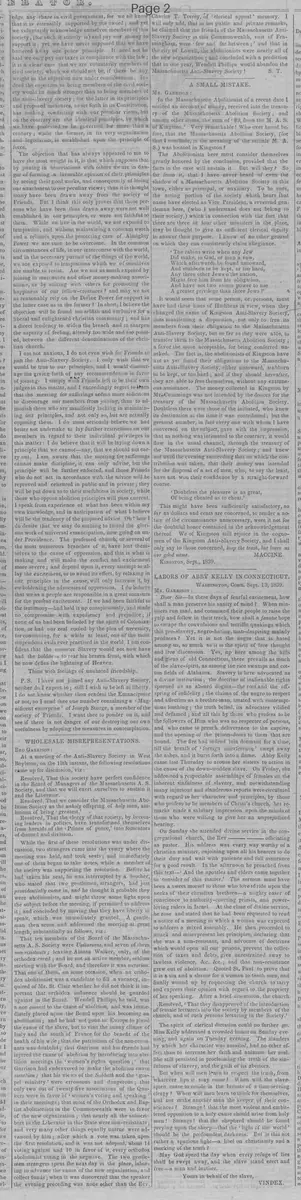
Bro Garrison:
At a meeting of the Anti-Slavery Society in West Boylston, on the 13th instant, the following resolutions came up for discussion, viz:
Resolved, That this society have perfect confidence in the Board of Managers of the Massachusetts A. S. Society, and that we will exert ourselves to sustain it and the Liberator.
Resolved, That we consider the Massachusetts Abolition Society as the unholy offspring of holy men, ambitious of being 'greatest.'
Resolved, That the clergy of that society, by becoming leaders in politics, have transformed themselves from heralds of the 'Prince of peace,' into fomentors of discord and division.
While the first of these resolutions was under discussion, two strangers came into the vestry where the meeting was held, and took seats; and immediately one of them began to take notes, while a member of the society was supporting the resolution. Before he had taken his seat, he was interrupted by a brother, who stated that two gentlemen, strangers, had just providentially come in, and he thought it probable they were abolitionists, and might throw some light upon the subject before the meeting, if permitted to address it; and concluded by moving that they have liberty to speak, which was immediately granted. A gentleman then arose and addressed the meeting at great length, substantially as follows, viz:
That ten members of the Board of the Massachusetts A. S. Society were Unitarians, and seven of them non-resistants; leaving Amasa Walker, only, of the orthodox creed; and he not an active member, seldom meeting with the Board, and therefore it was sectarian.
That one of them, on some occasion, when an orthodox abolitionist was a candidate to fill a vacancy, inquired of Mr. St. Clair whether he did not think it important that orthodox influence should be guarded against in the Board. Wendell Phillips, he said, was a new convert to the cause of abolition, and was immediately placed upon the Board upon his becoming an abolitionist; and he had not gone to Europe to plead the cause of the slave, but to visit the sunny climes of Italy and the south of France for the benefit of the health of his wife; that the patriotism of the non-resistants was doubtful; that Garrison and his friends had injured the cause of abolition by introducing into abolition meetings the 'women's rights question:' that Garrison had endeavored to make the abolition cause sectarian; that his views of the Sabbath and the 'gospel ministry' were erroneous and dangerous; that only two out of twenty-five associations of the Quakers were in favor of 'women's voting and speaking in their meetings; that most of the Orthodox and Baptist abolitionists in the Commonwealth were in favor of the new organization; that nearly all the subscribers to the Liberator in this State were non-resistants; and very many other things equally untrue were advanced by him; after which a vote was taken upon the first resolution, and it was not adopted, about 14 voting against and 10 in favor of it, every orthodox abolitionist voting in the negative. The two gentlemen strangers spent the next day in the place, laboring to advance the cause of the new organization, and collect funds; when it was discovered that the speaker the evening preceding was none other than the Rev.
Charles T. Torrey, of 'clerical appeal' memory. I will only add, that in his public and private remarks, he claimed that the friends of the Massachusetts Anti-Slavery Society in this Commonwealth, east of Framingham, were 'few and far between;' and that in the city of Lowell, the abolitionists were nearly all of the new organization; and concluded with a prediction that in one year, Wendell Phillips would abandon the Massachusetts Anti-Slavery Society!
S. T.
What sub-type of article is it?
What themes does it cover?
What keywords are associated?
What entities or persons were involved?
Letter to Editor Details
Author
S. T.
Recipient
Bro Garrison
Main Argument
rev. charles t. torrey made numerous false and misleading statements at an anti-slavery society meeting to discredit the massachusetts a.s. society, its board, garrison, and non-resistants, promoting a rival organization and influencing the defeat of a resolution supporting the society.
Notable Details