Thank you for visiting SNEWPapers!
Sign up free
Literary
September 8, 1866
Event 1 of 2
American Citizen
Canton, Madison County, Mississippi
What is this article about?
Excerpt from Victor Hugo's 'Letters of the Sea' reflecting on the gradual, humiliating process of financial ruin likened to Napoleon's exile, followed by a brief anecdote on Rothschild's advice for speculation.
Clipping
OCR Quality
98%
Excellent
Full Text
This is Event 1 of 2. The full text below covers all events in this component.
[From Letters of the Sea, by Victor Hugo.]
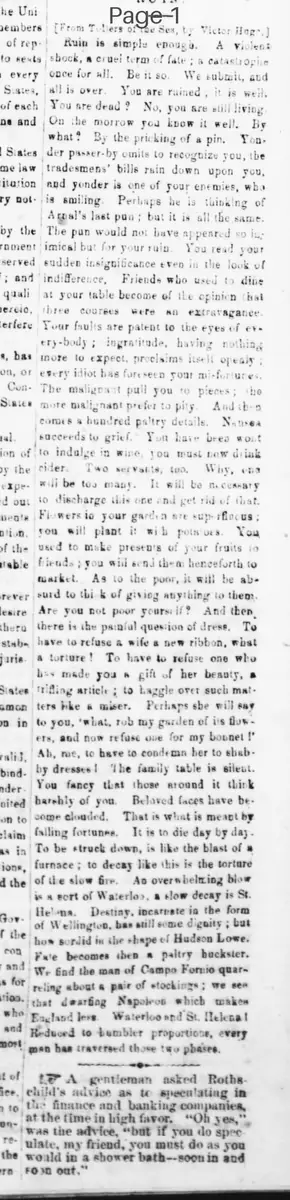
Ruin is simple enough. A violent shock, cruel turn of fate, a catastrophe once for all. Be it so! We submit, and all is over. You are ruined. It is well. You are dead? No, you are still living. On the morrow God knows it well. By what? By the pricking of a pin. Yonder passer-by omits to recognize you, the tradesmen's bills rain down upon you, and yonder is one of your enemies, who is smiling. Perhaps he is thinking of Aron's last pun; but it is all the same. The pun would not have appeared so inimical but for your ruin. You read your sudden insignificance even in the look of indifference. Friends who used to dine at your table become of the opinion that three courses were an extravagance. Four faults are patent to the eyes of everybody: ingratitude, having nothing more to expect, proclaims itself openly. Every idiot has foreseen your misfortunes. The malignant pull you to pieces; the more malignant prefer to pity. And then comes a hundred paltry details. Nausea succeeds to grief. You have been wont to indulge in wine; you must now drink cider. Two servants, too. Why, one will be too many. It will be necessary to discharge this one and get rid of that. Flowers in your garden are superfluous; you will plant it with potatoes. You used to make presents of your fruits to friends; you will send them henceforth to market. As to the poor, it will be absurd to think of giving anything to them. Are you not poor yourself? And then there is the painful question of dress. To have to refuse a wife a new ribbon, what a torture! To have to refuse one who has made you a gift of her beauty, trifling article; to haggle over such matters like a miser. Perhaps she will say to you, 'What, rob my garden of its flowers, and now refuse one for my bonnet!' Ah, woe, to have to condemn her to shabby dresses! The family table is silent. You fancy that those around it think harshly of you. Beloved faces have become clouded. That is what is meant by falling fortunes. It is to die day by day. To be struck down, is like the blast of a furnace; to decay like this is the torture of the slow fire. An overwhelming blow is a sort of Waterloo, a slow decay is St. Helena. Destiny, incarnate in the form of Wellington, has still some dignity; but how sordid in the shape of Hudson Lowe. Fate becomes then a paltry buckster. We find the man of Campo Formio quarreling about a pair of stockings; we see that dwarfing Napoleon which wakened England less Waterloo and St. Helena. Reduced to humbler proportions, every man has traversed those two phases.
A gentleman asked Rothschild's advice as to speculating in the finance and banking companies, at the time in high favor. "Oh yes," was the advice, "but if you do speculate, my friend, you must do as you would in a shower bath--soon in and soon out."
Ruin is simple enough. A violent shock, cruel turn of fate, a catastrophe once for all. Be it so! We submit, and all is over. You are ruined. It is well. You are dead? No, you are still living. On the morrow God knows it well. By what? By the pricking of a pin. Yonder passer-by omits to recognize you, the tradesmen's bills rain down upon you, and yonder is one of your enemies, who is smiling. Perhaps he is thinking of Aron's last pun; but it is all the same. The pun would not have appeared so inimical but for your ruin. You read your sudden insignificance even in the look of indifference. Friends who used to dine at your table become of the opinion that three courses were an extravagance. Four faults are patent to the eyes of everybody: ingratitude, having nothing more to expect, proclaims itself openly. Every idiot has foreseen your misfortunes. The malignant pull you to pieces; the more malignant prefer to pity. And then comes a hundred paltry details. Nausea succeeds to grief. You have been wont to indulge in wine; you must now drink cider. Two servants, too. Why, one will be too many. It will be necessary to discharge this one and get rid of that. Flowers in your garden are superfluous; you will plant it with potatoes. You used to make presents of your fruits to friends; you will send them henceforth to market. As to the poor, it will be absurd to think of giving anything to them. Are you not poor yourself? And then there is the painful question of dress. To have to refuse a wife a new ribbon, what a torture! To have to refuse one who has made you a gift of her beauty, trifling article; to haggle over such matters like a miser. Perhaps she will say to you, 'What, rob my garden of its flowers, and now refuse one for my bonnet!' Ah, woe, to have to condemn her to shabby dresses! The family table is silent. You fancy that those around it think harshly of you. Beloved faces have become clouded. That is what is meant by falling fortunes. It is to die day by day. To be struck down, is like the blast of a furnace; to decay like this is the torture of the slow fire. An overwhelming blow is a sort of Waterloo, a slow decay is St. Helena. Destiny, incarnate in the form of Wellington, has still some dignity; but how sordid in the shape of Hudson Lowe. Fate becomes then a paltry buckster. We find the man of Campo Formio quarreling about a pair of stockings; we see that dwarfing Napoleon which wakened England less Waterloo and St. Helena. Reduced to humbler proportions, every man has traversed those two phases.
A gentleman asked Rothschild's advice as to speculating in the finance and banking companies, at the time in high favor. "Oh yes," was the advice, "but if you do speculate, my friend, you must do as you would in a shower bath--soon in and soon out."
What sub-type of article is it?
Essay
What themes does it cover?
Commerce Trade
Moral Virtue
Political
What keywords are associated?
Ruin
Falling Fortunes
Financial Decay
Napoleon
Waterloo
What entities or persons were involved?
Victor Hugo
Literary Details
Author
Victor Hugo
Subject
On Ruin And Falling Fortunes
Key Lines
Ruin Is Simple Enough. A Violent Shock, Cruel Turn Of Fate, A Catastrophe Once For All.
To Be Struck Down, Is Like The Blast Of A Furnace; To Decay Like This Is The Torture Of The Slow Fire. An Overwhelming Blow Is A Sort Of Waterloo, A Slow Decay Is St. Helena.