Thank you for visiting SNEWPapers!
Sign up free
Gazette Of The United States & Evening Advertiser
Philadelphia, Philadelphia County, Pennsylvania
What is this article about?
On February 28, 1794, the U.S. House of Representatives discussed a report on fortifying principal ports, adopted a select committee's recommendation to authorize the President to borrow up to $1,000,000 if needed for current fiscal demands, and addressed Treasury procedures via correspondence with Secretary Hamilton. Motions passed to request bank contract details and prepare related bills.
Merged-components note: Continuation of congressional proceedings report; relabeled to domestic_news as it covers U.S. government activities.
Clippings
1 of 2
OCR Quality
Full Text
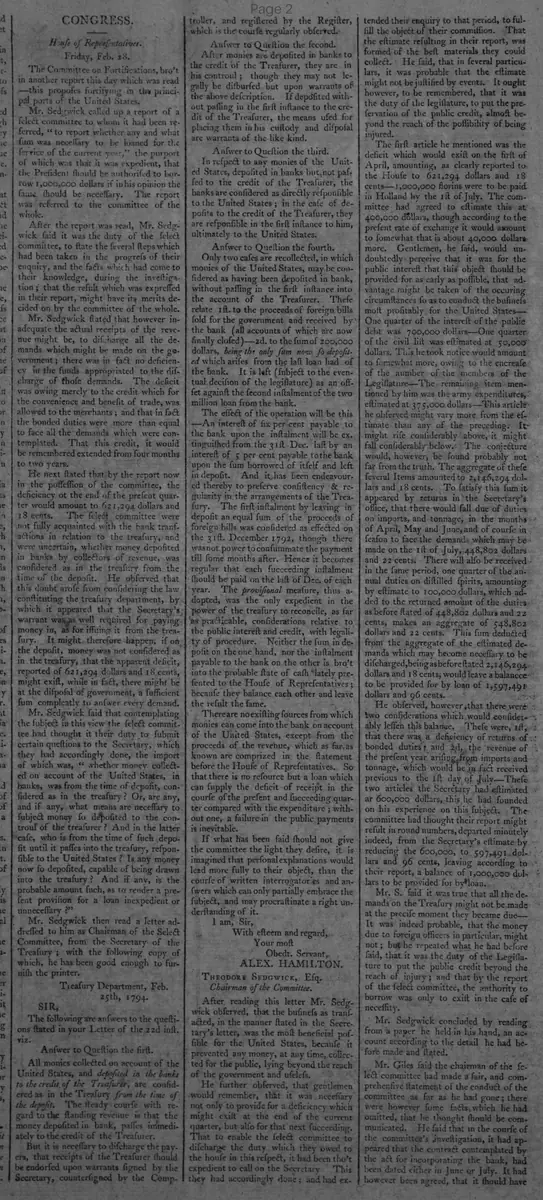
House of Representatives.
Friday, Feb. 28.
The Committee on Fortifications, bro't in another report this day which was read—this proposes fortifying in the principal ports of the United States.
Mr. Sedgwick called up a report of a select committee to whom it had been referred, "to report whether any and what sum was necessary to be loaned for the service of the current year," the purport of which was that it was expedient, that the President should be authorized to borrow 1,000,000 dollars if in his opinion the same should be necessary. The report was referred to the committee of the whole.
After the report was read, Mr. Sedgwick said it was the duty of the select committee, to state the several steps which had been taken in the progress of their enquiry, and the facts which had come to their knowledge, during the investigation; that the result which was expressed in their report, might have its merits decided on by the committee of the whole.
Mr. Sedgwick stated that however inadequate the actual receipts of the revenue might be, to discharge all the demands which might be made on the government; there was in fact no deficiency in the funds appropriated to the discharge of those demands. The deficit was owing merely to the credit which for the convenience and benefit of trade, was allowed to the merchants; and that in fact the bonded duties were more than equal to face all the demands which were contemplated. That this credit, it would be remembered extended from four months to two years.
He next stated that by the report now in the possession of the committee, the deficiency at the end of the present quarter would amount to 621,294 dollars and 18 cents. The select committee were not fully acquainted with the bank transactions in relation to the treasury, and were uncertain, whether money deposited in banks by collectors of revenue, was considered as in the treasury from the time of the deposit. He observed that this doubt arose from considering the law constituting the treasury department, by which it appeared that the Secretary's warrant was as well required for paying money in, as for issuing it from the treasury. It might therefore happen, if on the deposit, money was not considered as in the treasury, that the apparent deficit, reported of 621,294 dollars and 18 cents, might exist, while in fact, there might be at the disposal of government, a sufficient sum completely to answer every demand.
Mr. Sedgwick said that contemplating the subject in this view the select committee had thought it their duty to submit certain questions to the Secretary, which they had accordingly done, the import of which was, "whether money collected on account of the United States, in banks, was from the time of deposit, considered as in the treasury? Or, are any, and if any, what means are necessary to subject money so deposited to the control of the treasurer? And in the latter case, who is from the time of such deposit until it passes into the treasury, responsible to the United States? Is any money now so deposited, capable of being drawn into the treasury? And if any, is the probable amount such, as to render a present provision for a loan inexpedient or unnecessary?"
Mr. Sedgwick then read a letter addressed to him as Chairman of the Select Committee, from the Secretary of the Treasury; with the following copy of which, he has been good enough to furnish the printer.
Treasury Department, Feb. 25th, 1794.
SIR,
The following are answers to the questions stated in your Letter of the 22d inst. viz.
Answer to Question the first.
All monies collected on account of the United States, and deposited in the banks to the credit of the Treasurer, are considered as in the Treasury from the time of the deposit. The steady course with regard to the standing revenue is that the money deposited in bank, passes immediately to the credit of the Treasurer.
But it is necessary to discharge the payers, that receipts of the Treasurer should be endorsed upon warrants signed by the Secretary, countersigned by the Comptroller, and registered by the Register, which is the course regularly observed.
Answer to Question the second.
After monies are deposited in banks to the credit of the Treasurer, they are in his controul; though they may not legally be disbursed but upon warrants of the above description. If deposited without passing in the first instance to the credit of the Treasurer, the means used for placing them in his custody and disposal are warrants of the like kind.
Answer to Question the third.
In respect to any monies of the United States, deposited in banks but not passed to the credit of the Treasurer, the banks are considered as directly responsible to the United States: in the case of deposits to the credit of the Treasurer, they are responsible in the first instance to him, ultimately to the United States.
Answer to Question the fourth.
Only two cases are recollected, in which monies of the United States, may be considered as having been deposited in bank, without passing in the first instance into the account of the Treasurer. These relate 1st. to the proceeds of foreign bills sold for the government and received by the bank (all accounts of which are now finally closed)—2d. to the sum of 200,000 dollars, being that only sum now so deposited which arises from the last loan made of the bank. It is left (subject to the eventual decision of the legislature) as an offset against the second installment of the two million loan from the bank.
The effect of the operation will be this—An interest of six per cent payable to the bank upon the installment will be extinguished from the 31st Dec. last by an interest of 5 per cent payable to the bank upon the sum borrowed of itself and left in deposit. And it has been endeavoured thereby to preserve consistency & regularity in the arrangements of the Treasury. The first installment by leaving in deposit an equal sum of the proceeds of foreign bills was considered as effected on the 31st. December 1792, though there was not power to consummate the payment till some months after. Hence it becomes regular that each succeeding installment should be paid on the last of Dec. of each year. The provisional measure, thus adopted, was the only expedient in the power of the treasury to reconcile, as far as practicable, considerations relative to the public interest and credit, with legality of procedure. Neither the sum in deposit on the one hand, nor the installment payable to the bank on the other is brought into the probable state of cash lately presented to the House of Representatives; because they balance each other and leave the result the same.
There are no existing sources from which monies can come into the bank on account of the United States, except from the proceeds of the revenue, which as far as known are comprised in the statement before the House of Representatives. So that there is no resource but a loan which can supply the deficit of receipt in the course of the present and succeeding quarter compared with the expenditure; without one, a failure in the public payments is inevitable.
If what has been said should not give the committee the light they desire, it is imagined that personal explanations would lead more fully to their object, than the course of written interrogatories and answers which can only partially embrace the subject, and may procrastinate a right understanding of it.
I am, Sir,
With esteem and regard,
Your most Obedt. Servant,
ALEX. HAMILTON.
Theodore Sedgwick, Esq.
Chairman of the Committee.
After reading this letter Mr. Sedgwick observed, that the business as transacted, in the manner stated in the Secretary's letter, was the most beneficial possible for the United States, because it prevented any money, at any time, collected for the public, lying beyond the reach of the government and useless.
He further observed, that gentlemen would remember, that it was necessary not only to provide for a deficiency which might exist at the end of the current quarter, but also for that next succeeding. That to enable the select committee to discharge the duty which they owed to the house in this respect, it had been thought expedient to call on the Secretary. This they had accordingly done; and had extended their enquiry to that period, to fulfill the object of their commission. That the estimate resulting in their report, was formed of the best materials they could collect. He said, that in several particulars, it was probable that the estimate might not be justified by events. It ought however, to be remembered, that it was the duty of the legislature, to put the preservation of the public credit, almost beyond the reach of the possibility of being injured.
The first article he mentioned was the deficit which would exist on the first of April, amounting, as clearly reported to the House to 621,294 dollars and 18 cents—1,000,000 florins were to be paid in Holland by the 1st of July. The committee had agreed to estimate this at 400,000 dollars, though according to the present rate of exchange it would amount to somewhat more, that is about 40,000 dollars more. Gentlemen, he said, would undoubtedly perceive that it was for the public interest that this object should be provided for as early as possible, that advantage might be taken of the occurring circumstances so as to conduct the business most profitably for the United States—
One quarter of the interest of the public debt was 700,000 dollars—One quarter of the civil list was estimated at 50,000 dollars. This he took notice would amount to somewhat more, owing to the increase of the number of the members of the Legislature. The remaining item mentioned by him was the army expenditures, estimated at 375,000 dollars—This article he observed might vary more from the estimate than any of the preceding. It might rise considerably above, it might fall considerably below. The conjecture would, however, be found probably not far from the truth. The aggregate of these several Items amounted to 2,146,294 dollars and 18 cents. To satisfy this sum it appeared by returns in the Secretary's office, that there would fall due of duties on imports, and tonnage, in the months of April, May and June, and of course in season to face the demands which may be made on the 1st of July, 448,802 dollars and 22 cents. There will also be received in the same period, one quarter of the annual duties on distilled spirits, amounting by estimate to 100,000 dollars, which added to the returned amount of the duties as before stated of 448,802 dollars and 22 cents, makes an aggregate of 548,802 dollars and 22 cents. This sum deducted from the aggregate of the estimated demands which may become necessary to be discharged, being as before stated 2,146,294 dollars and 18 cents, would leave a balance to be provided for by loan of 1,597,491 dollars and 96 cents.
He observed, however, that there were two considerations which would considerably lessen this balance. These were, 1st, that there was a deficiency of returns of bonded duties; and 2d, the revenue of the present year arising from imports and tonnage, which would be in fact received previous to the 1st day of July—These two articles the Secretary had estimated at 600,000 dollars, this he had founded on his experience on this subject. The committee had thought their report might result in round numbers, departed minutely indeed, from the Secretary's estimate by reducing the 600,000, to 597,491. dollars and 96 cents, leaving according to their report, a balance of 1,000,000 dollars to be provided for by loan.
Mr. S. said it was true that all the demands on the Treasury might not be made at the precise moment they became due—It was indeed probable, that the money due to foreign officers in particular, might not; but he repeated what he had before said, that it was the duty of the Legislature to put the public credit beyond the reach of injury; and that by the report of the select committee, the authority to borrow was only to exist in the case of necessity.
Mr. Sedgwick concluded by reading from a paper he held in his hand, an account according to the detail he had before made and stated.
Mr. Giles said the chairman of the select committee had made a fair, and comprehensive statement of the conduct of the committee as far as he had gone; there were however some facts which he had omitted, that he thought should be communicated. He said that in the course of the committee's investigation, it had appeared that the contract contemplated by the act for incorporating the bank, had been dated either in June or July. It had however been agreed, that it should have
a retrospective effect so as to interest the United States in the bank from the commencement of its operations. He thought it also his duty to state to the committee, though not in opposition to the report, that it had been made a question whether the payment of the installments due to the bank from the United States, should be considered as falling due at the time of the commencement of its operations, or at the time of executing the contract. That this question had been referred to the Attorney General, who had given an opinion in favor of the latter period. That the Secretary notwithstanding had in opposition to this opinion, made the first payment in December, very near the time when the bank commenced its operations, instead of June or July, when the contract was executed. Mr. Giles said he merely stated these facts, believing the committee should be acquainted with them.
Mr. S. said the facts mentioned by the gentleman from Virginia, (Mr. Giles) had appeared during the investigation of the committee, and were truly stated. That he himself should have mentioned them, had he supposed they could have any influence in determining the question under consideration. That when this question was decided, he would bring forward a motion by which the house should be officially possessed of a knowledge of those facts. At present he would only observe to the committee, that it was true the contract between the secretary and the bank, in pursuance of the legal provision, was executed in June or July, that it was by the contract agreed, that it should have a retrospective operation to the time of the commencement of the negotiations of the bank. It ought, however, to be noticed that by this means the United States were obliged to pay an interest of six per cent on the amount of their subscription for the time preceding the date of the contract, but they were for the same time interested in the profits of the bank, which amounting to considerably more than six per cent, the difference was a clear balance in favor of the public. It was also to be observed, that by paying the installments in December, instead of June or July, a debt due from the government, bearing an interest of six per cent. was exchanged for one bearing an interest of five per cent. so that in both the instances mentioned by the gentleman, there was a clear and manifest saving to the United States.
The report of the select committee was agreed to and adopted by the house, and Mr. Sedgwick, Mr. Giles, and Mr. Dearborn, were directed to report a bill conformably thereto.
Mr. Sedgwick then moved that the Secretary of the Treasury be directed to furnish the house with a copy of the contract made in pursuance of the 11th section of the act for incorporating the subscribers to the Bank of the United States. Also, a copy of any opinion which may have been given by the Attorney-General, relative to a construction of the contract, and that he inform the House, of any provisional measures, which may have been taken to discharge the second installment, due on the said loan. This motion was agreed to.
He next moved, that a committee be appointed to prepare and report a bill providing for the second installment, due on a loan made of the Bank of the United States. This motion was also agreed to, and a committee consisting of Mr. Sedgwick, Mr. W. Smith, and Mr. Cadwallader, accordingly appointed.
What sub-type of article is it?
What keywords are associated?
What entities or persons were involved?
Where did it happen?
Domestic News Details
Primary Location
United States
Event Date
Friday, Feb. 28, 1794
Key Persons
Outcome
report on loan authorization adopted; committees appointed to draft bills; motions agreed to request treasury contract and opinion copies.
Event Details
The House received a Committee on Fortifications report proposing fortifications in principal U.S. ports. Mr. Sedgwick presented a select committee report recommending presidential authority to borrow $1,000,000 if necessary, based on Treasury deficit analysis and Secretary Hamilton's letter clarifying bank deposit procedures. Debate covered revenue, deficits, and bank loan installments. The report was adopted, and committees were directed to prepare conforming bills. Additional motions passed for Treasury documents on the Bank of the United States contract.