Thank you for visiting SNEWPapers!
Sign up free
Daily National Intelligencer
Washington, District Of Columbia
What is this article about?
U.S. House of Representatives on Jan. 9: New members qualified; militia organization bill reported; Col. Earle cleared in contract report; amendment proposed for militia training; post road inquiry ordered; debate on discharging Col. Anderson from contempt charges adjourned undecided.
Clipping
OCR Quality
Full Text
FRIDAY, JAN. 9
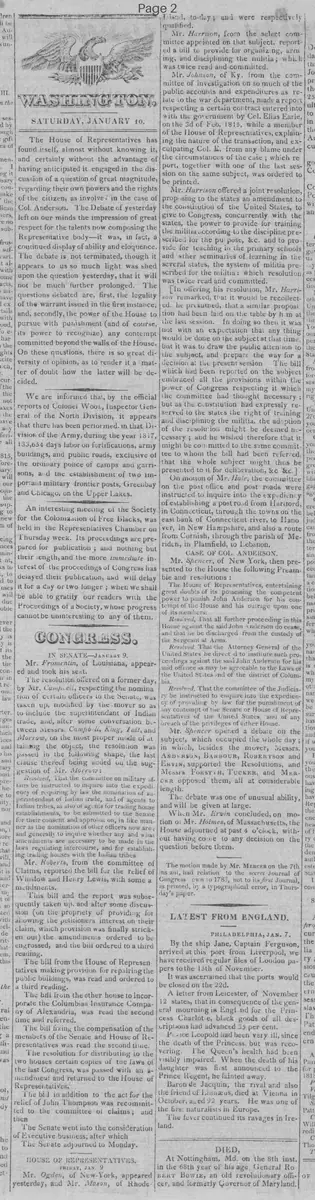
Mr. Ogden, of New-York, appeared yesterday, and Mr. Mason, of Rhode Island, to-day; and were respectively qualified.
Mr. Harrison, from the select committee appointed on that subject, reported a bill to provide for organizing, arming, and disciplining the militia; which was twice read and committed.
Mr. Johnson, of Ky. from the committee of investigation on so much of the public accounts and expenditures as relate to the war department, made a report respecting a certain contract entered into with the government by Col. Elias Earle, on the 3d of Feb. 1815, while a member of the House of Representatives, explaining the nature of the transaction, and exculpating Col. E. from any blame under the circumstances of the case; which report, together with one of the last session on the same subject, was ordered to be printed.
Mr. Harrison offered a joint resolution, proposing to the states an amendment to the constitution of the United States, to give to Congress, concurrently with the states, the power to provide for training the militia according to the discipline prescribed for the purpose, &c. and to provide for teaching in the primary schools and other seminaries of learning in the several states, the system of militia prescribed for the militia: which resolution was twice read and committed.
In offering his resolution, Mr. Harrison remarked, that it would be recollected, he presumed, that a similar proposition had been laid on the table by him at the last session. In doing so then it was not with an expectation that any thing would be done on the subject at that time, but it was to draw the public attention to the subject, and prepare the way for a decision at the present session. The bill which had been reported on the subject embraced all the provisions within the power of Congress respecting it which the committee had thought necessary; but as the constitution had expressly reserved to the states the right of training and disciplining the militia, the adoption of the resolution might be deemed necessary; and he wished therefore that it might be committed to the same committee to whom the bill had been referred that the whole subject might thus be presented to it for deliberation, &c. &c.
On motion of Mr. Hale, the committee on the post office and post roads were instructed to inquire into the expediency of establishing a post road from Hartford, in Connecticut, through the towns on the east bank of Connecticut river, to Hanover, in New Hampshire, and also a route from Cornish, through the parish of Meriden, in Plainfield, to Lebanon.
CASE OF COL. ANDERSON.
Mr. Spencer, of New York, then presented to the House the following Preamble and resolutions:
The House of Representatives, entertaining great doubts of its possessing the competent power to punish John Anderson for his contempt of the House and his outrage upon one of its members:
Resolved, That all further proceeding in this House against the said John Anderson do cease, and that he be discharged from the custody of the Sergeant at Arms.
Resolved That the Attorney General of the United States be directed to institute such proceedings against the said John Anderson for his said offence as may be agreeable to the Laws of the United States and of the district of Columbia.
Resolved, That the committee of the Judiciary be instructed to enquire into the expediency of providing by law for the punishment of any contempt of the Senate or House of Representatives of the United States, and of any breach of the privileges of either House.
Mr. Spencer opened a debate on the subject, which occupied the whole day; in which, besides the mover, Messrs. Anderson, Barbour, Robertson and Erwin, supported the Resolutions, and Messrs. Forsyth, Tucker, and Mercer opposed them, all at considerable length.
The debate was one of unusual ability, and will be given at large.
When Mr. Erwin concluded, on motion of Mr. Holmes, of Massachusetts, the House adjourned at past 4 o'clock, without having come to any decision on the question before them.
The motion made by Mr. Mercer on the 7th instant, had relation to the secret Journal of Congress down to 1783, not to its first Journal, as printed, by a typographical error, in Thursday's paper.
What sub-type of article is it?
What keywords are associated?
What entities or persons were involved?
Where did it happen?
Domestic News Details
Primary Location
Washington, D.C.
Event Date
Friday, Jan. 9
Key Persons
Outcome
debate on resolutions regarding john anderson's case adjourned without decision; report exculpating col. earle printed; bills and resolutions committed.
Event Details
House proceedings included qualification of new members, report of a bill for militia organization, a report on Col. Elias Earle's contract exculpating him, a joint resolution proposing a constitutional amendment for militia training in schools, instructions to inquire into post roads, and a debate on resolutions to cease proceedings against John Anderson for contempt, direct the Attorney General to prosecute, and inquire into laws for punishing contempt of Congress.