Thank you for visiting SNEWPapers!
Sign up free
Daily National Intelligencer
Washington, District Of Columbia
What is this article about?
Napoleon Bonaparte returns from Elba, peacefully reclaims the French throne from the Bourbons with minimal forces, leading to Louis XVIII's proclamation dissolving chambers and retreating. Reports from Paris and Lyons detail enthusiastic receptions and troop reviews.
Merged-components note: These components form a single article on news from France regarding Napoleon's return, with the second being a direct continuation of extracts from French papers.
Clipping
OCR Quality
Full Text
From the National Advocate:
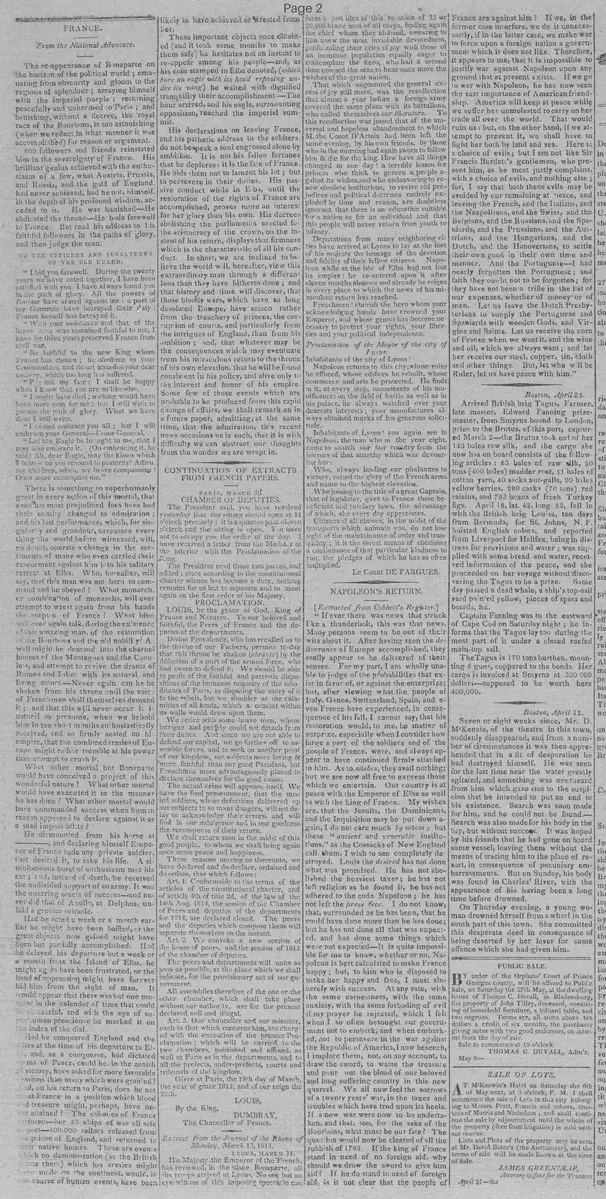
The re-appearance of Bonaparte on the horizon of the political world; emanating from obscurity and gloom to the regions of splendour; arraying himself with the imperial purple; returning peacefully and unharmed to Paris; and banishing, without a decree, the royal race of the Bourbons, is too astonishing (when we reflect in what manner it was accomplished) for reason or argument. 600 followers and friends reinstated him in the sovereignty of France. His brilliant genius achieved with the enthusiasm of a few, what Austria, Prussia, and Russia, and the gold of England had never achieved, had he not, himself, in the depth of his profound wisdom, acceded to it. He was banished—He abdicated the throne—He bade farewell to France. But read his address to his faithful followers in the paths of glory, and then judge the man.
TO THE OFFICERS AND SUBALTERNS OF THE OLD GUARD.
"I bid you farewell. During the twenty years we have acted together, I have been satisfied with you. I have always found you in the path of glory. All the powers of Europe have armed against me: a part of my Generals have betrayed their duty: France herself has betrayed it.
"With your assistance and that of the brave men who remained faithful to me, I have for three years preserved France from civil war.
"Be faithful to the new King whom France has chosen: be obedient to your Commanders, and do not abandon your dear country, which too long has suffered.
"Pity not my fate: I shall be happy when I know that you are so likewise.
"I might have died; nothing would have been more easy for me: but I still wish to pursue the path of glory. What we have done I will write.
"I cannot embrace you all; but I will embrace your General—Come General.
"Let the Eagle be brought to me, that I may also embrace it. (On embracing it, he said) Ah, dear Eagle, may the kisses which I bestow on you resound to posterity! Adieu my children, adieu, my brave companions! Once more encompass me."
There is something so superhumanly great in every action of this mortal, that even his most prejudiced foes have had their enmity changed to admiration; and his last performance, which, for singularity and grandeur, surpasses every thing the world before witnessed, will, no doubt, operate a change in the sentiments of many who even carried their resentment against him into his solitary retreat at Elba. Who, hereafter, will say, that this man was not born to command and be obeyed? What monarch, or combination of monarchs, will ever attempt to wrest again from his hands the sceptre of France? What idiot will ever again talk, during the existence of this amazing man, of the restoration of the Bourbons and the old nobility? As well might he descend into the charnel houses of the Montagues and the Capulets, and attempt to revive the drama of Romeo and Juliet with its natural and living actors.—Never again can he be shaken from his throne until the voice of Frenchmen shall themselves demand it; and that this will never occur it is natural to presume, when we behold him in ten short months enthusiastically received, and so firmly seated on his empire, that the combined armies of Europe might rather tremble at his power than attempt to crush it.
What other mortal but Bonaparte would have conceived a project of this wonderful nature? What other mortal would have executed it in the manner he has done? What other mortal would have commanded success when human reason appeared to declare against it as a mad impossibility?
He dismounted from his horse at —, and declaring himself Emperor of France bade any private soldier, that desired it, to take his life. A simultaneous burst of enthusiasm met his ear; and, instead of death, he received the undivided support of an army. It was the unerring oracle of success—and never did that of Apollo, at Delphos, unfold a greater miracle.
Had he acted a week or a month earlier he might have been baffled, or the great objects now gained might have been but partially accomplished. Had he delayed his departure but a week or a month from the Island of Elba, he might again have been frustrated, or the hand of oppression might have forever hid him from the sight of man. It would appear that there was but one moment in the calendar of time that could be successful, and with the eye of superhuman prescience he marked it on the index of the dial.
Had he conquered England and the Isles at the time of his departure to Elba, and, as a conqueror, had dictated terms of Peace, could he, in the zenith of victory, have asked for more favorable cessions than many which were granted? And, on his return to Paris, does he not find France in a position which blood and treasure might, perhaps, have never attained? The colonies of France restored—100,000 sailors released from the prison of England, and returned to their native homes. These are events which no demonstration (as the British term them) which his armies might have made on the continent, would, in due course of human events, have been likely to have achieved or wrested from her.
These important objects once obtained (and it took some months to make them safe) he hesitates not an instant to re-appear among his people—and, as his coin stamped in Elba denoted, (which bore an eagle with its head reposing under its wing) he waited with dignified tranquility their accomplishment.—The hour arrived, and his eagle, surmounting opposition, reached the imperial summit.
His declarations on leaving France and his pathetic address to the soldiers, do not bespeak a soul engrossed alone by ambition. It is not his fallen fortunes that he deplores: it is the fate of France. He bids them not to lament his lot; but to persevere in their duties. His passive conduct while in Elba, until the restoration of the rights of France are accomplished, proves more an interest for her glory than his own. His decrees abolishing the parliaments erected for the aristocracy of the crown, on the instant of his return, displays that firmness which is the characteristic of all his conduct. In short, we are inclined to believe the world will, hereafter, view this extraordinary man through a different lens than they have hitherto done; and that history and time will discover, that those bloody wars, which have so long desolated Europe, have arisen rather from the treachery of princes, the corruption of courts, and particularly from the intrigues of England, than from his ambition; and, that whatever may be the consequences which may eventuate from his miraculous return to the throne of his own elevation, that he will be found consistent in his policy, and alive only to the interest and honor of his empire.
Some few of those events which are probable to be produced from this rapid change of affairs, we shall remark on in a future paper, admitting, at the same time, that the admiration, this recent news occasions us is such, that it is with difficulty we can abstract our thoughts from the wonder we are wrapt in.
CONTINUATION OF EXTRACTS FROM FRENCH PAPERS.
PARIS, MARCH 20.
CHAMBER OF DEPUTIES
The President said, you have resolved yesterday that the sitting should open at 11 o'clock precisely; it is a quarter past eleven o'clock and the sitting is open. You have not to occupy you the order of the day. I have received a letter from the Minister of the interior with the Proclamation of the King.
The President read those two pieces, and added; since according to the constitutional charter silence has become a duty, nothing remains for us but to separate and to meet again on the first order of his Majesty.
PROCLAMATION.
LOUIS, by the grace of God. King of France and Navarre. To our beloved and faithful, the Peers of France and the deputies of the departments.
Divine Providence, who has recalled us to the throne of our Fathers, permits to-day that this throne be shaken (ébranlé) by the defection of a part of the armed force, who had sworn to defend it. We should be able to profit of the faithful and patriotic dispositions of the immense majority of the inhabitants of Paris, in disputing the entry of it to the rebels, but we shudder at the calamities of all kinds, which a combat within its walls would draw upon them.
We retire with some brave men, whom intrigue and perfidy could not detach from their duties. And since we are not able to defend our capital, we go further off to assemble forces, and to seek on another point of our kingdom, not subjects more loving & more faithful than our good Parisians, but Frenchmen more advantageously placed to declare themselves for the good cause.
The actual crisis will appease itself. We have the fond presentiment, that the misled soldiers, whose defections delivered up our subjects to so many dangers, will not delay to acknowledge their errors, and will find in our indulgence and in our goodness the recompense of their return.
We shall return soon in the midst of this good people, to whom we shall bring again once more peace and happiness.
These reasons moving us thereunto, we have declared and do declare, ordained and do ordain, that which follows:
Art. 1. Conformably to the terms of the articles of the constitutional charter, and of article 4th of title 2d. of the law of the 14th Aug. 1814, the session of the Chamber of Peers and deputies of the departments for 1814, are declared closed. The peers and the deputies which compose them will separate themselves on the instant.
Art.2. We convoke a new session of the house of peers, and the session of 1815 of the chamber of deputies. The peers and departments will unite as soon as possible, at the place which we shall indicate, for the provisionary act of our government.
All assemblies therefore of the one or the other chamber, which shall take place without our authority, are for the present declared null and illegal.
Art. 3. Our chancellor and our minister, each in that which concerns him, are charged with the execution of the present Proclamation; which will be carried to the two chambers, published and affixed, as well at Paris as in the departments, and to all the prefects, under-prefects, courts and tribunals of the kingdom.
Given at Paris. the 19th day of March the year of grace 1815, and of our reign the 20th.
LOUIS,
By the King,
DUMBRAY,
The Chancellor of France.
Extract from the Journal of the Rhone of Monday, March 13, 1815.
LYONS. MARCH 11.
His Majesty the Emperor of the French, has reviewed, in the place Bonaparte, all the troops arrived at Lyons. No one but an eye-witness of this imposing spectacle can form a just idea of this re-union of 15 or 20,000 brave men of all corps, finding again the chief whom they idolized, swearing to him anew the most inviolable devotedness, confounding their cries of joy with those of an immense population equally eager to contemplate the hero, who had a second time crossed the seas, to hear once more the wishes of the great nation.
That which augmented the general excess of joy still more, was the recollection that almost a year before a foreign army covered the same place with its battalions, who called themselves our liberators. To this recollection was joined that of the universal and hopeless abandonment to which M. the Count D'Artois had been left the same evening. by his own friends, by those who in the morning had again sworn to follow him & die for the king. How have all things changed in one day! a terrible lesson for princes who think to govern a people against its wishes, and who endeavoring to renew obsolete institutions, to revive old prejudices and political doctrines entirely exploded by time and reason, are doubtless ignorant that there is an education suitable for a nation as for an individual and that this people will never return from youth to infancy.
Deputations from many neighboring cities have arrived at Lyons to lay at the feet of his majesty the homage of the devotion and fidelity of their fellow citizens. Napoleon while at the isle of Elba had not lost its empire: he re-entered upon it after eleven months absence and already he reigns in every place to which the news of his miraculous return has reached.
Frenchmen! cherish the hero whom you acknowledging hands have crowned your Emperor, and whose genius has become necessary to protect your rights, your liberties and your political independence.
Proclamation of the Mayor of the city of Lyons.
Inhabitants of the city of Lyons
Napoleon returns to this city, whose ruins he effaced. whose edifices he rebuilt, whose commerce and arts he protected. He finds in it, at every step, monuments of his munificence: on the field of battle as well as in his palace, he always watched over your dearest interests; your manufactures always obtained marks of his generous solicitude.
Inhabitants of Lyons! you again see in Napoleon, the man who in the year eight, came to snatch our fair country from the horrors of that anarchy which was devouring her:
Who, always leading our phalanxes to victory, raised the glory of the French arms and name to the highest elevation.
Who joining to the title of a great Captain. that of legislator, gave to France those beneficent and tutelary laws, the advantage of which, she every day appreciates.
Citizens of all classes, in the midst of the transports which animate you, do not lose sight of the maintenance of order and tranquility ; it is the surest means of obtaining a continuance of that particular kindness to you, the pledges of which he has so often multiplied.
Le Count DE FARGUES.
What sub-type of article is it?
What keywords are associated?
What entities or persons were involved?
Where did it happen?
Foreign News Details
Primary Location
France
Event Date
March 1815
Key Persons
Outcome
napoleon reinstated as emperor with enthusiastic support from troops and populace; louis xviii dissolves chambers, retreats from paris; peaceful return without combat; restoration of french colonies and release of sailors.
Event Details
Napoleon returns from Elba with 600 followers, meets no resistance, and reclaims sovereignty in France. Address to Old Guard recalled. Louis XVIII issues proclamation on March 19, 1815, closing sessions and planning reconvention elsewhere. In Lyons on March 11, Napoleon reviews 15-20,000 troops amid celebrations; mayor proclaims support.