Thank you for visiting SNEWPapers!
Sign up free
United Automobile Worker
Detroit, Wayne County, Michigan
What is this article about?
UAW-CIO's GM Department, led by Walter Reuther, files a brief with federal agencies arguing that corporations' vast wartime profits and refunds allow wage increases without price hikes, criticizing double standards in wage and price controls during postwar reconversion.
Merged-components note: Headline matches the content of the GM wage policy article, referring to the 15 years of profits mentioned in the text.
Clipping
OCR Quality
Full Text
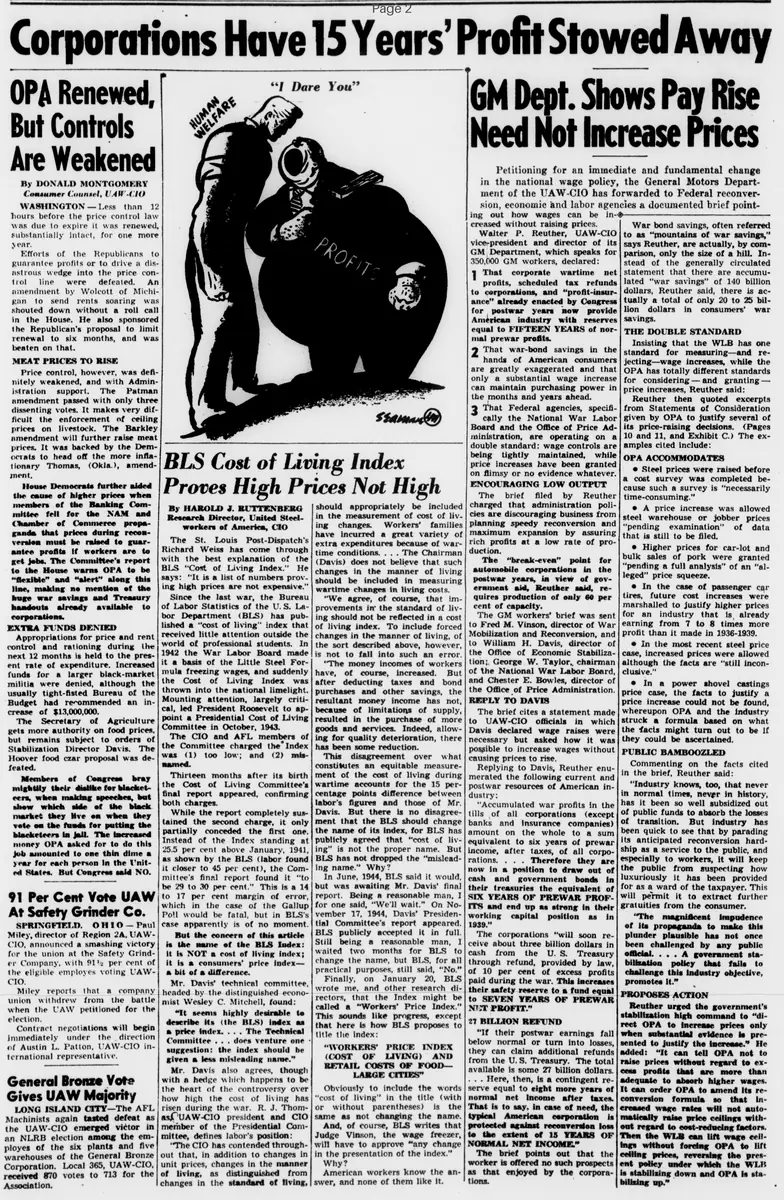
GM Dept. Shows Pay Rise Need Not Increase Prices
Petitioning for an immediate and fundamental change in the national wage policy, the General Motors Department of the UAW-CIO has forwarded to Federal reconversion, economic and labor agencies a documented brief pointing out how wages can be increased without raising prices.
Walter P. Reuther, UAW-CIO vice-president and director of its GM Department, which speaks for 350,000 GM workers, declared:
That corporate wartime net profits, scheduled tax refunds to corporations, and "profit-insurance" already enacted by Congress for postwar years now provide American industry with reserves equal to FIFTEEN YEARS of normal prewar profits.
That war-bond savings in the hands of American consumers are greatly exaggerated and that only a substantial wage increase can maintain purchasing power in the months and years ahead.
That Federal agencies, specifically the National War Labor Board and the Office of Price Administration, are operating on a double standard: wage controls are being tightly maintained, while price increases have been granted on flimsy or no evidence whatever.
ENCOURAGING LOW OUTPUT
The brief filed by Reuther charged that administration policies are discouraging business from planning speedy reconversion and maximum expansion by assuring rich profits at a low rate of production.
The "break-even" point for automobile corporations in the postwar years, in view of government aid, Reuther said, requires production of only 60 per cent of capacity.
The GM workers' brief was sent to Fred M. Vinson, director of War Mobilization and Reconversion, and to William H. Davis, director of the Office of Economic Stabilization; George W. Taylor, chairman of the National War Labor Board, and Chester E. Bowles, director of the Office of Price Administration.
REPLY TO DAVIS
The brief cites a statement made to UAW-CIO officials in which Davis declared wage raises were necessary but asked how it was possible to increase wages without causing prices to rise.
Replying to Davis, Reuther enumerated the following current and postwar resources of American industry:
"Accumulated war profits in the tills of all corporations (except banks and insurance companies) amount on the whole to a sum equivalent to six years of prewar income, after taxes, of all corporations. . . . Therefore they are now in a position to draw out of cash and government bonds in their treasuries the equivalent of SIX YEARS OF PREWAR PROFITS and end up as strong in their working capital position as in 1939."
The corporations "will soon receive about three billion dollars in cash from the U. S. Treasury through refund, provided by law, of 10 per cent of excess profits paid during the war. This increases their safety reserve to a fund equal to SEVEN YEARS OF PREWAR NET PROFIT."
27 BILLION REFUND
"If their postwar earnings fall below normal or turn into losses, they can claim additional refunds from the U.S. Treasury. The total available is some 27 billion dollars. . . . Here, then, is a contingent reserve equal to eight more years of normal net income after taxes.
That is to say, in case of need, the typical American corporation is protected against reconversion loss to the extent of 15 YEARS OF NORMAL NET INCOME"
The brief points out that the worker is offered no such prospects as that enjoyed by the corporations.
War bond savings, often referred to as "mountains of war savings," says Reuther, are actually, by comparison, only the size of a hill. Instead of the generally circulated statement that there are accumulated "war savings" of 140 billion dollars, Reuther said, there is actually a total of only 20 to 25 billion dollars in consumers' war savings.
THE DOUBLE STANDARD
Insisting that the WLB has one standard for measuring—and rejecting—wage increases, while the OPA has totally different standards for considering—and granting—price increases, Reuther said:
Reuther then quoted excerpts from Statements of Consideration given by OPA to justify several of its price-raising decisions. (Pages 10 and 11, and Exhibit C.) The examples cited include:
OPA ACCOMMODATES
• Steel prices were raised before a cost survey was completed because such a survey is "necessarily time-consuming."
A price increase was allowed steel warehouse or jobber prices "pending examination" of data that is still to be filed.
Higher prices for car-lot and bulk sales of pork were granted "pending a full analysis" of an "alleged" price squeeze.
In the case of passenger car tires, future cost increases were marshalled to justify higher prices for an industry that is already earning from 7 to 8 times more profit than it made in 1936-1939.
In the most recent steel price case, increased prices were allowed although the facts are "still inconclusive."
In a power shovel castings price case, the facts to justify a price increase could not be found, whereupon OPA and the industry struck a formula based on what the facts might turn out to be if they could be ascertained.
PUBLIC BAMBOOZLED
Commenting on the facts cited in the brief, Reuther said:
"Industry knows, too, that never in normal times, never in history, has it been so well subsidized out of public funds to absorb the losses of transition. But industry has been quick to see that by parading its anticipated reconversion hardship as a service to the public, and especially to workers, it will keep the public from suspecting how luxuriously it has been provided for as a ward of the taxpayer. This will permit it to extract further gratuities from the consumer.
"The magnificent impudence of its propaganda to make this plunder plausible has not once been challenged by any public official. . . . A government stabilization policy that fails to challenge this industry objective, promotes it."
PROPOSES ACTION
Reuther urged the government's stabilization high command to "direct OPA to increase prices only when substantial evidence is presented to justify the increase." He added: "It can tell OPA not to raise prices without regard to excess profits that are more than adequate to absorb higher wages.
It can order OPA to amend its reconversion formula so that increased wage rates will not automatically raise price ceilings without regard to cost-reducing factors.
Then the WLB can lift wage ceilings without forcing OPA to lift ceiling prices, reversing the present policy under which the WLB is stabilizing down and OPA is stabilizing up."
What sub-type of article is it?
What themes does it cover?
What keywords are associated?
What entities or persons were involved?
Where did it happen?
Story Details
Key Persons
Location
United States
Event Date
Postwar Years
Story Details
UAW-CIO GM Department files brief arguing corporations' 15 years of prewar profits reserves allow wage increases without price rises; criticizes double standards in wage/price controls and proposes policy changes for fair reconversion.