Thank you for visiting SNEWPapers!
Sign up free
The Arkansas Advocate
Little Rock, Pulaski County, Arkansas
What is this article about?
Condensed biographical summary of Senator Hugh Lawson White from the Knoxville Register, detailing his birth in North Carolina in 1773, move to Tennessee, legal education, judicial career, banking role, state senate service, national commissioner position, U.S. Senate election as Jackson's successor, political consistency, and personal virtues.
Clipping
OCR Quality
Full Text
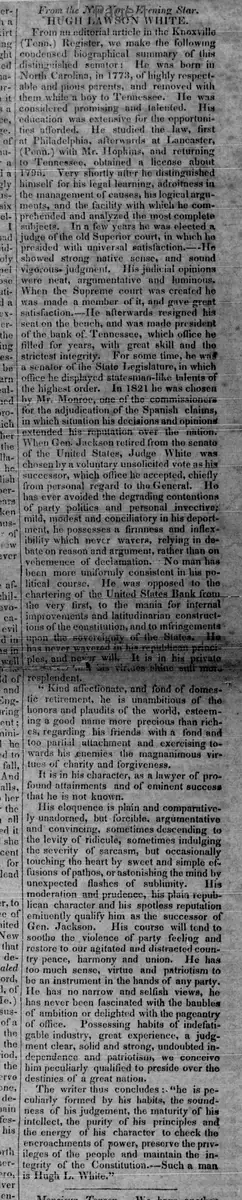
From an editorial article in the Knoxville (Tenn.) Register, we make the following condensed biographical summary of this distinguished senator: He was born in North Carolina, in 1773, of highly respectable and pious parents, and removed with them while a boy to Tennessee. He was considered promising and talented. His education was extensive for the opportunities afforded. He studied the law, first at Philadelphia, afterwards at Lancaster (Penn.) with Mr. Hopkins, and returning to Tennessee, obtained a license about 1790. Very shortly after he distinguished himself for his legal learning, adroitness in the management of causes, his logical arguments, and the facility with which he comprehended and analyzed the most complete subjects. In a few years he was elected a judge of the old Superior court, in which he presided with universal satisfaction.—He showed strong native sense, and sound vigorous judgment, His judicial opinions were neat, argumentative and luminous. When the Supreme court was created he was made a member of it, and gave great satisfaction.—He afterwards resigned his seat on the bench, and was made president of the bank of Tennessee, which office he filled for years, with great skill and the strictest integrity. For some time, he was a senator of the State Legislature, in which office he displayed statesman-like talents of the highest order. In 1821 he was chosen by Mr. Monroe, one of the commissioners for the adjudication of the Spanish claims, in which situation his decisions and opinions extended his reputation over the nation.
When Gen. Jackson retired from the senate of the United States, Judge White was chosen by a voluntary unsolicited vote as his successor, which office he accepted, chiefly from personal regard to the General. He has ever avoided the degrading contentions of party politics and personal invective; mild, modest and conciliatory in his deportment, he possesses a firmness and inflexibility which never wavers, relying in debate on reason and argument, rather than on vehemence of declamation. No man has been more uniformly consistent in his political course. He was opposed to the chartering of the United States Bank from the very first, to the mania for internal improvements and latitudinarian constructions of the constitution, and to infringements upon the sovereignty of the states, and never will. It is in his private character that he is most resplendent.
" Kind affectionate, and fond of domestic retirement, he is unambitious of the honors and plaudits of the world, esteeming a good name more precious than riches, regarding his friends with a fond and too partial attachment and exercising towards his enemies the magnanimous virtues of charity and forgiveness.
It is in his character, as a lawyer of profound attainments and of eminent success that he is not known. His eloquence is plain and comparatively unadorned, but forcible, argumentative and convincing, sometimes descending to the levity of ridicule, sometimes indulging the severity of sarcasm, but occasionally touching the heart by sweet and simple effusions of pathos, or astonishing the mind by unexpected flashes of sublimity. His moderation and prudence, his plain republican character and his spotless reputation eminently qualify him as the successor of Gen. Jackson. His course will tend to soothe the violence of party feeling and restore to our agitated and distracted country peace, harmony and union. He has too much sense, virtue and patriotism to be an instrument in the hands of any party. He has no narrow and selfish views, he has never been fascinated with the baubles of ambition or delighted with the pageantry of office. Possessing habits of indefatigable industry, great experience, a judgment clear, solid and strong, undoubted independence and patriotism we conceive him peculiarly qualified to preside over the destinies of a great nation.
The writer thus concludes: "he is peculiarly formed by his habits, the soundness of his judgement, the maturity of his intellect, the purity of his principles and the energy of his character to check the encroachments of power, preserve the privileges of the people and maintain the integrity of the Constitution.—Such a man is Hugh L. White."
What sub-type of article is it?
What keywords are associated?
What entities or persons were involved?
Where did it happen?
Domestic News Details
Primary Location
Tennessee
Key Persons
Event Details
Condensed biographical summary of Hugh Lawson White, born in North Carolina in 1773, moved to Tennessee, studied law in Philadelphia and Lancaster, licensed around 1790, became judge of Superior Court, then Supreme Court, president of Bank of Tennessee, state senator, commissioner for Spanish claims in 1821, U.S. Senator succeeding Jackson, known for political consistency, opposition to U.S. Bank and internal improvements, private virtues, legal eloquence, and qualifications as presidential successor.