Thank you for visiting SNEWPapers!
Sign up free
Story
June 29, 1895
The Daily Herald
Brownsville, Cameron County, Texas
What is this article about?
Biographical profile of Richard Olney's rapid rise from Boston lawyer to U.S. Attorney General in 1893 and Secretary of State in 1895 under President Cleveland, highlighting his legal expertise and handling of the 1894 Chicago riots against Eugene Debs.
Clipping
OCR Quality
98%
Excellent
Full Text
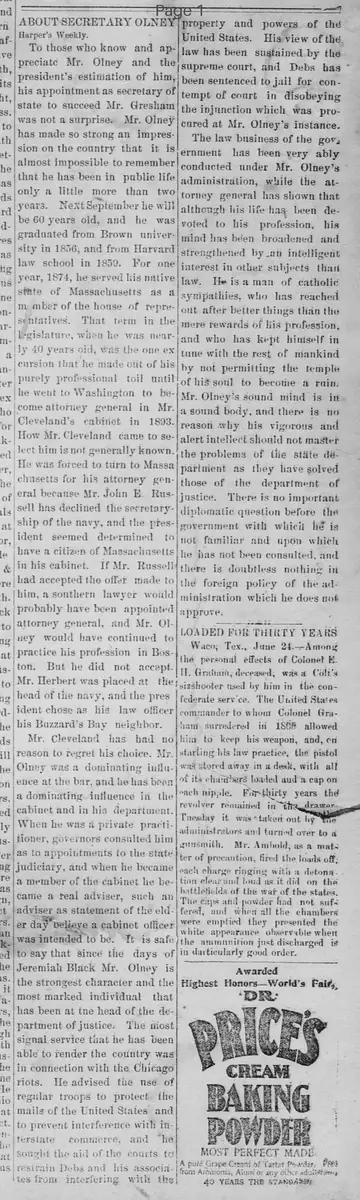
ABOUT SECRETARY OLNEY
Harper's Weekly.
To those who know and appreciate Mr. Olney and the president's estimation of him, his appointment as secretary of state to succeed Mr. Gresham was not a surprise. Mr. Olney has made so strong an impression on the country that it is almost impossible to remember that he has been in public life only a little more than two years. Next September he will be 60 years old, and he was graduated from Brown university in 1856, and from Harvard law school in 1859. For one year, 1874, he served his native state of Massachusetts as a member of the house of representatives. That term in the legislature, when he was nearly 40 years old, was the one excursion that he made out of his purely professional toil until he went to Washington to become attorney general in Mr. Cleveland's cabinet in 1893.
How Mr. Cleveland came to select him is not generally known. He was forced to turn to Massachusetts for his attorney general because Mr. John E. Russell had declined the secretaryship of the navy, and the president seemed determined to have a citizen of Massachusetts in his cabinet. If Mr. Russell had accepted the offer made to him, a southern lawyer would probably have been appointed attorney general, and Mr. Olney would have continued to practice his profession in Boston. But he did not accept. Mr. Herbert was placed at the head of the navy, and the president chose as his law officer his Buzzard's Bay neighbor.
Mr. Cleveland has had no reason to regret his choice. Mr. Olney was a dominating influence at the bar, and he has been a dominating influence in the cabinet and in his department. When he was a private practitioner, governors consulted him as to appointments to the state judiciary, and when he became a member of the cabinet he became a real adviser, such an adviser as statesmen of the elder day believe a cabinet officer was intended to be. It is safe to say that since the days of Jeremiah Black Mr. Olney is the strongest character and the most marked individual that has been at the head of the department of justice. The most signal service that he has been able to render the country was in connection with the Chicago riots. He advised the use of regular troops to protect the mails of the United States and to prevent interference with interstate commerce, and he sought the aid of the courts to restrain Debs and his associates from interfering with the property and powers of the United States. His view of the law has been sustained by the supreme court, and Debs has been sentenced to jail for contempt of court in disobeying the injunction which was procured at Mr. Olney's instance.
The law business of the government has been very ably conducted under Mr. Olney's administration, while the attorney general has shown that although his life has been devoted to his profession, his mind has been broadened and strengthened by an intelligent interest in other subjects than law. He is a man of catholic sympathies, who has reached out after better things than the mere rewards of his profession, and who has kept himself in tune with the rest of mankind by not permitting the temple of his soul to become a ruin.
Mr. Olney's sound mind is in a sound body, and there is no reason why his vigorous and alert intellect should not master the problems of the state department as they have solved those of the department of justice. There is no important diplomatic question before the government with which he is not familiar and upon which he has not been consulted, and there is doubtless nothing in the foreign policy of the administration which he does not approve.
Harper's Weekly.
To those who know and appreciate Mr. Olney and the president's estimation of him, his appointment as secretary of state to succeed Mr. Gresham was not a surprise. Mr. Olney has made so strong an impression on the country that it is almost impossible to remember that he has been in public life only a little more than two years. Next September he will be 60 years old, and he was graduated from Brown university in 1856, and from Harvard law school in 1859. For one year, 1874, he served his native state of Massachusetts as a member of the house of representatives. That term in the legislature, when he was nearly 40 years old, was the one excursion that he made out of his purely professional toil until he went to Washington to become attorney general in Mr. Cleveland's cabinet in 1893.
How Mr. Cleveland came to select him is not generally known. He was forced to turn to Massachusetts for his attorney general because Mr. John E. Russell had declined the secretaryship of the navy, and the president seemed determined to have a citizen of Massachusetts in his cabinet. If Mr. Russell had accepted the offer made to him, a southern lawyer would probably have been appointed attorney general, and Mr. Olney would have continued to practice his profession in Boston. But he did not accept. Mr. Herbert was placed at the head of the navy, and the president chose as his law officer his Buzzard's Bay neighbor.
Mr. Cleveland has had no reason to regret his choice. Mr. Olney was a dominating influence at the bar, and he has been a dominating influence in the cabinet and in his department. When he was a private practitioner, governors consulted him as to appointments to the state judiciary, and when he became a member of the cabinet he became a real adviser, such an adviser as statesmen of the elder day believe a cabinet officer was intended to be. It is safe to say that since the days of Jeremiah Black Mr. Olney is the strongest character and the most marked individual that has been at the head of the department of justice. The most signal service that he has been able to render the country was in connection with the Chicago riots. He advised the use of regular troops to protect the mails of the United States and to prevent interference with interstate commerce, and he sought the aid of the courts to restrain Debs and his associates from interfering with the property and powers of the United States. His view of the law has been sustained by the supreme court, and Debs has been sentenced to jail for contempt of court in disobeying the injunction which was procured at Mr. Olney's instance.
The law business of the government has been very ably conducted under Mr. Olney's administration, while the attorney general has shown that although his life has been devoted to his profession, his mind has been broadened and strengthened by an intelligent interest in other subjects than law. He is a man of catholic sympathies, who has reached out after better things than the mere rewards of his profession, and who has kept himself in tune with the rest of mankind by not permitting the temple of his soul to become a ruin.
Mr. Olney's sound mind is in a sound body, and there is no reason why his vigorous and alert intellect should not master the problems of the state department as they have solved those of the department of justice. There is no important diplomatic question before the government with which he is not familiar and upon which he has not been consulted, and there is doubtless nothing in the foreign policy of the administration which he does not approve.
What sub-type of article is it?
Biography
What themes does it cover?
Triumph
Fortune Reversal
What keywords are associated?
Richard Olney
Secretary Of State
Attorney General
Grover Cleveland
Chicago Riots
Debs Injunction
What entities or persons were involved?
Mr. Olney
Mr. Cleveland
Mr. Gresham
Mr. John E. Russell
Mr. Herbert
Debs
Jeremiah Black
Where did it happen?
Massachusetts, Boston, Washington
Story Details
Key Persons
Mr. Olney
Mr. Cleveland
Mr. Gresham
Mr. John E. Russell
Mr. Herbert
Debs
Jeremiah Black
Location
Massachusetts, Boston, Washington
Event Date
1893 1895
Story Details
Richard Olney, a prominent Boston lawyer, was appointed Attorney General in 1893 by President Cleveland and later Secretary of State in 1895 succeeding Gresham. His career highlights include handling the Chicago riots by deploying troops and obtaining injunctions against Debs, upheld by the Supreme Court.