Thank you for visiting SNEWPapers!
Sign up free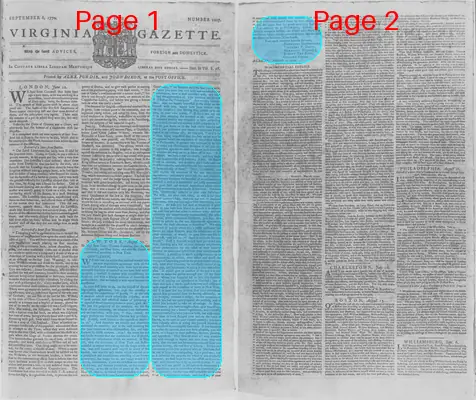
The Virginia Gazette
Richmond, Williamsburg, Richmond County, Virginia
What is this article about?
Albany merchants, led by Harmanus Gansevoort, rebuke New York merchant committee for abandoning the non-importation agreement against British revenue acts, urging them to retract orders and uphold colonial unity to preserve liberties. Dated August 7, 1770.
Merged-components note: This is a single continuous letter from Albany merchants to the New York committee criticizing their decision on non-importation, split across components due to parsing.
Clippings
1 of 2
OCR Quality
Full Text
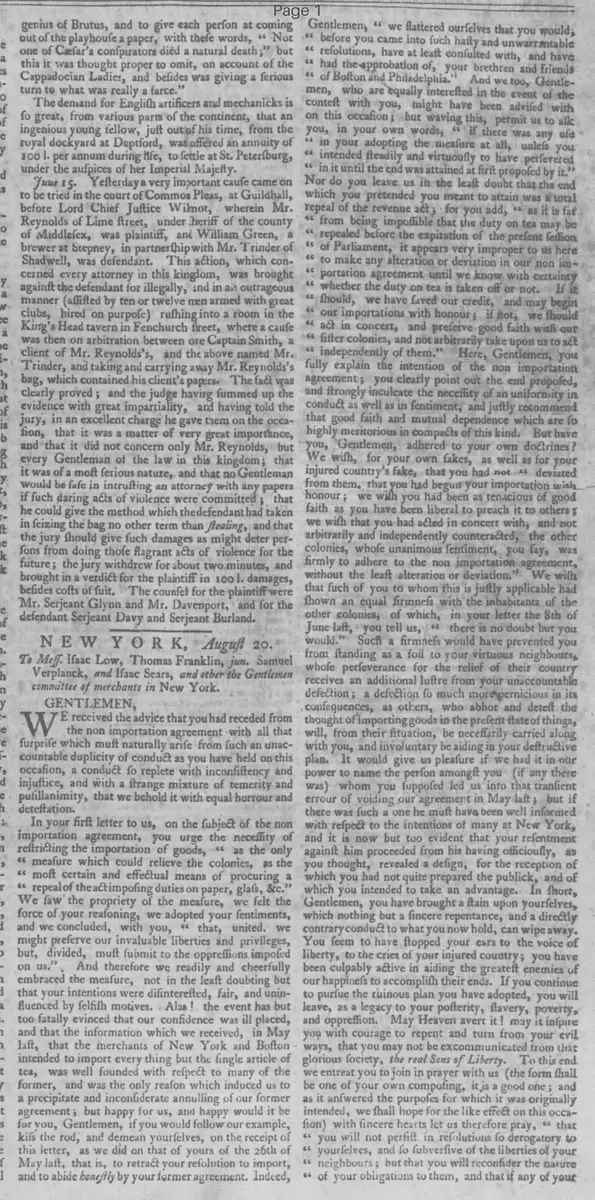
To Messrs. Isaac Low, Thomas Franklin, jun. Samuel Verplanck, and Isaac Sears, and other the Gentlemen committee of merchants in New York.
GENTLEMEN,
We received the advice that you had receded from the non importation agreement with all that surprise which must naturally arise from such an unaccountable duplicity of conduct as you have held on this occasion, a conduct so replete with inconsistency and injustice, and with a strange mixture of temerity and pusillanimity, that we behold it with equal horror and detestation.
In your first letter to us, on the subject of the non importation agreement, you urge the necessity of restricting the importation of goods, as the only "measure which could relieve the colonies, as the most certain and effectual means of procuring a repeal of the act imposing duties on paper, glass, &c."
We saw the propriety of the measure, we felt the force of your reasoning, we adopted your sentiments, and we concluded, with you, "that, united, we might preserve our invaluable liberties and privileges, but, divided, must submit to the oppressions imposed on us." And therefore we readily and cheerfully embraced the measure, not in the least doubting but that your intentions were disinterested, fair, and uninfluenced by selfish motives. Alas! the event has but too fatally evinced that our confidence was ill placed, and that the information which we received, in May last, that the merchants of New York and Boston intended to import every thing but the single article of tea, was well founded with respect to many of the former, and was the only reason which induced us to a precipitate and inconsiderate annulling of our former agreement; but happy for us, and happy would it be for you, Gentlemen, if you would follow our example, kiss the rod, and demean yourselves, on the receipt of this letter, as we did on that of yours of the 26th of May last, that is, to retract your resolution to import, and to abide honestly by your former agreement. Indeed,
Gentlemen, we flattered ourselves that you would, before you came into such hasty and unwarrantable "resolutions, have at least consulted with, and have had the approbation of, your brethren and friends of Boston and Philadelphia." And we too, Gentlemen, who are equally interested in the event of the contest with you, might have been advised with on this occasion; but waving this, permit us to ask you, in your own words, if there was any use in your adopting the measure at all, unless you intended steadily and virtuously to have persevered "in it until the end was attained at first proposed by it."
Nor do you leave us in the least doubt that the end which you pretended you meant to attain was a total repeal of the revenue act; for you add, as if it is far "from being impossible that the duty on tea may be repealed before the expiration of the present session of Parliament, it appears very improper to us here to make any alteration or deviation in our non importation agreement until we know with certainty whether the duty on tea is taken off or not. If it should, we have saved our credit, and may begin our importations with honour; if not, we should act in concert, and preserve good faith with our sister colonies, and not arbitrarily take upon us to act independently of them." Here, Gentlemen, you fully explain the intention of the non importation agreement; you clearly point out the end proposed, and strongly inculcate the necessity of an uniformity in conduct as well as in sentiment, and justly recommend that good faith and mutual dependence which are so highly meritorious in compacts of this kind. But have you, Gentlemen, adhered to your own doctrines?
We wish, for your own sakes, as well as for your injured country's sake, that you had not deviated from them, that you had begun your importation with honour; we wish you had been as tenacious of good faith as you have been liberal to preach it to others; we wish that you had acted in concert with, and not arbitrarily and independently counteracted, the other colonies, whose unanimous sentiment, you say, was firmly to adhere to the non importation agreement, without the least alteration or deviation." We wish that such of you to whom this is justly applicable had shown an equal firmness with the inhabitants of the other colonies, of which, in your letter the 8th of June last, you tell us, "there is no doubt but you would." Such a firmness would have prevented you from standing as a foil to your virtuous neighbours, whose perseverance for the relief of their country receives an additional lustre from your unaccountable defection; a defection so much more pernicious in its consequences, as others, who abhor and detest the thought of importing goods in the present state of things, will, from their situation, be necessarily carried along with you, and involuntarily be aiding in your destructive plan. It would give us pleasure if we had it in our power to name the person among you (if any there was) whom you supposed led us into that transient error of voiding our agreement in May last; but if there was such a one he must have been well informed with respect to the intentions of many at New York, and it is now but too evident that your resentment against him proceeded from his having officiously, as you thought, revealed a design, for the reception of which you had not quite prepared the public, and of which you intended to take an advantage. In short, Gentlemen, you have brought a stain upon yourselves, which nothing but a sincere repentance, and a directly contrary conduct to what you now hold, can wipe away.
You seem to have stopped your ears to the voice of liberty, to the cries of your injured country; you have been culpably active in aiding the greatest enemies of our happiness to accomplish their ends. If you continue to pursue the ruinous plan you have adopted, you will leave, as a legacy to your posterity, slavery, poverty, and oppression. May Heaven avert it! may it inspire you with courage to repent and turn from your evil ways, that you may not be excommunicated from that glorious society, the real Sons of Liberty. To this end we entreat you to join in prayer with us (the form shall be one of your own composing, it is a good one; and as it answered the purposes for which it was originally intended, we shall hope for the like effect on this occasion) with sincere hearts let us therefore pray, that "you will not persist in resolutions so derogatory to yourselves, and so subversive of the liberties of your neighbours; but that you will reconsider the nature of your obligations to them, and that if any of your
Some merchants have already sent forward their orders
"they will countermand them by next opportunity,
and not again send for goods until they shall hear
it is resolved on at Philadelphia, Boston, &c."
After so solemn a service, we would not disturb your
meditation by any farther animadversions, and therefore
we subscribe ourselves, Gentlemen,
Your most obedient humble servants,
Harmanus Gansevoort.
Volckert P. Douw
Harmanus Wendell.
Barent Ten Eyck.
Gysbert Fonde.
ALBANY, AUGUST 7, 1770.
What sub-type of article is it?
What themes does it cover?
What keywords are associated?
What entities or persons were involved?
Letter to Editor Details
Author
Harmanus Gansevoort, Volckert P. Douw, Harmanus Wendell, Barent Ten Eyck, Gysbert Fonde
Recipient
Messrs. Isaac Low, Thomas Franklin, Jun., Samuel Verplanck, Isaac Sears, And Other Gentlemen Committee Of Merchants In New York
Main Argument
the albany signatories condemn the new york merchants for abandoning the non-importation agreement, which was meant to force repeal of british revenue duties, and urge them to retract import orders to restore unity and preserve colonial liberties against oppression.
Notable Details