Thank you for visiting SNEWPapers!
Sign up free
Literary
January 23, 1879
Jamestown Alert
Jamestown, Stutsman County, North Dakota
What is this article about?
In 'Paying the Penalty,' a poor woman discovers her deceased husband's body was used by surgeon Dr. Fordyce to disguise the corpse of Clymer Remington, killed in a duel with Edouard De Vivo. She blackmails the Remington family for money and jewels to ensure silence about the secret.
Clipping
OCR Quality
95%
Excellent
Full Text
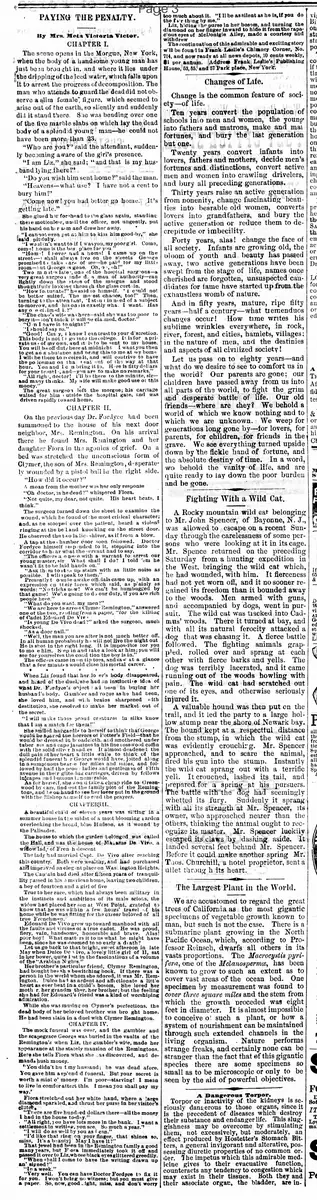
PAYING THE PENALTY.
By Mrs. Meta Victoria Victor.
CHAPTER I.
The scene opens in the Morgue, New York, when the body of a handsome young man has just been brought in, and where it lies under the dripping of the iced water, which falls upon it to arrest the progress of decomposition. The man who attends to guard the dead did not observe a slim female figure, which seemed to arise out of the earth, so silently and suddenly did it stand there. She was bending over one of the five marble slabs on which lay the dead body of a splendid young man—he could not have been more than 23.
"Who are you?" said the attendant, suddenly becoming aware of the girl's presence.
"I am Liz," she said; "and that is my husband lying there!"
"Do you wish him sent home?" said the man.
"Heavens—what use? I have not a cent to bury him!"
"Come now! you had better go home. It's getting late."
She glued her forehead to the glass again, standing there motionless, until the officer, not ungently, put his hand on her arm and drew her away.
"I cannot even get at him to kiss him good-by," she said pitifully.
"I wouldn't want to if I was you, my poor girl. Come, come! home is the best place for you."
"Home! I never had a home! I came up on the streets—I shall always live on the streets. George promised to take care of me—he paid for my little room—but George is gone. Oh, oh, oh!"
Two nights late, one of the hospital surgeons—a very great surgeon indeed, a man of authority—ran lightly down the steps of the morgue and stood thoughtfully looking through the glass curtain.
"How fortunate!" he said to himself. "I could not be better suited. The meetest chance, too!" Then, turning to the attendant, "I am in need of a subject to-morrow, and this case exactly what I want. Has anyone claimed it?"
"The chap's wife was here—said she was too poor to bury it—I don't think it will be claimed, doctor."
"Can I have it to-night?"
"I should say so."
"Good! Case you, I know I can trust to your discretion. This body is not to go into the college. It is for a private use of my own, and it is to be sent to my house. You will be off duty here at midnight. I want you then to get an ambulance and bring this to me at my home. I will be there to receive it, and will contrive to have the policeman on the beat out of the way at that hour. You and I can bring it in. Here is fifty dollars for your trouble, and—you are to make no remarks."
"All right, doctor! I'll be there to the minute, sir—and many thanks. My wife will make good use of this money."
The great surgeon left the morgue; his carriage waited for him outside the hospital gate, and was driven rapidly toward home.
CHAPTER II.
On the previous day Dr. Fordyce had been summoned to the house of his next door neighbor, Mrs. Remington. On his arrival there he found Mrs. Remington and her daughter Flora in the agonies of grief. On a bed was stretched the unconscious form of Clymer, the son of Mrs. Remington, desperately wounded by a pistol ball in the right side.
"How did it occur?"
A moan from the mother was her only response.
"Oh doctor, is he dead?" whispered Flora.
"Not quite, my dear, not quite. His heart beats, I think."
The surgeon turned down the sheet to examine the wound, which he found of the most critical character; and, as he stooped over the patient, heard a violent ringing at the bell and knocking on the street door. He observed the two ladies shiver, as if from a blow. A tap at the chamber door soon followed. Doctor Fordyce himself responded to it, stepping into the corridor to hear what the servant had to say.
"The officers are here with a warrant to arrest our young master, sir. What shall I do? I told'em he wasn't fit to be laid hands on."
"Ask them to come up stairs with as little noise as possible. I will speak to them."
Presently two wide-awake officials came up, with an expression on their faces which said, as plainly as words: "No tricks now! We can't be humbugged by that game! We're going to do our duty, if you are rich people here."
"What do you want, my men?"
"We are here to arrest Clymer Remington," answered one of the two, reading from a paper, "for the killing of Cadet Edouard De Vivo."
"Is young De Vivo dead?" asked the surgeon, much shocked.
"As a door nail."
"Well, the man you are after is not much better off. In all human probability he will not live the night out. He is shot in the right lung. It is impossible for you to move him. Step in and take a look at him: you will see for yourselves the condition the boy is in."
The officers came in on tiptoes, and saw at a glance that a few minutes would close his mortal career.
When Liz found that her lover's body disappeared, and heard of the duel, she had an instinctive idea of what Dr. Fordyce's object had been in buying her husband's body. Gambler and rogue as he had been, she loved him, and with brains sharpened with destitution, she resolved to make her market out of the secret.
"I will make those proud creatures in silks know that I am a match for them!"
She smiled haggardly to herself to think that George would be spared the horrors of Potter's Field—that he would be dressed in broadcloth, and smothered under tuberoses and cape jasmines in his fine rosewood coffin with the solid silver handles. It almost deadened the dull pain at her heart a little while to think of the splendid funeral her George would have, jolted along in a sumptuous hearse for miles and miles, and followed by half the proud ladies and gentlemen of Fifth avenue in their glittering carriages, driven by fellows in capes and buttons innumerable.
As for herself, she would take a cheap ride to Greenwood by cars, find out the family plot of the Remingtons, and be on hand to see her lover put in the ground with the Bishop himself to read the prayers.
CHAPTER III.
A beautiful child of eleven years was sitting in a summer house in the midst of a most blooming garden overlooking the broad, blue Hudson, as it wound by the Palisades.
The house to which the garden belonged was called the Hall, and was the house of Madame De Vivo, a widow lady of French descent.
The lady had married Capt. De Vivo after reaching this country. Both were wealthy, and had purchased and improved an elegant place on Washington Heights. The Captain had died after fifteen years of tranquility passed in his American home, leaving two children—a boy of fourteen and a girl of five.
True to her race, which had always been military in the instincts and ambitions of its male scions, the widow had placed her son at West Point, grateful to know that he was within a few hours' travel of his home while he was fitting for the career beloved of all true Frenchmen.
Edouard De Vivo grew up toward manhood with all the faults and virtues of a true cadet. He was proud, fiery, vain, handsome, honorable and brave. Alas! poor boy! What matters it to us what he might have been, since he was doomed to so early a death?
Let us go back to that bright, sweet afternoon in late May when Dulce De Vivo, a lovely little girl of 11, sat in her bower, quite lost in the fascinations of a volume of the "Arabian Nights."
Her brother's particular friend, Clymer Remington, had bought her this bewitching book. If there was a person in the world whom she adored, it was Mr. Remington. Dulce had as ardent and affectionate a little heart as ever beat in a child's bosom. She loved her mother, her grandmother, her brother; but the feeling she had for Edouard's friend was a kind of worshiping admiration.
While she was musing on Clymer's perfections, the dead body of her beloved brother was brought home. He had been slain in a duel with Clymer Remington.
CHAPTER IV.
The mock funeral was over, and the gambler and the scapegrace George was buried in the vaults of the Remingtons when Liz, the gambler's wife, made her appearance at the stately mansion of the Remingtons. Here she tells Flora what she has discovered, and demands hush money.
"You didn't hurt my husband; he was dead afore. You gave him a splendid funeral. But your secret is worth a mint o' money. I'm poor—starving! I mean to live in comfort after this. I mean you shall pay my way."
Flora stretched out her white hand, where a large diamond sparkled, and thrust her purse in her visitor's clutch.
"There are five hundred dollars there—all the money I had in the house to-day."
"All right, you have lots more in the bank. I want a settlement in writing, you see. So much a year."
"I will do as well by you as I can."
"I'd like that ring on your finger, that shines so, miss. It's a beauty. May I have it?"
That jewel had been in the Remington family a good many years, but Flora immediately took it off and passed it over to Liz, whose black eyes glittered greedily.
"When shall I come to have the writing drawn up an' signed?"
"In a week."
"Very well. You can have Doctor Fordyce to fix it for you. I won't bring no witness; but you must give paper. So, now, good night, miss, and don't worry too much about it. I'll be as silent as he is, if you do the fair thing by me."
Liz, holding the purse in her bosom, and turning the diamond on her finger inward to hide it from the rapacious eyes of McDonigle Alley, made a courtesy and withdrew.
By Mrs. Meta Victoria Victor.
CHAPTER I.
The scene opens in the Morgue, New York, when the body of a handsome young man has just been brought in, and where it lies under the dripping of the iced water, which falls upon it to arrest the progress of decomposition. The man who attends to guard the dead did not observe a slim female figure, which seemed to arise out of the earth, so silently and suddenly did it stand there. She was bending over one of the five marble slabs on which lay the dead body of a splendid young man—he could not have been more than 23.
"Who are you?" said the attendant, suddenly becoming aware of the girl's presence.
"I am Liz," she said; "and that is my husband lying there!"
"Do you wish him sent home?" said the man.
"Heavens—what use? I have not a cent to bury him!"
"Come now! you had better go home. It's getting late."
She glued her forehead to the glass again, standing there motionless, until the officer, not ungently, put his hand on her arm and drew her away.
"I cannot even get at him to kiss him good-by," she said pitifully.
"I wouldn't want to if I was you, my poor girl. Come, come! home is the best place for you."
"Home! I never had a home! I came up on the streets—I shall always live on the streets. George promised to take care of me—he paid for my little room—but George is gone. Oh, oh, oh!"
Two nights late, one of the hospital surgeons—a very great surgeon indeed, a man of authority—ran lightly down the steps of the morgue and stood thoughtfully looking through the glass curtain.
"How fortunate!" he said to himself. "I could not be better suited. The meetest chance, too!" Then, turning to the attendant, "I am in need of a subject to-morrow, and this case exactly what I want. Has anyone claimed it?"
"The chap's wife was here—said she was too poor to bury it—I don't think it will be claimed, doctor."
"Can I have it to-night?"
"I should say so."
"Good! Case you, I know I can trust to your discretion. This body is not to go into the college. It is for a private use of my own, and it is to be sent to my house. You will be off duty here at midnight. I want you then to get an ambulance and bring this to me at my home. I will be there to receive it, and will contrive to have the policeman on the beat out of the way at that hour. You and I can bring it in. Here is fifty dollars for your trouble, and—you are to make no remarks."
"All right, doctor! I'll be there to the minute, sir—and many thanks. My wife will make good use of this money."
The great surgeon left the morgue; his carriage waited for him outside the hospital gate, and was driven rapidly toward home.
CHAPTER II.
On the previous day Dr. Fordyce had been summoned to the house of his next door neighbor, Mrs. Remington. On his arrival there he found Mrs. Remington and her daughter Flora in the agonies of grief. On a bed was stretched the unconscious form of Clymer, the son of Mrs. Remington, desperately wounded by a pistol ball in the right side.
"How did it occur?"
A moan from the mother was her only response.
"Oh doctor, is he dead?" whispered Flora.
"Not quite, my dear, not quite. His heart beats, I think."
The surgeon turned down the sheet to examine the wound, which he found of the most critical character; and, as he stooped over the patient, heard a violent ringing at the bell and knocking on the street door. He observed the two ladies shiver, as if from a blow. A tap at the chamber door soon followed. Doctor Fordyce himself responded to it, stepping into the corridor to hear what the servant had to say.
"The officers are here with a warrant to arrest our young master, sir. What shall I do? I told'em he wasn't fit to be laid hands on."
"Ask them to come up stairs with as little noise as possible. I will speak to them."
Presently two wide-awake officials came up, with an expression on their faces which said, as plainly as words: "No tricks now! We can't be humbugged by that game! We're going to do our duty, if you are rich people here."
"What do you want, my men?"
"We are here to arrest Clymer Remington," answered one of the two, reading from a paper, "for the killing of Cadet Edouard De Vivo."
"Is young De Vivo dead?" asked the surgeon, much shocked.
"As a door nail."
"Well, the man you are after is not much better off. In all human probability he will not live the night out. He is shot in the right lung. It is impossible for you to move him. Step in and take a look at him: you will see for yourselves the condition the boy is in."
The officers came in on tiptoes, and saw at a glance that a few minutes would close his mortal career.
When Liz found that her lover's body disappeared, and heard of the duel, she had an instinctive idea of what Dr. Fordyce's object had been in buying her husband's body. Gambler and rogue as he had been, she loved him, and with brains sharpened with destitution, she resolved to make her market out of the secret.
"I will make those proud creatures in silks know that I am a match for them!"
She smiled haggardly to herself to think that George would be spared the horrors of Potter's Field—that he would be dressed in broadcloth, and smothered under tuberoses and cape jasmines in his fine rosewood coffin with the solid silver handles. It almost deadened the dull pain at her heart a little while to think of the splendid funeral her George would have, jolted along in a sumptuous hearse for miles and miles, and followed by half the proud ladies and gentlemen of Fifth avenue in their glittering carriages, driven by fellows in capes and buttons innumerable.
As for herself, she would take a cheap ride to Greenwood by cars, find out the family plot of the Remingtons, and be on hand to see her lover put in the ground with the Bishop himself to read the prayers.
CHAPTER III.
A beautiful child of eleven years was sitting in a summer house in the midst of a most blooming garden overlooking the broad, blue Hudson, as it wound by the Palisades.
The house to which the garden belonged was called the Hall, and was the house of Madame De Vivo, a widow lady of French descent.
The lady had married Capt. De Vivo after reaching this country. Both were wealthy, and had purchased and improved an elegant place on Washington Heights. The Captain had died after fifteen years of tranquility passed in his American home, leaving two children—a boy of fourteen and a girl of five.
True to her race, which had always been military in the instincts and ambitions of its male scions, the widow had placed her son at West Point, grateful to know that he was within a few hours' travel of his home while he was fitting for the career beloved of all true Frenchmen.
Edouard De Vivo grew up toward manhood with all the faults and virtues of a true cadet. He was proud, fiery, vain, handsome, honorable and brave. Alas! poor boy! What matters it to us what he might have been, since he was doomed to so early a death?
Let us go back to that bright, sweet afternoon in late May when Dulce De Vivo, a lovely little girl of 11, sat in her bower, quite lost in the fascinations of a volume of the "Arabian Nights."
Her brother's particular friend, Clymer Remington, had bought her this bewitching book. If there was a person in the world whom she adored, it was Mr. Remington. Dulce had as ardent and affectionate a little heart as ever beat in a child's bosom. She loved her mother, her grandmother, her brother; but the feeling she had for Edouard's friend was a kind of worshiping admiration.
While she was musing on Clymer's perfections, the dead body of her beloved brother was brought home. He had been slain in a duel with Clymer Remington.
CHAPTER IV.
The mock funeral was over, and the gambler and the scapegrace George was buried in the vaults of the Remingtons when Liz, the gambler's wife, made her appearance at the stately mansion of the Remingtons. Here she tells Flora what she has discovered, and demands hush money.
"You didn't hurt my husband; he was dead afore. You gave him a splendid funeral. But your secret is worth a mint o' money. I'm poor—starving! I mean to live in comfort after this. I mean you shall pay my way."
Flora stretched out her white hand, where a large diamond sparkled, and thrust her purse in her visitor's clutch.
"There are five hundred dollars there—all the money I had in the house to-day."
"All right, you have lots more in the bank. I want a settlement in writing, you see. So much a year."
"I will do as well by you as I can."
"I'd like that ring on your finger, that shines so, miss. It's a beauty. May I have it?"
That jewel had been in the Remington family a good many years, but Flora immediately took it off and passed it over to Liz, whose black eyes glittered greedily.
"When shall I come to have the writing drawn up an' signed?"
"In a week."
"Very well. You can have Doctor Fordyce to fix it for you. I won't bring no witness; but you must give paper. So, now, good night, miss, and don't worry too much about it. I'll be as silent as he is, if you do the fair thing by me."
Liz, holding the purse in her bosom, and turning the diamond on her finger inward to hide it from the rapacious eyes of McDonigle Alley, made a courtesy and withdrew.
What sub-type of article is it?
Prose Fiction
Dialogue
What themes does it cover?
Death Mortality
Social Manners
What keywords are associated?
Morgue
Duel
Blackmail
Surgeon
Poverty
Funeral
Wealthy Family
Gambler
What entities or persons were involved?
By Mrs. Meta Victoria Victor
Literary Details
Title
Paying The Penalty
Author
By Mrs. Meta Victoria Victor
Key Lines
"I Am Liz," She Said; "And That Is My Husband Lying There!"
"How Fortunate!" He Said To Himself. "I Could Not Be Better Suited. The Meetest Chance, Too!"
"We Are Here To Arrest Clymer Remington," Answered One Of The Two, Reading From A Paper, "For The Killing Of Cadet Edouard De Vivo."
"I Will Make Those Proud Creatures In Silks Know That I Am A Match For Them!"
"You Didn't Hurt My Husband; He Was Dead Afore. You Gave Him A Splendid Funeral. But Your Secret Is Worth A Mint O' Money."