Thank you for visiting SNEWPapers!
Sign up free
Literary
April 13, 1758
The New Hampshire Gazette
Portsmouth, Rockingham County, New Hampshire
What is this article about?
An essay praising Frederick the Great, King of Prussia, as a genius general, just ruler, philosopher, and patron of arts. It highlights his virtues, reforms, toleration, and humanity, concluding that he excels as both king and private man.
Clipping
OCR Quality
95%
Excellent
Full Text
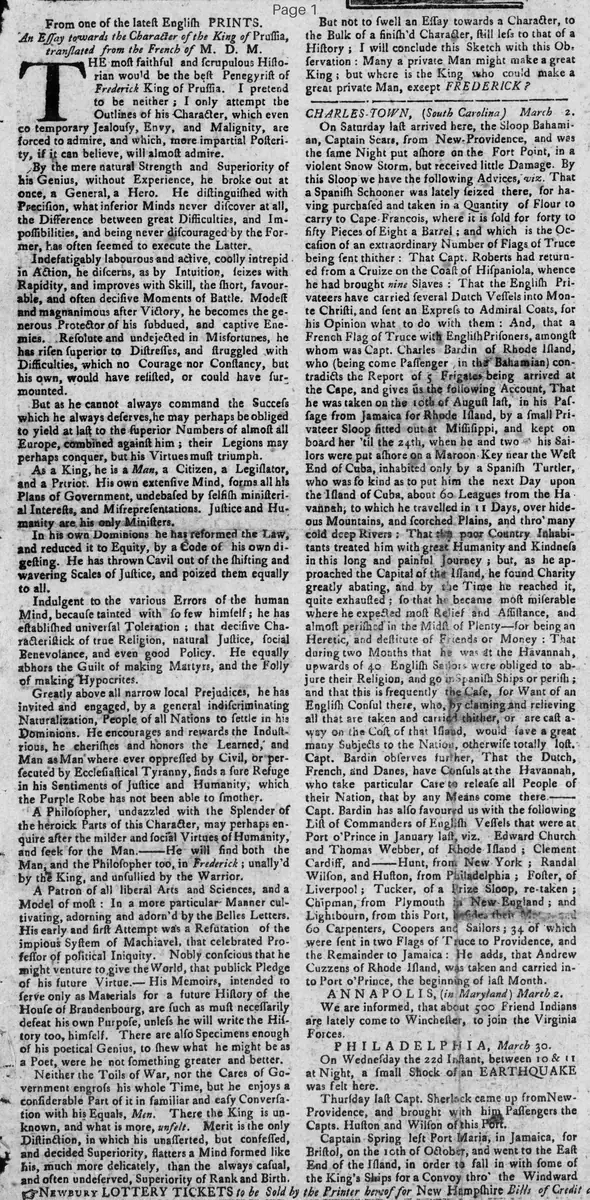
From one of the latest English PRINTS.
An Essay towards the Character of the King of Prussia, translated from the French of M. D. M.
The most faithful and scrupulous Historian would be the best Panegyrist of Frederick King of Prussia. I pretend to be neither; I only attempt the Outlines of his Character, which even contemporary Jealousy, Envy, and Malignity, are forced to admire, and which, more impartial Posterity, if it can believe, will almost admire.
By the mere natural Strength and Superiority of his Genius, without Experience, he broke out at once, a General, a Hero. He distinguished with Precision, what inferior Minds never discover at all, the Difference between great Difficulties, and Impossibilities, and being never discouraged by the Former, has often seemed to execute the Latter.
Indefatigably laborious and active, coolly intrepid in Action, he discerns, as by Intuition, seizes with Rapidity, and improves with Skill, the short, favourable, and often decisive Moments of Battle. Modest and magnanimous after Victory, he becomes the generous Protector of his subdued, and captive Enemies. Resolute and undejected in Misfortunes, he has risen superior to Distresses, and struggled with Difficulties, which no Courage nor Constancy, but his own, would have resisted, or could have surmounted.
But as he cannot always command the Success which he always deserves, he may perhaps be obliged to yield at last to the superior Numbers of almost all Europe, combined against him; their Legions may perhaps conquer, but his Virtues must triumph.
As a King, he is a Man, a Citizen, a Legislator, and a Patriot. His own extensive Mind, forms all his Plans of Government, unbiased by selfish ministerial Interests, and Misrepresentations. Justice and Humanity are his only Ministers.
In his own Dominions he has reformed the Law, and reduced it to Equity, by a Code of his own digesting. He has thrown Cavil out of the shifting and wavering Scales of Justice, and poised them equally to all.
Indulgent to the various Errors of the human Mind, because tainted with so few himself; he has established universal Toleration: that decisive Characteristic of true Religion, natural Justice, social Benevolence, and even good Policy. He equally abhors the Guilt of making Martyrs, and the Folly of making Hypocrites.
Greatly above all narrow local Prejudices, he has invited and engaged, by a general indiscriminating Naturalization, People of all Nations to settle in his Dominions. He encourages and rewards the Industrious, he cherishes and honors the Learned, and Man as Man wherever oppressed by Civil, or persecuted by Ecclesiastical Tyranny, finds a sure Refuge in his Sentiments of Justice and Humanity; which the Purple Robe has not been able to smother.
A Philosopher, undazzled with the Splendor of the heroick Parts of this Character, may perhaps enquire after the milder and social Virtues of Humanity, and seek for the Man. He will find both the Man, and the Philosopher too, in Frederick; unsullied by the King, and unpolluted by the Warrior.
A Patron of all liberal Arts and Sciences, and a Model of most: In a more particular Manner cultivating, adorning and adorn'd by the Belles Lettres.
His early and first Attempt was a Refutation of the impious System of Machiavel, that celebrated Professor of political Iniquity. Nobly conscious that he might venture to give the World, that publick Pledge of his future Virtue.-- His Memoirs, intended to Serve only as Materials for a future History of the House of Brandenbourg, are such as must necessarily defeat his own Purpose, unless he will write the History too, himself. There are also Specimens enough of his poetical Genius, to shew what he might be as a Poet, were he not something greater and better.
Neither the Toils of War, nor the Cares of Government engross his whole Time, but he enjoys a considerable Part of it in familiar and easy Conversation with his Equals, Men. There the King is unknown, and what is more, unfelt. Merit is the only Distinction, in which his unasserted, but confessed, and decided Superiority, flatters a Mind formed like his, much more delicately, than the always casual, and often undeserved, Superiority of Rank and Birth.
But not to swell an Essay towards a Character, to the Bulk of a finish'd Character, till less to that of a History; I will conclude this Sketch with this Observation: Many a private Man might make a great King; but where is the King who could make a great private Man, except FREDERICK?
An Essay towards the Character of the King of Prussia, translated from the French of M. D. M.
The most faithful and scrupulous Historian would be the best Panegyrist of Frederick King of Prussia. I pretend to be neither; I only attempt the Outlines of his Character, which even contemporary Jealousy, Envy, and Malignity, are forced to admire, and which, more impartial Posterity, if it can believe, will almost admire.
By the mere natural Strength and Superiority of his Genius, without Experience, he broke out at once, a General, a Hero. He distinguished with Precision, what inferior Minds never discover at all, the Difference between great Difficulties, and Impossibilities, and being never discouraged by the Former, has often seemed to execute the Latter.
Indefatigably laborious and active, coolly intrepid in Action, he discerns, as by Intuition, seizes with Rapidity, and improves with Skill, the short, favourable, and often decisive Moments of Battle. Modest and magnanimous after Victory, he becomes the generous Protector of his subdued, and captive Enemies. Resolute and undejected in Misfortunes, he has risen superior to Distresses, and struggled with Difficulties, which no Courage nor Constancy, but his own, would have resisted, or could have surmounted.
But as he cannot always command the Success which he always deserves, he may perhaps be obliged to yield at last to the superior Numbers of almost all Europe, combined against him; their Legions may perhaps conquer, but his Virtues must triumph.
As a King, he is a Man, a Citizen, a Legislator, and a Patriot. His own extensive Mind, forms all his Plans of Government, unbiased by selfish ministerial Interests, and Misrepresentations. Justice and Humanity are his only Ministers.
In his own Dominions he has reformed the Law, and reduced it to Equity, by a Code of his own digesting. He has thrown Cavil out of the shifting and wavering Scales of Justice, and poised them equally to all.
Indulgent to the various Errors of the human Mind, because tainted with so few himself; he has established universal Toleration: that decisive Characteristic of true Religion, natural Justice, social Benevolence, and even good Policy. He equally abhors the Guilt of making Martyrs, and the Folly of making Hypocrites.
Greatly above all narrow local Prejudices, he has invited and engaged, by a general indiscriminating Naturalization, People of all Nations to settle in his Dominions. He encourages and rewards the Industrious, he cherishes and honors the Learned, and Man as Man wherever oppressed by Civil, or persecuted by Ecclesiastical Tyranny, finds a sure Refuge in his Sentiments of Justice and Humanity; which the Purple Robe has not been able to smother.
A Philosopher, undazzled with the Splendor of the heroick Parts of this Character, may perhaps enquire after the milder and social Virtues of Humanity, and seek for the Man. He will find both the Man, and the Philosopher too, in Frederick; unsullied by the King, and unpolluted by the Warrior.
A Patron of all liberal Arts and Sciences, and a Model of most: In a more particular Manner cultivating, adorning and adorn'd by the Belles Lettres.
His early and first Attempt was a Refutation of the impious System of Machiavel, that celebrated Professor of political Iniquity. Nobly conscious that he might venture to give the World, that publick Pledge of his future Virtue.-- His Memoirs, intended to Serve only as Materials for a future History of the House of Brandenbourg, are such as must necessarily defeat his own Purpose, unless he will write the History too, himself. There are also Specimens enough of his poetical Genius, to shew what he might be as a Poet, were he not something greater and better.
Neither the Toils of War, nor the Cares of Government engross his whole Time, but he enjoys a considerable Part of it in familiar and easy Conversation with his Equals, Men. There the King is unknown, and what is more, unfelt. Merit is the only Distinction, in which his unasserted, but confessed, and decided Superiority, flatters a Mind formed like his, much more delicately, than the always casual, and often undeserved, Superiority of Rank and Birth.
But not to swell an Essay towards a Character, to the Bulk of a finish'd Character, till less to that of a History; I will conclude this Sketch with this Observation: Many a private Man might make a great King; but where is the King who could make a great private Man, except FREDERICK?
What sub-type of article is it?
Essay
What themes does it cover?
Political
Moral Virtue
Liberty Freedom
What keywords are associated?
Frederick The Great
King Of Prussia
Character Sketch
Political Virtues
Universal Toleration
Philosopher King
Justice Humanity
What entities or persons were involved?
Translated From The French Of M. D. M.
Literary Details
Title
An Essay Towards The Character Of The King Of Prussia, Translated From The French Of M. D. M.
Author
Translated From The French Of M. D. M.
Subject
Character Of Frederick King Of Prussia
Key Lines
The Most Faithful And Scrupulous Historian Would Be The Best Panegyrist Of Frederick King Of Prussia.
By The Mere Natural Strength And Superiority Of His Genius, Without Experience, He Broke Out At Once, A General, A Hero.
Justice And Humanity Are His Only Ministers.
He Has Established Universal Toleration: That Decisive Characteristic Of True Religion, Natural Justice, Social Benevolence, And Even Good Policy.
Many A Private Man Might Make A Great King; But Where Is The King Who Could Make A Great Private Man, Except Frederick?