Thank you for visiting SNEWPapers!
Sign up free
The Patowmac Guardian, And Berkeley Advertiser
Martinsburg, Shepherdstown, Berkeley County, Jefferson County, West Virginia
What is this article about?
House of Representatives, Dec. 14, debated draft response to President's speech, passing amendments on western frontier peace and Franco-American relations, while objecting to self-praise and administration compliments amid foreign policy crisis concerns.
Merged-components note: Continuation of congressional proceedings report from page 2 to page 3; relabeled 'story' to 'domestic_news' as it fits local/national non-story news on US politics.
Clippings
1 of 2
OCR Quality
Full Text
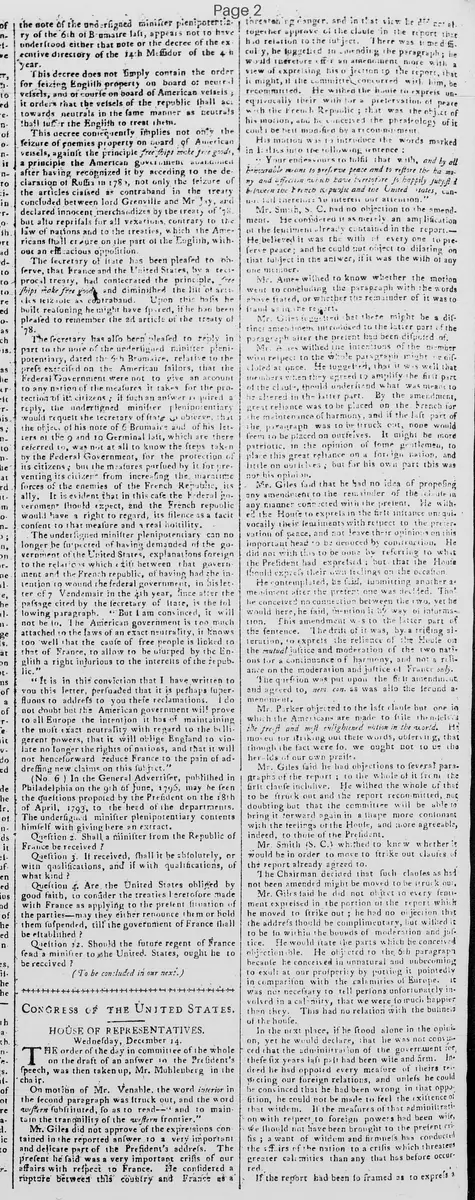
HOUSE OF REPRESENTATIVES.
Wednesday, December 14.
The order of the day in committee of the whole on the draft of an answer to the President's speech, was then taken up, Mr. Muhlenberg in the chair.
On motion of Mr. Venable, the word interior in the second paragraph was struck out, and the word western substituted, so as to read—'and to maintain the tranquility of the western frontier.'
Mr. Giles did not approve of the expressions contained in the reported answer to a very important and delicate part of the President's address. The present he said was a very important crisis of our affairs with respect to France. He considered a rupture between this country and France as a threat and danger, and in that view he did not together approve of the clause in the report that had relation to the subject. There was a medley, he suggested in amending the paragraph; he would therefore offer an amendment more with a view of expressing his objection to the report, that it might, if the committee concurred with him, be recommitted. He wished the house to express unequivocally their wish for a preservation of peace with the French Republic; that was the object of his motion, but he conceived the phraseology of it could be best modified by a committee. His motion was to introduce the words marked in italics to the following sentence:
'...Your endeavours to fulfill that wish, and by all honourable means to preserve peace and to restore the harmony and affection which have heretofore so happily subsisted between the French Republic and the United States, cannot therefore fail to merit our attention.'
Mr. Smith, S. C. had no objection to the amendment. He considered it as merely an amplification of the sentiment already contained in the report. He believed it was the wish of every one to preserve peace; and he could not object to declaring on that subject in the answer, if it was the wish of any one member.
Mr. Ames wished to know whether the motion went to concluding the paragraph with the words above stated, or whether the remainder of it was to stand as in the report.
Mr. Giles said that there might be a different amendment introduced to the latter part of the paragraph after the present had been disposed of.
Mr. Ames wished the intentions of the member with respect to the whole paragraph rightly disclosed at once. He supposed, that it was well that members when they agreed to amplify the first part of the clause, should understand what was meant to be altered in the latter part. By the amendment, great reliance was to be placed on the French for the maintenance of harmony, and if the last part of the paragraph was to be struck out, none would seem to be placed on ourselves. It might be more patriotic, in the opinion of some gentlemen, to place this great reliance on a foreign nation, and little on ourselves; but for his own part this was not his opinion.
Mr. Giles said that he had no idea of proposing any amendment to the remainder of the clause in any manner connected with the present. He wished the House to express in the first instance unequivocally their sentiments with respect to the preservation of peace, and not leave their opinions on this important head to be deduced by construction. He did not wish this to be done be referring to what the President had expressed: but that The House should express their own feelings on the occasion. He contemplated, he said, submitting another amendment after the present one was decided. Tho' he conceived no connection between the two, yet he would here, he said, mention it by way of information. This amendment was to the latter part of the sentence. The drift of it was, by a trifling alteration, to express the reliance of the House on the mutual justice and moderation of the two nations for a continuance of harmony, and not a reliance on the moderation and justice of France only.
The question was put upon the first amendment and agreed to, nem con. as was also the second amendment.
Mr. Parker objected to the last clause but one in which the Americans are made to style themselves the freest and most enlightened nation in the world. He moved for striking out these words, observing, that though the fact were so, we ought not to be the heralds of our own praise.
Mr. Giles said he had objections to several paragraphs of the report; to the whole of it from the first clause inclusive. He wished the whole of that to be struck out and the report recommitted, not doubting but that the committee will be able to bring it forward again in a shape more consonant with the feelings of the House, and more agreeable, indeed, to those of the President.
Mr. Smith (S. C.) wished to know whether it would be in order to move to strike out clauses of the report already agreed to.
The Chairman decided that such clauses as had not been amended might be moved to be struck out.
Mr. Giles said he did not object to every sentiment expressed in the portion of the report which he moved to strike out; he had no objection that the address should be complimentary, but wished it to be so within the bounds of moderation and justice. He would state the parts which he conceived objectionable. He objected to the 5th paragraph because he conceived it unnatural and unbecoming to exult at our prosperity by putting it pointedly in comparison with the calamities of Europe. It was not necessary to tell persons unfortunately involved in a calamity, that we were so much happier than they. This had no relation with the business of the house.
In the next place, if he stood alone in the opinion, yet he would declare, that he was not convinced that the administration of the government for these six years past had been wise and firm. Indeed he had opposed every measure of theirs respecting our foreign relations, and unless he could be convinced that he had been wrong in that opposition, he could not be made to feel the existence of that wisdom. If the measures of that administration with respect to foreign powers had been wise, we should not have been brought to the present crisis; a want of wisdom and firmness has conducted the affairs of the nation to a crisis which threatens greater calamities than any that has before occurred.
If the report had been so framed as to express a defense of the patriotism, virtue and uprightness of the President it might have obtained the unanimous vote of the house; but it was not to be expected, that many of the members should so far lose sight of "self respect" as to condemn by one vote the whole course of their own political conduct. In a view was taken, indeed, of our internal situation it would be seen that circumstances exist not usually ascendant on a state of prosperity: public and private credit is shaken, arising in a great degree from the fiscal operations of the administration.
Another sentiment in the report he could not agree in. He did not regret the President's retiring from office. He hoped he would retire and enjoy the happiness that awaited him in retirement. He believed it would more conduce to that happiness that he should retire than if he should remain in office. He believed the government of the United States founded on the broad basis of the people; that they were competent to their own government, and the remaining of no man in office was necessary to the success of that government. The people would merely be in a calamitous situation if one man were essential to the existence of their government; he was convinced that the United States produces a thousand citizens capable of filling the Presidential chair, and he would trust to the discernment of the people for a proper choice. Though the voice of all America should declare the President's retiring as a calamity, he could not join in the declaration, because he did not conceive it a misfortune. He hoped the President would be happy in his retirement, and he hoped he would retire.
He reverted again to that part of the report which declared the administration to have been wise and firm in its measures. He had always disapproved, he repeated, of the measures of that administration with respect to foreign relations, and many members of the house had agreed with him he was therefore surprised that gentlemen would now come forward and with him in one breath rescind all his former opinions without being previously convinced of having been in an error.
For his own part he conceived there was more cause than ever for adhering to his old opinions, the course of events had pointed out their propriety, and if he was not much mistaken a crisis was at hand which would confirm them. He wished that while gentlemen were willing to compliment the President, they would pay some respect to the feelings of others.
Several members spoke after Mr. Giles at considerable length. There was no decision.
The committee reported progress, and the house adjourned.
What sub-type of article is it?
What keywords are associated?
What entities or persons were involved?
Domestic News Details
Event Date
Wednesday, December 14.
Key Persons
Outcome
amendments proposed by mr. venable, mr. giles, and mr. parker; first two amendments agreed to nem con.; debate on striking out portions of the report continued without decision; committee reported progress and house adjourned.
Event Details
In committee of the whole, House of Representatives debated draft response to President's speech. Amendments substituted 'western' for 'interior' in one clause; added expressions of wish for peace with France and reliance on mutual justice of nations; objections raised to self-praise and compliments to administration's wisdom.