Thank you for visiting SNEWPapers!
Sign up free
Constitutional Whig
Richmond, Virginia
What is this article about?
Timothy Pickering critiques John Quincy Adams' appendix defending his role in Jefferson's 1807 embargo, arguing it was a secretive measure cooperating with Napoleon against Britain, and refuting Adams' denial of his pro-embargo statements in Senate debates.
Merged-components note: These components form a single continuous editorial piece by Timothy Pickering on the embargo and related historical context; sequential reading order and content continuity across columns.
Clipping
OCR Quality
Full Text
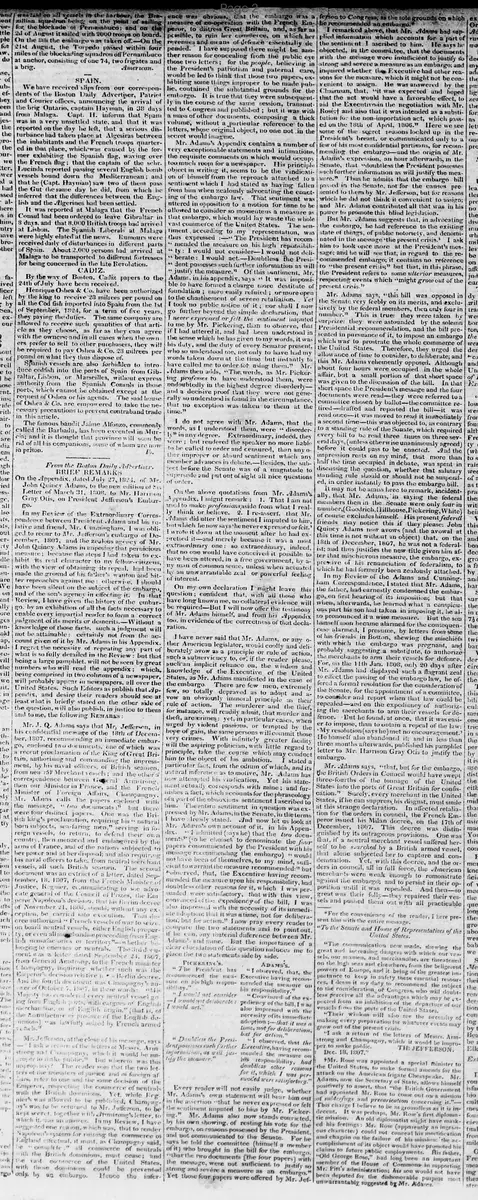
BRIEF REMARKS
On the Appendix, dated July 27, 1824, of Mr. John Quincy Adams, to the new edition of his Letter of March 31, 1808, to Mr. Harrison Gray Otis, on President Jefferson's Embargo.
In my Review of the Extraordinary Correspondence between President Adams and his relative and friend, Mr. Cunningham, I was obliged to recur to Mr. Jefferson's embargo of December, 1807, and the zealous agency of Mr. John Quincy Adams in imposing that pernicious measure; because the steps I had taken to exhibit its real character to my fellow-citizens, with the view of obtaining its repeal, had been made the ground of his father's wanton and bitter reproaches against me: otherwise, I should have been silent on the subject of the embargo, and of the son's agency in effecting it. In that Review, I have given the history of the embargo, by an exhibition of all the facts necessary to enable every impartial reader to form a correct judgment of its merits or demerits.—Without a knowledge of those facts, such a judgment will not be attainable: certainly not from the account given of it by Mr. Adams in his Appendix.
I regret the necessity of repeating any part of what is so fully detailed in the Review: but that being a large pamphlet, will not be seen by great numbers who will read the appendix; which, being comprised in two columns of a newspaper, will probably appear in newspapers, all over the United States. Such Editors as publish that Appendix, and desire their readers should see at least what is briefly stated on the other side of the question, will also publish, in justice to them and to me, the following Remarks:
Mr. J. Q. Adams says that Mr. Jefferson, in his confidential message of the 18th of December, 1807, recommending an immediate embargo, enclosed two documents, one of which was a recent proclamation of the King of Great Britain, authorising and commanding the impressment, by his naval officers, of British seamen, from neutral American Merchant vessels; and the other a correspondence between General Armstrong, then our Minister in France, and the French Minister of Foreign Affairs, Champagny.
Mr. Adams calls the papers enclosed with the message, "two documents:" but there were four distinct papers. One was the British king's proclamation, requiring his "natural born subjects, sea-faring men," serving in foreign vessels, to return, to defend their own country, then menaced and endangered by the arms of France, and of the nations subjected to her power and at her disposal; and also requiring his naval officers to take, from neutral merchant vessels, all such British seamen. The second document was an extract of a letter, dated September 18, 1807, from the French Minister of Justice, Regnier, communicating to the advocate general of the Council of Prizes, the Emperor Napoleon's decision, that his Berlin decree of November 21, 1806, should, without any exception, be carried into execution. That decree authorized "French vessels of war to seize, on board neutral vessels, either English property, or even all merchandise proceeding from English manufactories or territory"—whether belonging to enemies or neutrals. The third document was a letter dated September 21, 1807, from General Armstrong, to the French minister (Champagny), inquiring whether such was the Emperor's decree relative to the Berlin decree. And the fourth document was Champagny's answer of October 7, 1807, in these words: "His Majesty has concluded to every neutral vessel going from English ports, with cargoes of English merchandise, or of English origin," (that is, of the manufacture or produce of the English dominions) "as lawfully seized by French armed vessels."
Mr. Jefferson, at the close of his message, says—“I ask a return of the letters of Messrs. Armstrong and Champagny, which it would be improper to make public." But wherein was this impropriety? The reader sees that the two letters of the ministers of justice and of foreign affairs, refer to one and the same decision of the Emperor, respecting the commerce of neutrals with the British dominions. Yet, while Regnier's was allowed to be published, Champagny's was to be returned to Mr. Jefferson, to be kept secret, together with Armstrong's letter, to which it was an answer. In my Review, I have suggested one reason, which was, that to render Napoleon's system for ruining the commerce of England effectual, it must, as Champagny said, be "complete." all commerce of neutrals with the British dominions, must cease; and the vast commerce of the United States, with those dominions could be prevented only by an embargo. Hence the inference was obvious, that the embargo was a measure of co-operation with the French Emperor, to distress Great Britain, and, as far as possible, to ruin her commerce, on which her revenues and means of defence essentially depended. I have supposed there might be another reason for concealing from the public eye those two letters; for the people, believing in the President's patriotism and paternal care, would be led to think that those two papers, exhibiting something improper to be made public, contained the substantial grounds for the embargo. It is true that they were subsequently, in the course of the same session, transmitted to Congress and published; but it was with a mass of other documents, composing a thick volume, without a particular reference to the letters, whose original object, no one not in the secret would imagine.
Mr. Adams's Appendix contains a number of very exceptionable statements and intimations, the requisite comments on which would occupy too much room for a newspaper. His principal object in writing it, seems to be the vindication of himself from the reproach attached to a sentiment which I had stated as having fallen from him when zealously advocating the enacting of the embargo law. That sentiment was uttered in opposition to a motion for time to be allowed to consider so momentous a measure as that embargo, which would lay waste the whole vast commerce of the United States. The sentiment, according to my representation, was thus expressed: "The President has recommended the measure on his high responsibility: I would not consider—I would not deliberate: I would act.—Doubtless the President possesses such further information as will justify the measure." Of this sentiment, Mr. Adams, in his appendix, says "It was impossible to have formed a charge more destitute of foundation; more easily refuted; or more open to the chastisement of severe retaliation. Yet I took no public notice of it; nor shall I now go further beyond the simple declaration, that I never expressed or felt the sentiment imputed to me by Mr. Pickering, than to observe, that if I had uttered it, and had been understood in the sense which he has given to my words, it was his duty, and the duty of every Senator present, who so understood me, not only to have had my words taken down at the time but instantly to have called me to order for using them." Mr. Adams then adds, "The words, as Mr. Pickering professes to have understood them, were undoubtedly in the highest degree disorderly—and a decisive proof that they were not generally so understood is found in the circumstance, that no exception was taken to them at the time."
I do not agree with Mr. Adams, that the words, as I understood them, were "disorderly" in any degree. Extraordinary, indeed, they were; but rendered the speaker no more liable to be called to order and censured, than any other improper or absurd sentiment which any member advances in debate.—Besides, the subject before the Senate was of a magnitude to supersede and put out of sight all nice questions of order.
On the above quotations from Mr. Adams's Appendix, I might remark: 1. That I am not used to make professions aside from what I really think or believe. 2. I re-assert, that Mr. Adams did utter the sentiment I imputed to him, but which he now says he never expressed or felt. I wrote it down at the moment after he had expressed it—and merely because it was a most extraordinary one: so extraordinary, indeed, that no one would have conceived it possible to have been uttered, in a free government, by any man of common sense, unless when actuated by an unwarrantable zeal or powerful feeling of interest.
On my own declaration I might leave this question; confident that, with all those who have long known me, no collateral evidence will be required—But I will now offer the testimony of Mr. Adams himself, and from his Appendix too, in evidence of the correctness of that declaration.
I have never said that Mr. Adams, or any other American legislator, would coolly and deliberately avow as a principle or rule of action, such a subserviency to, or, if the reader please, such an implicit reliance on, the wisdom and knowledge of the Executive of the United States, as Mr. Adams manifested in the case of the embargo. There are few men, extremely few, so totally depraved as to adopt and avow an obviously immoral principle as their rule of action. The murderer and the thief, for instance, will readily admit, that murder and theft, are crimes: yet, in particular cases, when urged by violent passions, or tempted by the hope of gain, the same persons will commit those very crimes. With infinitely greater facility will the aspiring politician, with little regard to principle, take the course which may conduct him to the object of his ambition. I stated a particular fact, from the odium of which; and its natural inference as to motive, Mr. Adams has now attempted his vindication, Yet his statement actually corresponds with mine; and furnishes a fact, which accounts for the phraseology of a part of the obnoxious sentiment I ascribed to him. The entire sentiment in question was expressed by Mr. Adams, in the Senate, in the terms I have already stated. And now let us look at Mr. Adams's own account of it, in his Appendix. "I admitted (says he) that the two documents" (so he chooses to denominate the four papers communicated by the President with his message recommending the embargo) "would not have been of themselves, to my mind, sufficient to warrant the measure recommended:" but "observed, that, the Executive having recommended the measure upon his responsibility, had doubtless other reasons for it, which I was persuaded were satisfactory, that with this view, convinced of the expediency of the bill, I was also impressed with the necessity of its immediate adoption; that it was a time, not for deliberation, but for action." I now pray every reader to compare the two statements and to point out, if he can, any material difference between Mr. Adams's and mine. But the importance of a clear elucidation of this question induces me to place the two statements side by side.
PICKERING'S.
"The President has recommended the measure on his high responsibility."
"I would not consider—I would not deliberate: I would act."
"Doubtless the President possesses such further information as will justify the measure."
ADAMS'S.
"I observed, that, the Executive having recommended the measure on his responsibility, had doubtless other reasons for it, which I was persuaded were satisfactory."
"Convinced of the expediency of the bill, I was also impressed with the necessity of its immediate adoption;—that it was a time, not for deliberation, but for action."
"The President has recommended the measure on his high responsibility."
"I observed, that the Executive, having recommended the measure on his responsibility, had doubtless other reasons for it, which I was persuaded were satisfactory."
I remarked above, that Mr. Adams had supplied information which accounts for a part of the sentiment I ascribed to him. He says he objected, in the committee, that the documents with the message were insufficient to justify so strong and severe a measure as an embargo: and inquired whether the Executive had other reasons for the measure, which it might not be convenient to assign. He was answered by the Chairman, that, "it was expected and hoped that the act would have a favorable effect, to aid the Executive in the negotiation with Mr. Rose: and also that it was intended as a substitution for the non-importation act, which passed on the 18th of April, 1806." Here we see some of the secret reasons locked up in the President's breast, or communicated only to a few of his most confidential partisans, for recommending the embargo—and the origin of Mr. Adams's expression, an hour afterwards, in the Senate, that "doubtless the President possesses such further information as will justify the measure." Thus he admits that the embargo bill passed in the Senate, not for the causes presented to them by Mr. Jefferson, but for reasons which he did not think it convenient to assign; and Mr. Adams contributed all that was in his power to promote this blind legislation.
But Mr. Adams suggests that, in advocating the embargo, he had reference to the existing state of things, of public notoriety, and denominated in the message 'the present crisis.' I ask him to look once more at the President's message; and he will see that, in regard to the recommended embargo; it contains no reference to "the present crisis;" but that, in this phrase, the President refers to some ulterior measures, respecting events which "might grow out of the present crisis."
Mr. Adams says, "this bill was opposed in the Senate very feebly on its merits, and exclusively by the federal members, then only four in number." This is true: they were taken by surprise: they were astounded by the solemn Presidential recommendation, and the bill presented in pursuance of it, to impose an embargo which was to prostrate the whole commerce of the United States. Therefore, they urged the allowance of time to consider, to deliberate; and this Mr. Adams vehemently opposed. Although about four hours were occupied in the whole affair, but a small portion of that short space was given to the discussion of the bill. In that short space the President's message and the four documents were read—they were referred to a committee chosen by ballot—the committee retired—drafted and reported the bill—it was read once—it was moved to read it immediately a second time—this was objected to, as contrary to a standing rule of the Senate, which required every bill to be read three times on three several days, (unless otherwise unanimously agreed) before it could pass to be enacted. And the impression rests on my mind, that more than half the time occupied in debate, was spent in discussing the question, whether that salutary standing rule should or should not be suspended, in order instantly to pass the embargo bill.
It may not be amiss here to remark, incidentally, that Mr. Adams, in saying the federal members then in the Senate were only four in number, (Goodrich, Hillhouse, Pickering, White) of course excludes himself. His present federal friends may notice this if they please: John Quincy Adams now avows (and the avowal at this time is not without an object) that, on the 18th of December, 1807, he was not a federalist; and this justifies the new title given him after that mischievous measure, the embargo, expressive of his renunciation of federalism, to which he had formerly been zealously attached.
In my Review of the Adams and Cunningham Correspondence, I stated that Mr. Adams, the father, had earnestly condemned the embargo, on first hearing of its imposition; but that, when, afterwards, he learned what a conspicuous part his son had taken in imposing it, he also pronounced it a wise measure. But the son himself soon became alarmed for the consequences: alarmed, I presume, by letters from some of his friends in Boston, shewing the mischiefs with which the embargo was pregnant, and probably suggesting a substitute, to authorize the merchants to arm their vessels for defence. For, on the 11th Jan. 1808, only 20 days after Mr. Adams had displayed such a flagrant zeal to effect the passing of the embargo law, he offered a formal resolution for the consideration of the Senate, for the appointment of a committee, to consider and report when that law could be repealed—and on the expediency of authorizing the merchants to arm their vessels for defence. —But he found, at once, that it was easier to impose, than to obtain a repeal of the law: My resolution (says he) met no encouragement. He himself also abandoned it; and in less than three months afterwards, published his pamphlet letter to Mr. Harrison Gray Otis to justify the embargo.
Mr. Adams says, "that, but for the embargo, the British Orders in Council would have swept three-fourths of the tonnage of the United States into the ports of Great Britain for confiscation." Surely, every merchant in the United States, if he can suppress his disgust, must smile at this strange declaration. In affected retaliation for the orders in council, the French Emperor issued his Milan decree, on the 17th of December, 1807. This decree was distinguished by its outrageous provisions. One was that, if a neutral merchant vessel suffered herself to be searched by a British armed vessel, that alone subjected her to capture and condemnation. Yet, with this decree, and the orders in council, all in full force, the American merchants were weak enough to remonstrate against the embargo; and to persist in their opposition until it was repealed. And then—so great was their folly—they repaired their vessels and pushed them out with all practicable expedition, to renew their foreign commerce! Or, to adopt the favorite figurative style of Mr. Adams, "The spirit of desperate adventure rushed to sea still in every plank that could be made to float."
Mr. Adams introduces the name of the lately deceased Mr. Cabot, and sneeringly repeating my words, "my excellent friend George Cabot," adds, in the popular slang, "since President of the Hartford Convention;" for the dishonorable purpose of fixing a stigma on an eminently enlightened, accomplished, and most virtuous citizen. Mr. Adams, in his vain attempt to damn the character of Mr. Cabot, could not have forgotten that Mr. Harrison Gray Otis, to whom, as his friend, he addressed his long embargo letter of 1808, which he has just caused to be re-printed, was also a member, and a conspicuous one, of the Hartford Convention, whose proceedings he has lately very ably vindicated.
TIMOTHY PICKERING.
Salem, Aug. 24, 1824.
*For the convenience of the reader, I have presented him with the entire message.
"To the Senate and House of Representatives of the United States.
"The communication now made, shewing the great and increasing dangers with which our vessels, our seamen, and merchandise, are threatened on the high seas and elsewhere, from the belligerent powers of Europe, and it being of the greatest importance to keep in safety these essential resources, I deem it my duty to recommend the subject to the consideration of Congress, who will doubtless perceive all the advantages which may be expected from an inhibition of the departure of our vessels from the ports of the United States.
"Their wisdom will also see the necessity of making every preparation for whatever events may grow out of the present crisis.
"I ask a return of the letters of Messrs. Armstrong and Champagny, which it would be improper to make public."
TH: JEFFERSON.
Dec. 18, 1807."
Mr. Rose was appointed a special minister to the United States, to make formal amends for the attack on the American frigate Chesapeake. Mr. Adams, now the Secretary of State, allows himself positively to assert, that "the British Government had appointed Mr. Rose to come out on a mission of subterfuge and prevarication concerning it."—This charge I believe to be as groundless as it is indecent. It was perhaps, Mr. Rose's first diplomatic mission. An old diplomatist might have masked his feelings: Mr. Rose (apparently an ingenuous character) could not conceal his mortification and chagrin on the failure of his mission: the accomplishment of its object would have promoted his claims to future public employments. His father, "Old George Rose," had long been an important member of the House of Commons in supporting Mr. Pitt's administration; his son would not have been deputed for the dishonorable purpose most unwarrantably suggested by Mr. Adams.
What sub-type of article is it?
What keywords are associated?
What entities or persons were involved?
Editorial Details
Primary Topic
Critique Of John Quincy Adams' Defense Of Jefferson's 1807 Embargo
Stance / Tone
Strongly Critical Of Adams And The Embargo As Pro French Cooperation Against Britain
Key Figures
Key Arguments