Thank you for visiting SNEWPapers!
Sign up free
Gazette Of The United States
New York, New York County, New York
What is this article about?
Congressional debate on petitions from late U.S. Army officers seeking compensation for depreciated certificates. Mr. Gerry proposed limited provision; Mr. Clark amended to broaden it; Mr. Hartley advocated for officers' unique claims based on wartime hardships and government promises. Debate continued.
Clipping
OCR Quality
Full Text
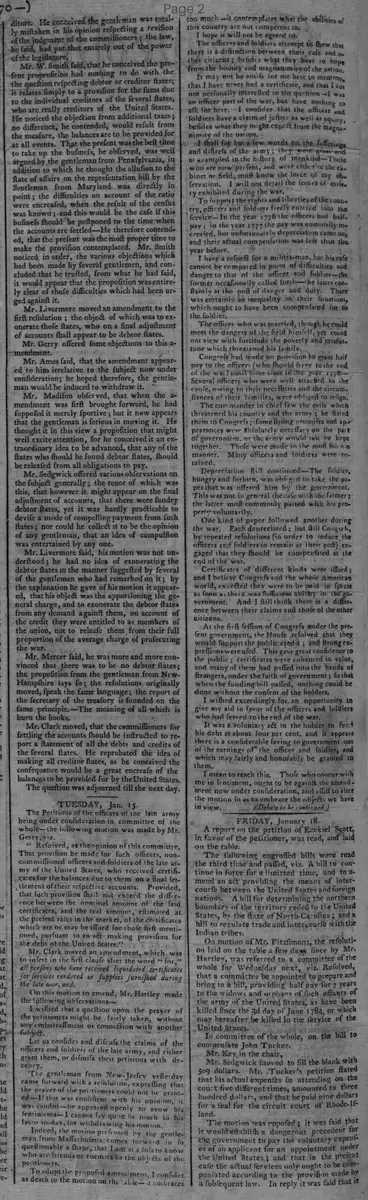
The Petitions of the officers of the late army being under consideration in committee of the whole—the following motion was made by Mr. Gerry, viz.
"Resolved, as the opinion of this committee, That provision be made for such officers, non-commissioned officers and soldiers of the late army of the United States, who received certificates for the balances due to them on a final settlement of their respective accounts. Provided, that such provision shall not exceed the difference between the nominal amount of the said certificates, and the real amount, estimated at the present rates in the market, of the certificates which are or may be issued for those first mentioned, pursuant to an act making provision for the debt of the United States."
Mr. Clark moved an amendment, which was to insert in the first clause after the word "for." all persons who have received liquidated certificates for services rendered or supplies furnished during the late war, and.
On this motion to amend, Mr. Hartley made the following observations—
I wished that a question upon the prayer of the petitioners might be fairly taken, without any embarrassment or connection with another subject.
Let us consider and discuss the claims of the officers and soldiers of the late army, and either grant them, or dismiss their petitions with decency.
The gentleman from New-Jersey yesterday came forward with a resolution, expressing that the prayer of the petitioners could not be granted—If this was consistent with his opinion, it was candid—he appeared openly to avow his sentiments—I cannot say quite so much in his favor to-day, for withdrawing his motion.
Indeed, the motion presented by the gentleman from Massachusetts, comes forward in so questionable a shape, that I am at a loss to know who are friends or enemies to the objects of the petitioners.
To adopt the proposed amendment, I consider as death to the motion on the table—it embraces too much -it contemplates what the abilities of this country are not competent to. I hope it will not be agreed to.
The officers and soldiers attempt to shew that there is a distinction between their case and other citizens; besides what they have to hope from the bounty and magnanimity of the nation.
It may not be amiss for me here to mention, that I have never had a certificate, and that I am not personally interested in the question -I was an officer part of the war, but have nothing to ask for here. I consider that the officers and soldiers have a claim of justice as well as equity, besides what they might expect from the magnanimity of the nation.
I shall say but a few words on the sufferings and distress of the army: they were great and unparalleled in the history of mankind—Those who are now present, and were either in the cabinet or field, must know the force of my observation. I will not detail the scenes of misery exhibited during the war.
To support the rights and liberties of the country, officers and soldiers freely entered into the service—In the year 1776 the officers had half-pay: in the year 1777 the pay was nominally increased, but unfortunately depreciation came on, and their actual compensation was less than the year before.
I have a respect for a militia-man, but his case cannot be compared in point of difficulties and danger to that of the officer and soldier—the former occasionally called forth—the latter constantly at the post of danger and duty. There was certainly an inequality in their situations, which ought to have been compensated for to the soldier.
The officer who was married, though he could meet the dangers of the field himself, yet could not view with fortitude the poverty and misfortune which threatened his family.
Congress had made no provision to grant half pay to the officers (who should serve to the end of the war) until some time in the year 1780—Several officers who were well attached to the cause, owing to their necessities and the circumstances of their families, were obliged to resign.
The commander in chief saw the evils which threatened his country and the army; he stated them to Congress; some strong promises and appearances were absolutely necessary on the part of government, or the army would not be kept together. These were made in the most solemn manner. Many officers and soldiers were retained.
Depreciation still continued—The soldier, hungry and forlorn, was obliged to take the paper that was offered him by the government. This was not in general the case with the farmer; the latter most commonly parted with his property voluntarily.
One kind of paper followed another during the war. Each depreciated; but still Congress, by repeated resolutions (in order to induce the officers and soldiers to remain at their post) engaged that they should be compensated at the end of the war.
Certificates of different kinds were issued; and I believe Congress and the whole American world, expected they were to be paid in specie as soon as there was sufficient stability in the government. And I still think there is a difference between their claims and those of the other citizens.
At the first session of Congress under the present government, the House resolved that they would support the public credit; and strong expressions were used. This gave great confidence to the public; certificates were enhanced in value, and many of them had passed into the hands of strangers, under the faith of government; so that when the funding bill passed, nothing could be done without the consent of the holders.
I wished exceedingly for an opportunity to give my aid in favor of the officers and soldiers who had served to the end of the war.
It was a voluntary act in the holder to fund his debt at about four per cent. and it appears there is a considerable saving to government out of the earnings of the officer and soldier, and which may fairly and honorably be granted to them.
I mean to reach this. Those who concur with me in sentiment, ought to be against the amendment now under consideration, and assist to alter the motion so as to embrace the objects we have in view.
(Debate to be continued.)
What sub-type of article is it?
What keywords are associated?
What entities or persons were involved?
Domestic News Details
Event Date
Tuesday, Jan. 15.
Key Persons
Outcome
debate ongoing; no resolution mentioned.
Event Details
In committee of the whole, Mr. Gerry moved a resolution to provide for officers, non-commissioned officers, and soldiers of the late army who received certificates for balances due, limited to the difference between nominal and market value. Mr. Clark proposed an amendment to include all persons with liquidated certificates for services or supplies during the war. Mr. Hartley opposed the amendment, arguing for prioritizing army claims due to their unique sufferings, depreciation of pay, and promises made, emphasizing justice and distinction from other citizens' claims.