Thank you for visiting SNEWPapers!
Sign up free
Literary
September 23, 1789
Gazette Of The United States
New York, New York County, New York
What is this article about?
This essay argues that diverse interests among U.S. states, far from dividing them, cement the union under wise government. It refutes British propaganda of colonial disunity, emphasizing complementary regional economies like southern staples and northern navigation, promoting internal commerce and mutual prosperity.
Clipping
OCR Quality
95%
Excellent
Full Text
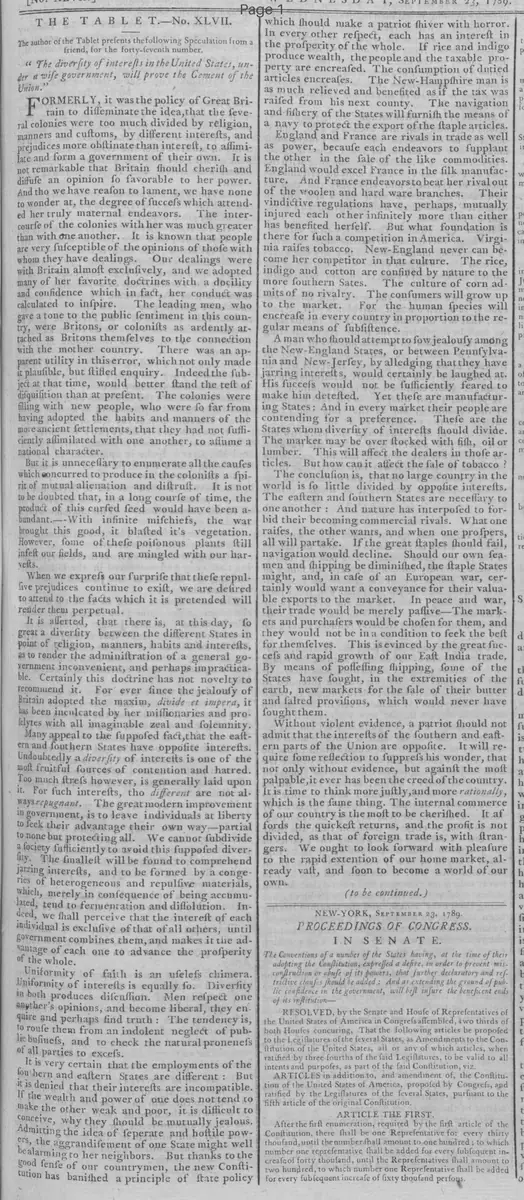
THE TABLET. No. XLVII.
The author of the Tablet presents the following Speculation from a friend, for the forty-seventh number.
"The diversity of interests in the United States, under a wise government, will prove the Cement of the Union."
FORMERLY, it was the policy of Great Britain to disseminate the idea, that the several colonies were too much divided by religion, manners and customs, by different interests, and prejudices more obstinate than interest, to assimilate and form a government of their own. It is not remarkable that Britain should cherish and diffuse an opinion so favorable to her power. And tho we have reason to lament, we have none to wonder at, the degree of success which attended her truly maternal endeavors. The intercourse of the colonies with her was much greater than with one another. It is known that people are very susceptible of the opinions of those with whom they have dealings. Our dealings were with Britain almost exclusively, and we adopted many of her favorite doctrines with a docility and confidence which in fact, her conduct was calculated to inspire. The leading men, who gave a tone to the public sentiment in this country, were Britons, or colonists as ardently attached as Britons themselves to the connection with the mother country. There was an apparent utility in this error, which not only made it plausible, but stifled enquiry. Indeed the subject at that time, would better stand the test of disquisition than at present. The colonies were filling with new people, who were so far from having adopted the habits and manners of the more ancient settlements, that they had not sufficiently assimilated with one another, to assume a national character.
But it is unnecessary to enumerate all the causes which concurred to produce in the colonists a spirit of mutual alienation and distrust. It is not to be doubted that, in a long course of time, the product of this cursed seed would have been abundant.—With infinite mischiefs, the war brought this good, it blasted its vegetation. However, some of these poisonous plants still infest our fields, and are mingled with our harvests.
When we express our surprise that these repulsive prejudices continue to exist, we are desired to attend to the facts which it is pretended will render them perpetual.
It is asserted, that there is, at this day, so great a diversity between the different States in point of religion, manners, habits and interests, as to render the administration of a general government inconvenient, and perhaps impracticable. Certainly this doctrine has not novelty to recommend it. For ever since the jealousy of Britain adopted the maxim, divide et impera, it has been inculcated by her missionaries and proselytes with all imaginable zeal and solemnity.
Many appeal to the supposed fact, that the eastern and southern States have opposite interests. Undoubtedly a diversity of interests is one of the most fruitful sources of contention and hatred. Too much stress however, is generally laid upon it. For such interests, tho different are not always repugnant. The great modern improvement in government, is to leave individuals at liberty to seek their advantage their own way—partial to none but protecting all. We cannot subdivide a society sufficiently to avoid this supposed diversity. The smallest will be found to comprehend jarring interests, and to be formed by a congeries of heterogeneous and repulsive materials, which, merely in consequence of being accumulated, tend to fermentation and dissolution. Indeed, we shall perceive that the interest of each individual is exclusive of that of all others, until government combines them, and makes it the advantage of each one to advance the prosperity of the whole.
Uniformity of faith is an useless chimera. Uniformity of interests is equally so. Diversity in both produces diffusion. Men respect one another's opinions, and become liberal, they enquire and perhaps find truth: The tendency is, to rouse them from an indolent neglect of public business, and to check the natural proneness of all parties to excess.
It is very certain that the employments of the Southern and eastern States are different: But it is denied that their interests are incompatible. If the wealth and power of one does not tend to make the other weak and poor, it is difficult to conceive, why they should be mutually jealous. Admitting the idea of separate and hostile powers, the aggrandizement of one State might well be alarming to her neighbors. But thanks to the good sense of our countrymen, the new Constitution has banished a principle of state policy which should make a patriot shiver with horror.
In every other respect, each has an interest in the prosperity of the whole. If rice and indigo produce wealth, the people and the taxable property are increased. The consumption of dutied articles increases. The New-Hampshire man is as much relieved and benefited as if the tax was raised from his next county. The navigation and fishery of the States will furnish the means of a navy to protect the export of the staple articles. England and France are rivals in trade as well as power, because each endeavors to supplant the other in the sale of the like commodities. England would excel France in the silk manufacture. And France endeavors to beat her rival out of the woolen and hardware branches. Their vindictive regulations have, perhaps, mutually injured each other infinitely more than either has benefited herself. But what foundation is there for such a competition in America. Virginia raises tobacco. New-England never can become her competitor in that culture. The rice, indigo and cotton are confined by nature to the more southern States. The culture of corn admits of no rivalry. The consumers will grow up to the market. For the human species will increase in every country in proportion to the regular means of subsistence.
A man who should attempt to sow jealousy among the New-England States, or between Pennsylvania and New-Jersey, by alleging that they have jarring interests, would certainly be laughed at. His success would not be sufficiently feared to make him detested. Yet these are manufacturing States: And in every market their people are contending for a preference. These are the States whom diversity of interests should divide. The market may be over stocked with fish, oil or lumber. This will affect the dealers in those articles. But how can it affect the sale of tobacco?
The conclusion is, that no large country in the world is so little divided by opposite interests. The eastern and southern States are necessary to one another: And nature has interposed to forbid their becoming commercial rivals. What one raises, the other wants, and when one prospers, all will partake. If the great staples should fail, navigation would decline. Should our own seamen and shipping be diminished, the staple States might, and, in case of an European war, certainly would want a conveyance for their valuable exports to the market. In peace and war, their trade would be merely passive—The markets and purchasers would be chosen for them, and they would not be in a condition to seek the best for themselves. This is evinced by the great success and rapid growth of our East India trade. By means of possessing shipping, some of the States have sought, in the extremities of the earth, new markets for the sale of their butter and salted provisions, which would never have sought them.
Without violent evidence, a patriot should not admit that the interests of the southern and eastern parts of the Union are opposite. It will require some reflection to suppress his wonder, that not only without evidence, but against the most palpable, it ever has been the creed of the country. It is time to think more justly, and more rationally, which is the same thing. The internal commerce of our country is the most to be cherished. It affords the quickest returns, and the profit is not divided, as that of foreign trade is, with strangers. We ought to look forward with pleasure to the rapid extension of our home market, already vast, and soon to become a world of our own.
(to be continued.)
The author of the Tablet presents the following Speculation from a friend, for the forty-seventh number.
"The diversity of interests in the United States, under a wise government, will prove the Cement of the Union."
FORMERLY, it was the policy of Great Britain to disseminate the idea, that the several colonies were too much divided by religion, manners and customs, by different interests, and prejudices more obstinate than interest, to assimilate and form a government of their own. It is not remarkable that Britain should cherish and diffuse an opinion so favorable to her power. And tho we have reason to lament, we have none to wonder at, the degree of success which attended her truly maternal endeavors. The intercourse of the colonies with her was much greater than with one another. It is known that people are very susceptible of the opinions of those with whom they have dealings. Our dealings were with Britain almost exclusively, and we adopted many of her favorite doctrines with a docility and confidence which in fact, her conduct was calculated to inspire. The leading men, who gave a tone to the public sentiment in this country, were Britons, or colonists as ardently attached as Britons themselves to the connection with the mother country. There was an apparent utility in this error, which not only made it plausible, but stifled enquiry. Indeed the subject at that time, would better stand the test of disquisition than at present. The colonies were filling with new people, who were so far from having adopted the habits and manners of the more ancient settlements, that they had not sufficiently assimilated with one another, to assume a national character.
But it is unnecessary to enumerate all the causes which concurred to produce in the colonists a spirit of mutual alienation and distrust. It is not to be doubted that, in a long course of time, the product of this cursed seed would have been abundant.—With infinite mischiefs, the war brought this good, it blasted its vegetation. However, some of these poisonous plants still infest our fields, and are mingled with our harvests.
When we express our surprise that these repulsive prejudices continue to exist, we are desired to attend to the facts which it is pretended will render them perpetual.
It is asserted, that there is, at this day, so great a diversity between the different States in point of religion, manners, habits and interests, as to render the administration of a general government inconvenient, and perhaps impracticable. Certainly this doctrine has not novelty to recommend it. For ever since the jealousy of Britain adopted the maxim, divide et impera, it has been inculcated by her missionaries and proselytes with all imaginable zeal and solemnity.
Many appeal to the supposed fact, that the eastern and southern States have opposite interests. Undoubtedly a diversity of interests is one of the most fruitful sources of contention and hatred. Too much stress however, is generally laid upon it. For such interests, tho different are not always repugnant. The great modern improvement in government, is to leave individuals at liberty to seek their advantage their own way—partial to none but protecting all. We cannot subdivide a society sufficiently to avoid this supposed diversity. The smallest will be found to comprehend jarring interests, and to be formed by a congeries of heterogeneous and repulsive materials, which, merely in consequence of being accumulated, tend to fermentation and dissolution. Indeed, we shall perceive that the interest of each individual is exclusive of that of all others, until government combines them, and makes it the advantage of each one to advance the prosperity of the whole.
Uniformity of faith is an useless chimera. Uniformity of interests is equally so. Diversity in both produces diffusion. Men respect one another's opinions, and become liberal, they enquire and perhaps find truth: The tendency is, to rouse them from an indolent neglect of public business, and to check the natural proneness of all parties to excess.
It is very certain that the employments of the Southern and eastern States are different: But it is denied that their interests are incompatible. If the wealth and power of one does not tend to make the other weak and poor, it is difficult to conceive, why they should be mutually jealous. Admitting the idea of separate and hostile powers, the aggrandizement of one State might well be alarming to her neighbors. But thanks to the good sense of our countrymen, the new Constitution has banished a principle of state policy which should make a patriot shiver with horror.
In every other respect, each has an interest in the prosperity of the whole. If rice and indigo produce wealth, the people and the taxable property are increased. The consumption of dutied articles increases. The New-Hampshire man is as much relieved and benefited as if the tax was raised from his next county. The navigation and fishery of the States will furnish the means of a navy to protect the export of the staple articles. England and France are rivals in trade as well as power, because each endeavors to supplant the other in the sale of the like commodities. England would excel France in the silk manufacture. And France endeavors to beat her rival out of the woolen and hardware branches. Their vindictive regulations have, perhaps, mutually injured each other infinitely more than either has benefited herself. But what foundation is there for such a competition in America. Virginia raises tobacco. New-England never can become her competitor in that culture. The rice, indigo and cotton are confined by nature to the more southern States. The culture of corn admits of no rivalry. The consumers will grow up to the market. For the human species will increase in every country in proportion to the regular means of subsistence.
A man who should attempt to sow jealousy among the New-England States, or between Pennsylvania and New-Jersey, by alleging that they have jarring interests, would certainly be laughed at. His success would not be sufficiently feared to make him detested. Yet these are manufacturing States: And in every market their people are contending for a preference. These are the States whom diversity of interests should divide. The market may be over stocked with fish, oil or lumber. This will affect the dealers in those articles. But how can it affect the sale of tobacco?
The conclusion is, that no large country in the world is so little divided by opposite interests. The eastern and southern States are necessary to one another: And nature has interposed to forbid their becoming commercial rivals. What one raises, the other wants, and when one prospers, all will partake. If the great staples should fail, navigation would decline. Should our own seamen and shipping be diminished, the staple States might, and, in case of an European war, certainly would want a conveyance for their valuable exports to the market. In peace and war, their trade would be merely passive—The markets and purchasers would be chosen for them, and they would not be in a condition to seek the best for themselves. This is evinced by the great success and rapid growth of our East India trade. By means of possessing shipping, some of the States have sought, in the extremities of the earth, new markets for the sale of their butter and salted provisions, which would never have sought them.
Without violent evidence, a patriot should not admit that the interests of the southern and eastern parts of the Union are opposite. It will require some reflection to suppress his wonder, that not only without evidence, but against the most palpable, it ever has been the creed of the country. It is time to think more justly, and more rationally, which is the same thing. The internal commerce of our country is the most to be cherished. It affords the quickest returns, and the profit is not divided, as that of foreign trade is, with strangers. We ought to look forward with pleasure to the rapid extension of our home market, already vast, and soon to become a world of our own.
(to be continued.)
What sub-type of article is it?
Essay
What themes does it cover?
Political
Liberty Freedom
Commerce Trade
What keywords are associated?
Union
Diversity
Interests
States
Constitution
Commerce
British Policy
Regional Economies
What entities or persons were involved?
From A Friend
Literary Details
Title
"The Diversity Of Interests In The United States, Under A Wise Government, Will Prove The Cement Of The Union."
Author
From A Friend
Subject
Speculation On The Unity Of The United States
Form / Style
Argumentative Prose Essay
Key Lines
"The Diversity Of Interests In The United States, Under A Wise Government, Will Prove The Cement Of The Union."
The Great Modern Improvement In Government, Is To Leave Individuals At Liberty To Seek Their Advantage Their Own Way—Partial To None But Protecting All.
The Conclusion Is, That No Large Country In The World Is So Little Divided By Opposite Interests.