Thank you for visiting SNEWPapers!
Sign up free
Domestic News
April 29, 1865
Columbia Phoenix
Columbia, Richland County, South Carolina
What is this article about?
Article recounts a 1864 Talmud passage interpreted as prophesying Abraham Lincoln's grief, published in Raleigh Progress and Mobile Register, and reflects on its fulfillment in Lincoln's assassination amid Southern commentary.
Clipping
OCR Quality
95%
Excellent
Full Text
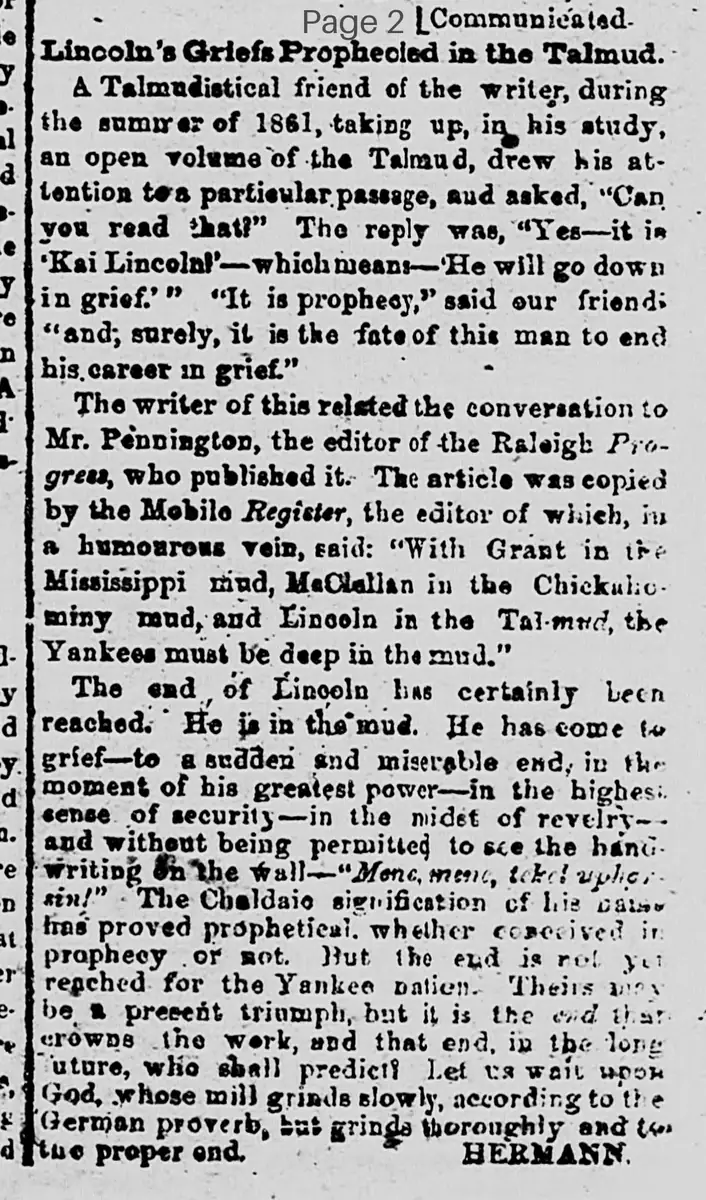
Lincoln's Griefs Prophesied in the Talmud.
A Talmudistical friend of the writer, during the summer of 1864, taking up, in his study, an open volume of the Talmud, drew his attention to a particular passage, and asked, "Can you read that?" The reply was, "Yes—it is 'Kai Lincoln'—which means—He will go down in grief." "It is prophecy," said our friend, "and surely it is the fate of this man to end his career in grief."
The writer of this related the conversation to Mr. Pennington, the editor of the Raleigh Progress, who published it. The article was copied by the Mobile Register, the editor of which, in a humorous vein, said: "With Grant in the Mississippi mud, McClellan in the Chickahominy mud, and Lincoln in the Talmud, the Yankees must be deep in the mud."
The end of Lincoln has certainly been reached. He is in the mud. He has come to grief—to a sudden and miserable end; in the moment of his greatest power—in the highest sense of security—in the midst of revelry—and without being permitted to see the handwriting on the wall—"Mene, mene, tekel upharsin!" The Chaldean signification of his name has proved prophetic, whether conceived in prophecy or not. But the end is not yet reached for the Yankee nation. Theirs may be a present triumph, but it is the god that crowds the work, and that end in the long future, who shall predict? Let us wait upon God, whose mill grinds slowly, according to the German proverb, but grinds thoroughly and to the proper end.
HERMANN.
A Talmudistical friend of the writer, during the summer of 1864, taking up, in his study, an open volume of the Talmud, drew his attention to a particular passage, and asked, "Can you read that?" The reply was, "Yes—it is 'Kai Lincoln'—which means—He will go down in grief." "It is prophecy," said our friend, "and surely it is the fate of this man to end his career in grief."
The writer of this related the conversation to Mr. Pennington, the editor of the Raleigh Progress, who published it. The article was copied by the Mobile Register, the editor of which, in a humorous vein, said: "With Grant in the Mississippi mud, McClellan in the Chickahominy mud, and Lincoln in the Talmud, the Yankees must be deep in the mud."
The end of Lincoln has certainly been reached. He is in the mud. He has come to grief—to a sudden and miserable end; in the moment of his greatest power—in the highest sense of security—in the midst of revelry—and without being permitted to see the handwriting on the wall—"Mene, mene, tekel upharsin!" The Chaldean signification of his name has proved prophetic, whether conceived in prophecy or not. But the end is not yet reached for the Yankee nation. Theirs may be a present triumph, but it is the god that crowds the work, and that end in the long future, who shall predict? Let us wait upon God, whose mill grinds slowly, according to the German proverb, but grinds thoroughly and to the proper end.
HERMANN.
What sub-type of article is it?
Death Or Funeral
Politics
Religious Event
What keywords are associated?
Lincoln Prophecy
Talmud Lincoln
Abraham Lincoln Death
Raleigh Progress
Mobile Register
What entities or persons were involved?
Lincoln
Mr. Pennington
Hermann
Domestic News Details
Event Date
Summer Of 1864; Post April 1865
Key Persons
Lincoln
Mr. Pennington
Hermann
Outcome
lincoln's sudden and miserable end
Event Details
A 1864 conversation interprets a Talmud passage 'Kai Lincoln' as prophesying Lincoln's grief; published in Raleigh Progress and Mobile Register; article reflects on its fulfillment in Lincoln's assassination.