Thank you for visiting SNEWPapers!
Sign up free
Daily National Intelligencer
Washington, District Of Columbia
What is this article about?
Report from Vienna on July 29 details the recent revolution in Naples led by Carbonari, sparking Austrian concerns over spread to northern Italy. Prince Metternich orders military preparations; diplomatic talks with Russia continue amid rumors of a sovereigns' conference. A new pro-legitimacy journal is announced.
Clipping
OCR Quality
Full Text
VIENNA, JULY 29.
Extract from a private letter published in a Belgian Journal.
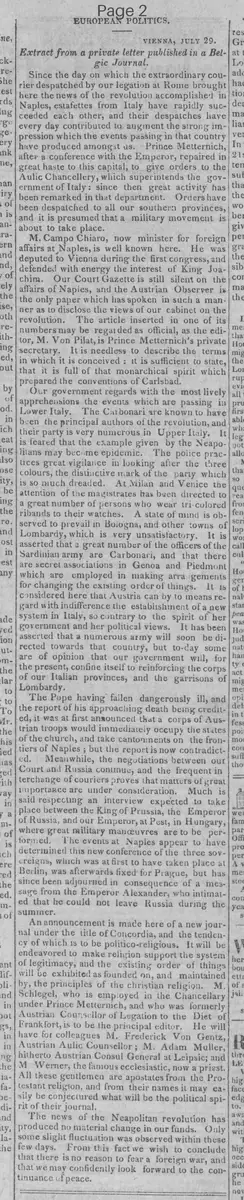
Since the day on which the extraordinary courier despatched by our legation at Rome brought here the news of the revolution accomplished in Naples, estafettes from Italy have rapidly succeeded each other, and their despatches have every day contributed to augment the strong impression which the events passing in that country have produced amongst us. Prince Metternich, after a conference with the Emperor, repaired in great haste to this capital, to give orders to the Aulic Chancellery, which superintends the government of Italy: since then great activity has been remarked in that department. Orders have been despatched to all our southern provinces, and it is presumed that a military movement is about to take place. M. Campo Chiaro, now minister for foreign affairs at Naples, is well known here. He was deputed to Vienna during the first congress, and defended with energy the interest of King Joachim. Our Court Gazette is still silent on the affairs of Naples, and the Austrian Observer is the only paper which has spoken in such a manner as to disclose the views of our cabinet on the revolution. The article inserted in one of its numbers may be regarded as official, as the editor, M. Von Pilat, is Prince Metternich's private secretary. It is needless to describe the terms in which it is conceived: it is sufficient to state, that it is full of that monarchical spirit which prepared the conventions of Carlsbad. Our government regards with the most lively apprehensions the events which are passing in Lower Italy. The Carbonari are known to be the principal authors of the revolution, and their party is very numerous in Upper Italy. It is feared that the example given by the Neapolitans may become epidemic. The police practices great vigilance in looking after the three colours, the distinctive mark of the party which is so much dreaded. At Milan and Venice the attention of the magistrates has been directed to a great number of persons who wear tri-colored ribands to their watches. A state of mind is observed to prevail in Bologna, and other towns of Lombardy, which is very unsatisfactory. It is asserted that a great number of the officers of the Sardinian army are Carbonari, and that there are secret associations in Genoa and Piedmont which are employed in making arrangements for changing the existing order of things. It is considered here that Austria can by no means regard with indifference the establishment of a new system in Italy, so contrary to the spirit of her government and her political views. It has been asserted that a numerous army will soon be directed towards that country, but to-day some are of opinion that our government will, for the present, confine itself to reinforcing the corps of our Italian provinces, and the garrisons of Lombardy. The Pope having fallen dangerously ill, and the report of his approaching death being credited, it was at first announced that a corps of Austrian troops would immediately occupy the states of the church, and take cantonments on the frontiers of Naples; but the report is now contradicted. Meanwhile, the negotiations between our Court and Russia continue, and the frequent interchange of couriers proves that matters of great importance are under consideration. Much is said respecting an interview expected to take place between the King of Prussia, the Emperor of Russia, and our Emperor, at Pesth, in Hungary, where great military manoeuvres are to be performed. The events at Naples appear to have determined this new conference of the three sovereigns, which was at first to have taken place at Berlin, was afterwards fixed for Prague, but has since been adjourned in consequence of a message from the Emperor Alexander, who intimated that he could not leave Russia during the summer. An announcement is made here of a new journal under the title of Concordia, and the tendency of which is to be politico-religious. It will be endeavored to make religion support the system of legitimacy, and the existing order of things will be exhibited as founded on, and maintained by, the principles of the christian religion. M. Schlegel, who is employed in the Chancellery under Prince Metternich, and who was formerly Austrian Counsellor of Legation to the Diet of Frankfort, is to be the principal editor. He will have for colleagues M. Frederick Von Gentz, Austrian Aulic Counsellor; M. Adam Muller, hitherto Austrian Consul General at Leipsic; and M. Werner, the famous ecclesiastic, now a priest. All these gentlemen are apostates from the Protestant religion, and from their names it may easily be conjectured what will be the political spirit of their journal. The news of the Neapolitan revolution has produced no material change in our funds. Only some slight fluctuation was observed within these few days. From this fact we wish to conclude that there is no reason to fear a foreign war, and that we may confidently look forward to the continuance of peace.
What sub-type of article is it?
What keywords are associated?
What entities or persons were involved?
Where did it happen?
Foreign News Details
Primary Location
Naples
Event Date
July 29
Key Persons
Outcome
revolution accomplished in naples; austrian government apprehensive of epidemic spread, reinforces italian garrisons; diplomatic negotiations ongoing; no material change in funds, peace expected.
Event Details
A revolution led by Carbonari has succeeded in Naples, prompting urgent Austrian responses including orders to the Aulic Chancellery and presumed military movements in southern provinces. Fears of spread to Upper Italy, with vigilance against Carbonari symbols in Milan, Venice, Bologna, and reports of secret associations in Genoa and Piedmont. Plans for sovereigns' conference at Pesth influenced by events; new journal Concordia to promote legitimacy. Pope's illness rumors contradicted regarding Austrian troop occupation.