Thank you for visiting SNEWPapers!
Sign up free
Editorial
May 7, 1890
The Central Presbyterian
Richmond, Virginia
What is this article about?
This Presbyterian editorial defends the doctrine that believers' souls are perfected in holiness and immediately enter glory at death, critiquing Roman Catholic purgatory and Dr. C. A. Briggs' views on an intermediate state of probation, emphasizing scriptural and confessional teachings.
Clipping
OCR Quality
98%
Excellent
Full Text
For the Central Presbyterian.
The Intermediate State.
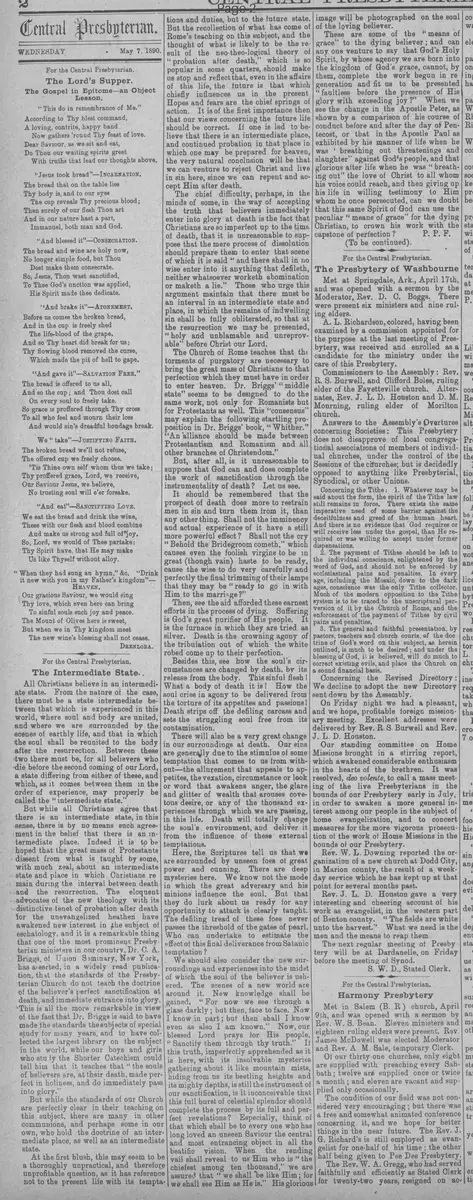
All Christians believe in an intermediate state. From the nature of the case, there must be a state intermediate between that which is experienced in this world, where soul and body are united, and where we are surrounded by the scenes of earthly life, and that in which the soul shall be reunited to the body after the resurrection. Between these two there must be, for all believers who die before the second coming of our Lord, a state differing from either of these, and which, as it comes between them in the order of experience, may properly be called the "intermediate state."
But while all Christians agree that there is an intermediate state, in this sense, there is by no means such agreement in the belief that there is an intermediate place. Indeed it is to be hoped that the great mass of Protestants dissent from what is taught by some, with much zeal, about an intermediate state and place in which Christians remain during the interval between death and the resurrection. The eloquent advocates of the new theology with its distinctive tenet of probation after death for the unevangelized heathen have awakened new interest in the subject of eschatology, and it is a remarkable thing that one of the most prominent Presbyterian ministers in our country, Dr. C. A. Briggs, of Union Seminary, New York, has asserted, in a widely read publication, that the standards of the Presbyterian Church do not teach the doctrine of the believer's perfect sanctification at death, and immediate entrance into glory. This is all the more remarkable in view of the fact that Dr. Briggs is said to have made the standards the subjects of special study for many years, and to have collected the largest library on the subject in the world, while our boys and girls who study the Shorter Catechism could tell him that it teaches that "the souls of believers are, at their death, made perfect in holiness, and do immediately pass into glory."
But while the standards of our Church are perfectly clear in their teaching on this subject, there are many in other communions, and perhaps some in our own, who hold the doctrine of an intermediate place, as well as an intermediate state.
At the first blush, this may seem to be a thoroughly unpractical, and therefore unprofitable question, as it has reference not to the present life with its temptations and duties, but to the future state.
But the recollection of what has come of Rome's teaching on this subject, and the thought of what is likely to be the result of the neo-theological theory of "probation after death," which is so popular in some quarters, should make us stop and reflect that, even in the affairs of this life, the future is that which chiefly influences us in the present. Hopes and fears are the chief springs of action. It is of the first importance then that our views concerning the future life should be correct. If one is led to believe that there is an intermediate place, and continued probation in that place in which one may be prepared for heaven, the very natural conclusion will be that we can venture to reject Christ and live in sin here, since we can repent and accept Him after death.
The chief difficulty, perhaps, in the minds of some, in the way of accepting the truth that believers immediately enter into glory at death is the fact that Christians are so imperfect up to the time of death, that it is unreasonable to suppose that the mere process of dissolution should prepare them to enter that scene of which it is said "and there shall in no wise enter into it anything that defileth, neither whatsoever worketh abomination or maketh a lie." Those who urge this argument maintain that there must be an interval in an intermediate state and place, in which the remains of indwelling sin shall be fully obliterated, so that at the resurrection we may be presented, "holy and unblamable and unreprovable" before Christ our Lord.
The Church of Rome teaches that the torments of purgatory are necessary to bring the great mass of Christians to that perfection which they must have in order to enter heaven. Dr. Briggs' "middle state" seems to be designed to do the same work, not only for Romanists but for Protestants as well. This "consensus" may explain the following startling proposition in Dr. Briggs' book, "Whither."
"An alliance should be made between Protestantism and Romanism and all other branches of Christendom."
But, after all, is it unreasonable to suppose that God can and does complete the work of sanctification through the instrumentality of death? Let us see.
It should be remembered that the prospect of death does more to restrain men in sin and turn them from it, than any other thing. Shall not the imminency and actual experience of it have a still more powerful effect? Shall not the cry "Behold the Bridegroom cometh," which causes even the foolish virgins to be in great (though vain) haste to be ready, cause the wise to do very carefully and perfectly the final trimming of their lamps that they may be "ready to go in with Him to the marriage?"
Then, see the aid afforded these earnest efforts in the process of dying. Suffering is God's great purifier of His people. It is the furnace in which they are tried as silver. Death is the crowning agony of the tribulation out of which the white robed come up to their perfection.
Besides this, see how the soul's circumstances are changed by death, by its release from the body. This sinful flesh! What a body of death it is! How the soul cries in agony to be delivered from the torture of its appetites and passions! Death strips off the defiling carcass and sets the struggling soul free from its contamination.
There will also be a very great change in our surroundings at death. Our sins are generally due to the stimulus of some temptation that comes to us from without--the allurement that appeals to appetites, the vexation, circumstance or look or word that awakens anger, the glare and glitter of wealth that arouses covetous desire, or any of the thousand experiences through which we are passing, in this life. Death will totally change the soul's environment, and deliver it from the influence of these external temptations.
Here, the Scriptures tell us that we are surrounded by unseen foes of great power and cunning. There are deep mysteries here. We know not the mode in which the great adversary and his minions influence the soul. But that they do lurk about us ready for any opportunity to attack is clearly taught. The defiling tread of these foes never passes the threshold of the gates of pearl. Who can undertake to estimate the effect of this final deliverance from Satanic temptation?
We should also consider the new surroundings and experiences into the midst of which the soul of the believer is ushered. The scenes of a new world are around it. New knowledge shall be gained. "For now we see through a glass darkly: but then, face to face. Now I know in part: but then shall I know even as also I am known." Now, our blessed Lord prays for His people, "Sanctify them through thy truth." If this truth, imperfectly apprehended as it is here, with its insolvable mysteries gathering about it like mountain mists, hiding from us its beetling heights and its mighty depths, is still the instrument of our sanctification, is it inconceivable that this full burst of celestial splendor should complete the process by its full and perfect revelations? Especially, think of that which shall be to every one who has long loved an unseen Saviour the central and most entrancing object in all the beatific vision. When the rending vail shall reveal to us Him who is "the chiefest among ten thousand," we are assured that "we shall be like Him; for we shall see Him as He is." His glorious image will be photographed on the soul of the loving believer.
These are some of the "means of grace" to the dying believer; and can any one venture to say that God's Holy Spirit, by whose agency we are born into the kingdom of God's grace, cannot, by them, complete the work begun in regeneration and fit us to be presented "faultless before the presence of His glory with exceeding joy?" When we see the change in the Apostle Peter, as shown by a comparison of his course of conduct before and after the day of Pentecost, or that in the Apostle Paul as exhibited by his manner of life when he was "breathing out threatenings and slaughter" against God's people, and that glorious after life when he was "breathing out" the love of Christ to all whom his voice could reach, and then giving up his life in willing testimony to Him whom he once persecuted, can we doubt that this same Spirit of God can use the peculiar "means of grace" for the dying Christian, to crown his work with the capstone of perfection?
P. P. F.
(To be continued)
The Intermediate State.
All Christians believe in an intermediate state. From the nature of the case, there must be a state intermediate between that which is experienced in this world, where soul and body are united, and where we are surrounded by the scenes of earthly life, and that in which the soul shall be reunited to the body after the resurrection. Between these two there must be, for all believers who die before the second coming of our Lord, a state differing from either of these, and which, as it comes between them in the order of experience, may properly be called the "intermediate state."
But while all Christians agree that there is an intermediate state, in this sense, there is by no means such agreement in the belief that there is an intermediate place. Indeed it is to be hoped that the great mass of Protestants dissent from what is taught by some, with much zeal, about an intermediate state and place in which Christians remain during the interval between death and the resurrection. The eloquent advocates of the new theology with its distinctive tenet of probation after death for the unevangelized heathen have awakened new interest in the subject of eschatology, and it is a remarkable thing that one of the most prominent Presbyterian ministers in our country, Dr. C. A. Briggs, of Union Seminary, New York, has asserted, in a widely read publication, that the standards of the Presbyterian Church do not teach the doctrine of the believer's perfect sanctification at death, and immediate entrance into glory. This is all the more remarkable in view of the fact that Dr. Briggs is said to have made the standards the subjects of special study for many years, and to have collected the largest library on the subject in the world, while our boys and girls who study the Shorter Catechism could tell him that it teaches that "the souls of believers are, at their death, made perfect in holiness, and do immediately pass into glory."
But while the standards of our Church are perfectly clear in their teaching on this subject, there are many in other communions, and perhaps some in our own, who hold the doctrine of an intermediate place, as well as an intermediate state.
At the first blush, this may seem to be a thoroughly unpractical, and therefore unprofitable question, as it has reference not to the present life with its temptations and duties, but to the future state.
But the recollection of what has come of Rome's teaching on this subject, and the thought of what is likely to be the result of the neo-theological theory of "probation after death," which is so popular in some quarters, should make us stop and reflect that, even in the affairs of this life, the future is that which chiefly influences us in the present. Hopes and fears are the chief springs of action. It is of the first importance then that our views concerning the future life should be correct. If one is led to believe that there is an intermediate place, and continued probation in that place in which one may be prepared for heaven, the very natural conclusion will be that we can venture to reject Christ and live in sin here, since we can repent and accept Him after death.
The chief difficulty, perhaps, in the minds of some, in the way of accepting the truth that believers immediately enter into glory at death is the fact that Christians are so imperfect up to the time of death, that it is unreasonable to suppose that the mere process of dissolution should prepare them to enter that scene of which it is said "and there shall in no wise enter into it anything that defileth, neither whatsoever worketh abomination or maketh a lie." Those who urge this argument maintain that there must be an interval in an intermediate state and place, in which the remains of indwelling sin shall be fully obliterated, so that at the resurrection we may be presented, "holy and unblamable and unreprovable" before Christ our Lord.
The Church of Rome teaches that the torments of purgatory are necessary to bring the great mass of Christians to that perfection which they must have in order to enter heaven. Dr. Briggs' "middle state" seems to be designed to do the same work, not only for Romanists but for Protestants as well. This "consensus" may explain the following startling proposition in Dr. Briggs' book, "Whither."
"An alliance should be made between Protestantism and Romanism and all other branches of Christendom."
But, after all, is it unreasonable to suppose that God can and does complete the work of sanctification through the instrumentality of death? Let us see.
It should be remembered that the prospect of death does more to restrain men in sin and turn them from it, than any other thing. Shall not the imminency and actual experience of it have a still more powerful effect? Shall not the cry "Behold the Bridegroom cometh," which causes even the foolish virgins to be in great (though vain) haste to be ready, cause the wise to do very carefully and perfectly the final trimming of their lamps that they may be "ready to go in with Him to the marriage?"
Then, see the aid afforded these earnest efforts in the process of dying. Suffering is God's great purifier of His people. It is the furnace in which they are tried as silver. Death is the crowning agony of the tribulation out of which the white robed come up to their perfection.
Besides this, see how the soul's circumstances are changed by death, by its release from the body. This sinful flesh! What a body of death it is! How the soul cries in agony to be delivered from the torture of its appetites and passions! Death strips off the defiling carcass and sets the struggling soul free from its contamination.
There will also be a very great change in our surroundings at death. Our sins are generally due to the stimulus of some temptation that comes to us from without--the allurement that appeals to appetites, the vexation, circumstance or look or word that awakens anger, the glare and glitter of wealth that arouses covetous desire, or any of the thousand experiences through which we are passing, in this life. Death will totally change the soul's environment, and deliver it from the influence of these external temptations.
Here, the Scriptures tell us that we are surrounded by unseen foes of great power and cunning. There are deep mysteries here. We know not the mode in which the great adversary and his minions influence the soul. But that they do lurk about us ready for any opportunity to attack is clearly taught. The defiling tread of these foes never passes the threshold of the gates of pearl. Who can undertake to estimate the effect of this final deliverance from Satanic temptation?
We should also consider the new surroundings and experiences into the midst of which the soul of the believer is ushered. The scenes of a new world are around it. New knowledge shall be gained. "For now we see through a glass darkly: but then, face to face. Now I know in part: but then shall I know even as also I am known." Now, our blessed Lord prays for His people, "Sanctify them through thy truth." If this truth, imperfectly apprehended as it is here, with its insolvable mysteries gathering about it like mountain mists, hiding from us its beetling heights and its mighty depths, is still the instrument of our sanctification, is it inconceivable that this full burst of celestial splendor should complete the process by its full and perfect revelations? Especially, think of that which shall be to every one who has long loved an unseen Saviour the central and most entrancing object in all the beatific vision. When the rending vail shall reveal to us Him who is "the chiefest among ten thousand," we are assured that "we shall be like Him; for we shall see Him as He is." His glorious image will be photographed on the soul of the loving believer.
These are some of the "means of grace" to the dying believer; and can any one venture to say that God's Holy Spirit, by whose agency we are born into the kingdom of God's grace, cannot, by them, complete the work begun in regeneration and fit us to be presented "faultless before the presence of His glory with exceeding joy?" When we see the change in the Apostle Peter, as shown by a comparison of his course of conduct before and after the day of Pentecost, or that in the Apostle Paul as exhibited by his manner of life when he was "breathing out threatenings and slaughter" against God's people, and that glorious after life when he was "breathing out" the love of Christ to all whom his voice could reach, and then giving up his life in willing testimony to Him whom he once persecuted, can we doubt that this same Spirit of God can use the peculiar "means of grace" for the dying Christian, to crown his work with the capstone of perfection?
P. P. F.
(To be continued)
What sub-type of article is it?
Moral Or Religious
What keywords are associated?
Intermediate State
Sanctification At Death
Presbyterian Doctrine
Purgatory Critique
Dr Briggs
Eschatology
Probation After Death
What entities or persons were involved?
Dr. C. A. Briggs
Union Seminary, New York
Presbyterian Church
Church Of Rome
Editorial Details
Primary Topic
Believers' Immediate Sanctification And Entry Into Glory At Death
Stance / Tone
Defense Of Presbyterian Doctrine Against Intermediate State Or Place
Key Figures
Dr. C. A. Briggs
Union Seminary, New York
Presbyterian Church
Church Of Rome
Key Arguments
All Christians Agree On An Intermediate State But Not An Intermediate Place.
Presbyterian Standards Teach Souls Of Believers Are Perfected At Death And Pass Immediately Into Glory.
Belief In Intermediate Probation Encourages Sin In This Life.
Death Completes Sanctification Through Suffering, Release From Body, Changed Environment, Deliverance From Temptation, And Beatific Vision.
God's Holy Spirit Uses These Means To Perfect Believers For Heaven.