Thank you for visiting SNEWPapers!
Sign up free
The New York Herald
New York, New York County, New York
What is this article about?
The London Literary Gazette details preparations for Arctic search expeditions for Sir John Franklin, led by Sir James Clark Ross with ships Enterprise and Investigator, and Sir John Richardson's overland party from Great Bear Lake, aiming to explore key regions by April 1848.
Clipping
OCR Quality
Full Text
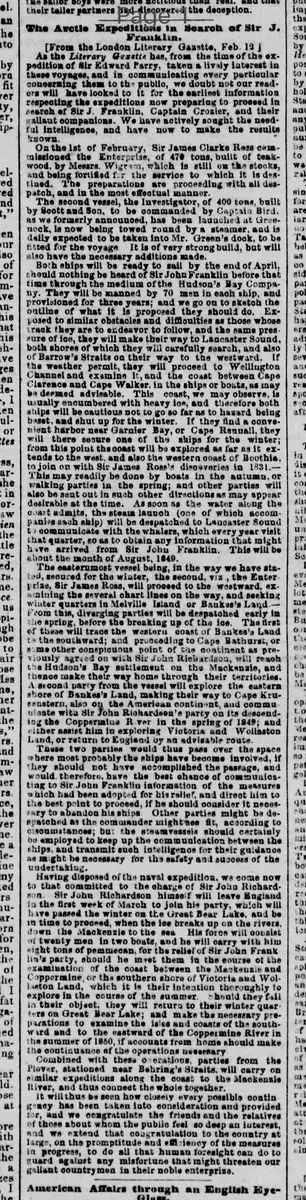
[From the London Literary Gazette, Feb. 12.]
As the Literary Gazette has, from the time of the expedition of Sir Edward Parry, taken a lively interest in these voyages, and in communicating every particular concerning them to the public, we doubt not our readers will have looked to it for the earliest information respecting the expeditions now preparing to proceed in search of Sir J. Franklin, Captain Crozier, and their gallant companions. We have actively sought the needful intelligence, and have now to make the result known.
On the 1st of February, Sir James Clark Ross commissioned the Enterprise, of 470 tons, built of teak-wood, by Messrs. Wigram, which is still on the stocks, and being fortified for the service to which it is destined. The preparations are proceeding with all dispatch, and in the most effectual manner.
The second vessel, the Investigator, of 400 tons, built by Scott and Son, to be commanded by Captain Bird, as we formerly announced, has been launched at Greenock, is now being towed round by a steamer, and is daily expected to be taken into Mr. Green's dock, to be fitted for the voyage. It is of very strong build, but will also have the necessary additions made. Both ships will be ready to sail by the end of April, should nothing be heard of Sir John Franklin before that time through the medium of the Hudson's Bay Company. They will be manned by 70 men in each ship, and provisioned for three years; and we go on to sketch the outline of what it is proposed they should do. Exposed to similar obstacles and difficulties as those whose track they are to endeavor to follow, and the same pressure of ice, they will make their way to Lancaster Sound, both shores of which they will carefully search, and also of Barrow's Straits on their way to the westward. If the weather permit, they will proceed to Wellington Channel and examine it, and the coast between Cape Clarence and Cape Walker, in the ships or boats, as may be deemed advisable. This coast, we may observe, is usually encumbered with heavy ice, and therefore both ships will be cautious not to go so far as to hazard being beset, and shut up for the winter. If they find a convenient harbor near Garnier Bay, or Cape Rennell, they will there secure one of the ships for the winter; from this point the coast will be explored as far as it extends to the west, and also the western coast of Boothia, to join on with Sir James Ross's discoveries in 1831. This may readily be done by boats in the autumn, or walking parties in the spring; and other parties will also be sent out in such other directions as may appear desirable at the time. As soon as the water along the coast admits, the steam launch (one of which accompanies each ship) will be despatched to Lancaster Sound to communicate with the whalers, which every year visit that quarter, so as to obtain any information that might have arrived from Sir John Franklin. This will be about the month of August, 1849.
The easternmost vessel being, in the way we have stated, secured for the winter, the second, viz., the Enterprise, Sir James Ross, will proceed to the westward, examining the several chart lines on the way, and seeking winter quarters in Melville Island or Banks's Land. From this, diverging parties will be despatched early in the spring, before the breaking up of the ice. The first of these will trace the western coast of Banks's Land to the southward; and proceeding to Cape Bathurst, or some other conspicuous point of the continent as previously agreed on with Sir John Richardson, will reach the Hudson's Bay settlement on the Mackenzie, and thence make their way home through their territories. A second party from the vessel will explore the eastern shore of Banks's Land, making their way to Cape Krusenstern, also on the American continent, and communicate with Sir John Richardson's party on its descending the Coppermine River in the spring of 1849; and either assist him in exploring Victoria and Wollaston Land, or return to England by an advisable route. Those two parties would thus pass over the space where most probably the ships have become involved, if they should not have accomplished the passage, and would, therefore, have the best chance of communicating to Sir John Franklin information of the measures which had been adopted for his relief, and direct him to the best point to proceed, if he should consider it necessary to abandon his ships. Other parties might be despatched as the commander might see fit, according to circumstances; but the steam vessels should certainly be employed to keep up the communication between the ships, and transmit such intelligence for their guidance as might be necessary for the safety and success of the undertaking.
Having disposed of the naval expedition, we come now to that committed to the charge of Sir John Richardson. Sir John Richardson himself will leave England in the first week of March to join his party, which will have passed the winter on the Great Bear Lake, and be in time to proceed, when the ice breaks up on the rivers, down the Mackenzie to the sea. His force will consist of twenty men in two boats, and he will carry with him eight tons of pemmican, for the relief of Sir John Franklin's party, should he meet them in the course of the examination of the coast between the Mackenzie and Coppermine, or the southern shore of Victoria and Wollaston Land, which it is their intention thoroughly to explore in the course of the summer. Should they fail in their object, they will return to their winter quarters on Great Bear Lake; and make the necessary preparations to examine the isles and coasts of the southward and to the eastward of the Coppermine River in the summer of 1850, if accounts from home should make the continuance of the operations necessary.
Combined with these operations, parties from the Plover, stationed near Behring's Straits, will carry on similar expeditions along the coast to the Mackenzie River, and thus connect the whole together. It will thus be seen how closely every possible contingency has been taken into consideration and provided for, and we congratulate the friends and the relatives of those about whom the public feel so deep an interest, and we extend that congratulation to the country at large, on the promptitude and efficiency of the measures in progress, to do all that human foresight can do to guard against any misfortune that might threaten our gallant countrymen in their noble enterprize.
What sub-type of article is it?
What keywords are associated?
What entities or persons were involved?
Where did it happen?
Foreign News Details
Primary Location
Arctic Regions
Event Date
February 1848
Key Persons
Outcome
preparations for search expeditions including ships enterprise and investigator to sail by end of april 1848, manned by 70 men each, provisioned for three years; richardson's party to depart march 1848 with supplies for relief.
Event Details
Detailed plans for naval expedition under Sir James Clark Ross to search Lancaster Sound, Barrow's Straits, Wellington Channel, and coasts toward Boothia and Banks's Land, wintering one ship and sending exploring parties; overland expedition by Sir John Richardson from Great Bear Lake down Mackenzie River to explore coasts between Mackenzie and Coppermine, carrying pemmican for Franklin's relief; coordination with Plover near Behring's Straits.