Thank you for visiting SNEWPapers!
Sign up free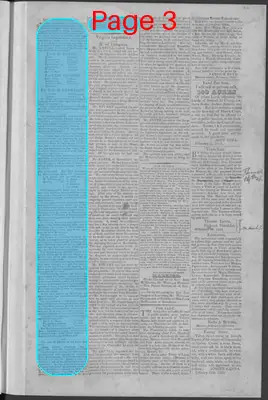
Palladium Of Virginia And The Pacific Monitor
Lewisburg, Greenbrier County, West Virginia
What is this article about?
Detailed account of the 1824 U.S. Presidential election vote counting in Congress on February 9, 1825, where no candidate achieved a majority of electoral votes, leading to John Quincy Adams' election as President by the House of Representatives with 13 states, Andrew Jackson with 7, and William H. Crawford with 4; John C. Calhoun elected Vice President with 182 votes.
Merged-components note: Merged the election results table into the accompanying election story on page 3, as the table provides the vote counts referenced in the narrative text with sequential reading orders.
Clipping
OCR Quality
Full Text
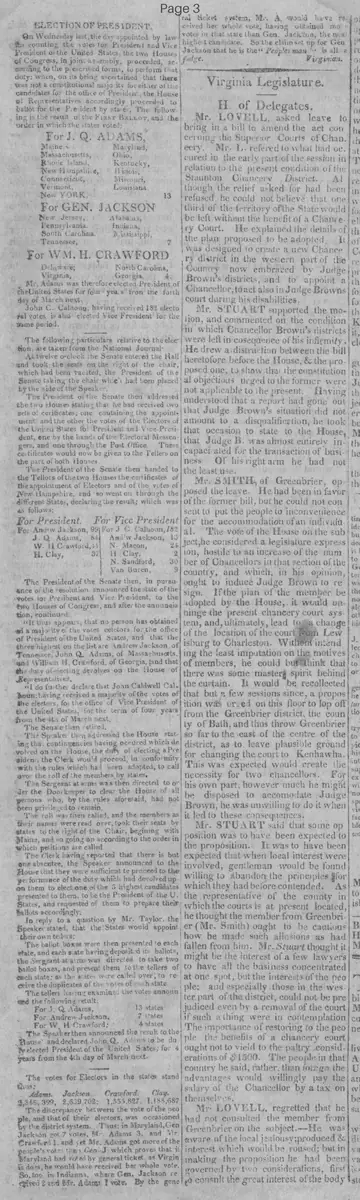
| For President. | For Vice President |
| For Andrew Jackson, 99 | For J. C. Calhoun, 182 |
| J. Q. Adams, 84 | Andrew Jackson, 13 |
| W. H. Crawford, 44 | N. Macon, 24 |
| H. Clay, 37 | H. Clay, 2 |
| N. Sandford, 30 | |
| Van Buren, 9 |
ELECTION OF PRESIDENT.
On Wednesday last, the day appointed by law for counting the votes for President and Vice President of the United States, the two Houses of Congress, in joint assembly, proceeded, according to the prescribed forms, to perform that duty: when, on its being ascertained that there was not a constitutional majority for either of the candidates for the office of President, the House of Representatives accordingly proceeded to ballot for the President by states. The following is the result of the First Ballot, and the order in which the states voted:
For J. Q. ADAMS.
Maine
Maryland,
Massachusetts,
Ohio,
Rhode Island,
Kentucky,
New Hampshire,
Illinois,
Connecticut,
Missouri,
Vermont,
Louisiana.
New York 13
For GEN. JACKSON
New Jersey,
Alabama,
Pennsylvania.
Indiana,
South Carolina,
Mississippi,
Tennessee, 7
For WM. H. CRAWFORD
Delaware;
North Carolina,
Virginia,
Georgia, 4.
Mr. Adams was therefore elected President of the United States for four years from the fourth day of March next.
John C. Calhoun, having received 182 electoral votes is also elected Vice President for the same period.
The following particulars relative to the election are taken from the National Journal
At twelve o'clock the Senate entered the Hall and took the seats on the right of the chair, which had been vacated, the President of the Senate taking the chair which had been placed by the side of the Speaker.
The President of the Senate then addressed the two Houses stating that he had received two sets of certificates, one containing the appointment and the other the votes of the Electors of the United States for President and Vice-President, one by the hands of the Electoral Messengers, and one through the Post Office. These certificates would now be given to the Tellers on the part of both Houses.
The President of the Senate then handed to the Tellers of the two Houses the certificates of the appointment of Electors and of the votes of New Hampshire, and so went on through the different States, declaring the result; which was as follows:
The President of the Senate then, in pursuance of the resolution announced the state of the votes for President and Vice President, to the two Houses of Congress, and after the announcement, continued.
"It thus appears, that no person has obtained a majority of the votes of electors for the office of President of the United States, and that the three highest on the list are Andrew Jackson of Tennessee, John Q. Adams, of Massachusetts, and William H. Crawford, of Georgia, and that the duty of electing devolves on the House of Representatives."
"I do further declare that John Caldwell Calhoun having received a majority of the votes of the electors, for the office of Vice President of the United States, for the term of four years from the 4th of March next."
The Senate then retired.
The Speaker then addressed the House stating that contingencies having occurred which devolved on the House, the duty of electing a President, the Clerk would proceed, in conformity with the rules which had been adopted, to call over the roll of the members by states.
The Sergeant at arms was then directed to order the Doorkeeper to clear the House of all persons who, by the rules aforesaid, had not been privileged to remain.
The roll was then called, and the members as their names were read over, took their seats by states to the right of the Chair, beginning with Maine, and so going on according to the order in which petitions are called
The Clerk having reported that there is but one absentee, the Speaker announced to the House that they were sufficient to proceed to the performance of the duty which had devolved upon them to elect one of the three highest candidates presented to them, to be the President of the U. States, and requested of them to prepare their ballots accordingly.
In reply to a question by Mr. Taylor, the Speaker stated, that the States would appoint their own tellers:
The ballot boxes were then presented to each state, and each state having deposited its ballots, the Sergeant-at arms was directed to take two ballot boxes, and present them to the tellers of each state; as the states were called over, to receive the duplicates of the votes of each state
The tellers having examined the votes announced the following result:
For J. Q Adams. 13 states
For Andrew Jackson. 7 states
For W. H Crawford: 4 states
The Speaker then announced the result to the House, and declared John Q. Adams to be duly elected President of the United States, for 4 years from the 4th day of March next.
The votes for Electors in the states stand thus;
Adams. Jackson Crawford. Clay.
9,346,399 2,639,702: 1,555,827. 1,188,687
The discrepancy between the vote of the people, and that of their electors, was occasioned by the district system. Thus: in Maryland, Gen Jackson got 7 votes, Mr. Adams 3. and Mr Crawford 1. and yet Mr. Adams got more of the people's vote than Gen. J which proves that if Maryland had voted by general ticket, as Virginia does, he would have received her whole vote.
So, too, in Indiana, where Gen. Jackson received 7 and Mr. Adams 1 vote. By the general ticket system, Mr. A. would have received her whole vote, having obtained more votes in that state than Gen. Jackson, the next highest candidate. So the claim set up for Gen Jackson that he is the "Peoples man".. is all a fudge.
What sub-type of article is it?
What themes does it cover?
What keywords are associated?
What entities or persons were involved?
Where did it happen?
Story Details
Key Persons
Location
United States Congress
Event Date
1824
Story Details
No candidate received a majority of electoral votes for President; House of Representatives elected J. Q. Adams with 13 states over Jackson (7) and Crawford (4). Calhoun elected Vice President with 182 votes. Text details the counting process and notes discrepancies due to district system favoring Adams in some states.