Thank you for visiting SNEWPapers!
Sign up free
Story
September 25, 1807
Alexandria Daily Advertiser
Alexandria, Virginia
What is this article about?
Robert R. Livingston details profits and losses from wintering a mixed flock of Merino and common sheep at Clermont in 1806-7, demonstrating the superior wool yield and economic benefits of Merino breeds over common sheep to encourage farmers to adopt them.
Clipping
OCR Quality
88%
Good
Full Text
From the Poughkeepsie Journal.
COMMUNICATION.
Messrs. Printers,
THE committee of publication of the agricultural society of Duchess county, conceiving the subject of the following communication of considerable importance, and that it is of consequence to give it as early publication as possible, request you will insert it in your useful paper as soon as you conveniently can.
WM. BROOM, Sec'ry.
August 3, 1807.
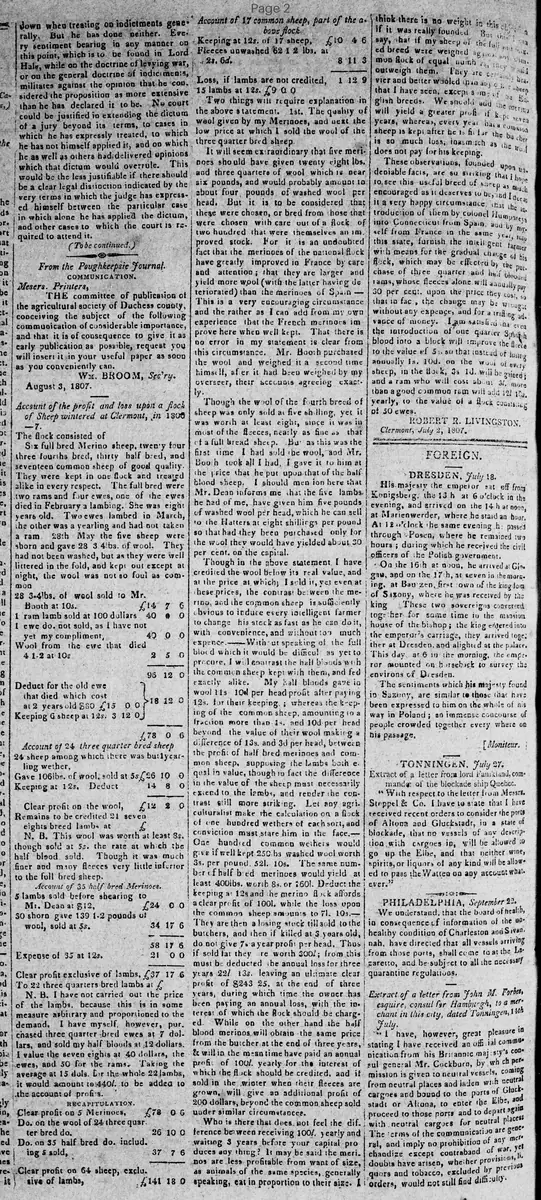
Account of the profit and loss upon a flock of Sheep wintered at Clermont, in 1806-7.
The flock consisted of Six full bred Merino sheep, twenty four three fourths bred, thirty half bred, and seventeen common sheep of good quality. They were kept in one flock and treated alike in every respect. The full bred were two rams and four ewes, one of the ewes died in February a lambing. She was eight years old. Two ewes lambed in March, the other was a yearling and had not taken a ram. 28th May the five sheep were shorn and gave 28 3/4 lbs. of wool. They had not been washed, but as they were well littered in the fold, and kept out except at night, the wool was not so foul as common
28 3/4 lbs. of wool sold to Mr. Booth at 10s. £14 7 6
1 ram lamb sold at 100 dollars 400.0
1 ewe do. not sold, as I have not yet my compliment, 40 0 0
Wool from the ewe that died 4 1/2 at 10s 2 5 0
Deduct for the old ewe that died which cost at 2 years old $80 15 0 0 -18 12 0
Keeping 6 sheep at 12s. 3 12 0. 1 7 8 0 6
Account of 24 three quarter bred sheep 24 sheep among which there was but one yearling wether, Gave 106 lbs. of wool, sold at 5s £26 10 0 Keeping at 12s. Deduct 14 8 0
Clear profit on the wool, 12 2 0 Remains to be credited 21 seven eights breed lamb at
N. B. This wool was worth at least 8s. though sold at 5s. the rate at which the half blood sold. Though it was much finer and many fleeces very little inferior to the full bred sheep.
Account of 35 half bred Merinoes. 5 lambs sold before shearing to Mr. Dean at $12. £24 0 0 30 shorn gave 139 1/2 pounds of wool, sold at 5s. 34 17 6 58 17 6 Expense of 35 at 12s. 21 0 0
Clear profit exclusive of lambs, £37 17 6 To 22 three quarters bred lambs at
N. B. I have not carried out the price of the lambs. because this is in some measure arbitrary and proportioned to the demand. I have myself, however, purchased three quarter bred ewes at 7 dollars, and sold my half bloods at 12 dollars. I value the seven eights at 40 dollars, the ewes, and 50 for the rams. Taking the average at 15 dols. For the whole 22 lambs, it would amount to 330 l. to be added to the account of profit s.
RECAPITULATION. Clear profit on 5 Merinoes, 7 8 0 6 Do. on the wool of 24 three quarter bred do. 26 10 0 Do. on 35 half bred do. including 5 sold, 37 7 6 Clear profit on 64 sheep, exclusive of lambs, 141 18 0
Account of 17 common sheep, part of the above flock Keeping at 12s. of 17 sheep. - £10 4 6 Fleeces unwashed 62 1/2 lbs, at 2s. 6d. 8 11 3 Loss, if lambs are not credited, 1 12 9 15 lambs at 12s. 9 0 0
Two things will require explanation in the above statement. 1st. The quality of wool given by my Merinoes, and next the low price at which I sold the wool of the three quarter bred sheep. It will seem extraordinary that five merinoes should have given twenty eight lbs. and three quarters of wool which is near six pounds, and would probably amount to about four, pounds, of washed wool per head. But it is to be considered that these were chosen, or bred from those that were chosen with care out of a flock of two hundred that were themselves an improved stock. For it is an undoubted fact that the merinoes of the parental flock have greatly improved in France by care and attention; that they are larger and yield more wool (with the latter having deteriorated) than the merinoes of Spain -- This is a very encouraging circumstance and the rather as I can add from my own experience that the French merinos improve here when well kept. That there is no error in my statement is clear from this circumstance. Mr. Booth purchased the wool and weighed it a second time himself, after it had been weighed by my overseer, their accounts agreeing exactly.
Though the wool of the fourth breed of sheep was only sold at five shillings, yet it was worth at least eight, since it was in most of the fleeces, nearly as fine as that of a full bred sheep. But as this was the first time I had sold the wool. and Mr. Booth took all I had, I gave it to him at the price that he put upon that of the half blood sheep. I should mention here that Mr. Dean informs me that the five lambs. he had of me, have given him five pounds of washed wool per head, which he can sell to the Hatters at eight shillings per pound so that had they been purchased only for the wool they would have yielded about 30 per cent. on the capital.
Though in the above statement I have credited the wool below its real value, and at the price at which I sold it, yet even at these prices, the contrast between the merino, and the common sheep is sufficiently obvious to induce every intelligent farmer to change his stock as fast as he can do it. with convenience, and without too much expense. Without speaking of the full blood which it would be difficult as yet to procure, I will contrast the half bloods with the common sheep kept with them, and fed exactly alike. My half bloods gave in wool its 10d per head profit after paying 12s. for their keeping. ; whereas the keeping of the common sheep, amounting to a fraction more than 1s. and 10d. per head beyond the value of their wool making a difference of 13s. and 3d per head, between the profit of half bred merinoes and common sheep. supposing the lambs both equal in value, though in fact the difference in the value of the sheep must necessarily extend to the lambs, and render the contrast still more striking. Let any agriculturalist make the calculation on a stock of one hundred wethers of each sort, and conviction must stare him in the face. One hundred common wethers would give if well kept 250 lbs washed wool worth 3s. per pound. 52l. 10s. The same number of half bred merinoes would yield at least 400 lbs. worth 8s. or 160l. Deduct the keeping at 12s and the merino flock affords a clear profit of 100l. while the loss upon the common sheep amounts to 7l. 10s. They are then a losing stock till sold to the butchers, and then if killed at 5 years old, do not give 7s a year profit per head. Thus if sold fat they are worth 300l: from this must be deducted the annual loss for three years 22l 13s. leaving an ultimate clear profit of 277 7s, at the end of three years, during which time the owner has been paying an annual loss, with the interest of which the flock should be charged. While on the other hand the half blood merinos will obtain the same price from the butcher at the end of three years, & will in the mean time have paid an annual profit of 100l. yearly for the interest of which the flock should be credited, and if sold in the winter when their fleeces are grown, will give an additional profit of 200 dollars, beyond the common sheep sold under similar circumstances.
Who is there that does not feel the difference between receiving 100l. yearly and waiting 5 years before your capital produces any thing? It may be said the merinoes are less profitable from want of size, as animals of the same species, generally speaking, eat in proportion to their size. I think there is no weight in this objection if it was really founded say ed breed hat if were my weighed sheep of agas the an cim outweigh mon ock of equal numh hey il Phey are cer'ainly bea. vier and better wooled than any sheep that I have seen. except some of the English breeds We sncoli aud the merino will yield a greater profit kept even years whereas every Year naia sheep is kept after he is fit for the butcher is so much loss; inasmuch a3 the wool does not pay for his keeping. These observations, founded upon undeniable facts, are so striking that I hope to see this useful breed of sheep as much encouraged as it deserves to be, and I deem it a very happy circumstance, that the introduction of them by colonel Humphreys into Connecticut from Spain, and by myself from France in the same year into this state, furnish the intelligent farmer with means for the gradual change of his flock, which may be effected by the purchase of three quarter and half blood rams, whose fleeces alone will annually pay 30 per cent. upon the price they cost, so that in fact, the change may be wrought without any expense, and for a trifling ad. vance of money. I am satisfied that even the introduction of one quarter Spanish blood into a flock will improve the fleece to the value of 5s so that instead of losing annually 1s. 10d. on the wool of every sheep, in the flock, 3s 1d. will be gained; and a ram who will cost about 3l. more than a good common ram will add 12l 10s. yearly, to the value of a flock consisting of 50 ewes.
ROBERT R. LIVINGSTON.
Clermont, July 2, 1807.
COMMUNICATION.
Messrs. Printers,
THE committee of publication of the agricultural society of Duchess county, conceiving the subject of the following communication of considerable importance, and that it is of consequence to give it as early publication as possible, request you will insert it in your useful paper as soon as you conveniently can.
WM. BROOM, Sec'ry.
August 3, 1807.
Account of the profit and loss upon a flock of Sheep wintered at Clermont, in 1806-7.
The flock consisted of Six full bred Merino sheep, twenty four three fourths bred, thirty half bred, and seventeen common sheep of good quality. They were kept in one flock and treated alike in every respect. The full bred were two rams and four ewes, one of the ewes died in February a lambing. She was eight years old. Two ewes lambed in March, the other was a yearling and had not taken a ram. 28th May the five sheep were shorn and gave 28 3/4 lbs. of wool. They had not been washed, but as they were well littered in the fold, and kept out except at night, the wool was not so foul as common
28 3/4 lbs. of wool sold to Mr. Booth at 10s. £14 7 6
1 ram lamb sold at 100 dollars 400.0
1 ewe do. not sold, as I have not yet my compliment, 40 0 0
Wool from the ewe that died 4 1/2 at 10s 2 5 0
Deduct for the old ewe that died which cost at 2 years old $80 15 0 0 -18 12 0
Keeping 6 sheep at 12s. 3 12 0. 1 7 8 0 6
Account of 24 three quarter bred sheep 24 sheep among which there was but one yearling wether, Gave 106 lbs. of wool, sold at 5s £26 10 0 Keeping at 12s. Deduct 14 8 0
Clear profit on the wool, 12 2 0 Remains to be credited 21 seven eights breed lamb at
N. B. This wool was worth at least 8s. though sold at 5s. the rate at which the half blood sold. Though it was much finer and many fleeces very little inferior to the full bred sheep.
Account of 35 half bred Merinoes. 5 lambs sold before shearing to Mr. Dean at $12. £24 0 0 30 shorn gave 139 1/2 pounds of wool, sold at 5s. 34 17 6 58 17 6 Expense of 35 at 12s. 21 0 0
Clear profit exclusive of lambs, £37 17 6 To 22 three quarters bred lambs at
N. B. I have not carried out the price of the lambs. because this is in some measure arbitrary and proportioned to the demand. I have myself, however, purchased three quarter bred ewes at 7 dollars, and sold my half bloods at 12 dollars. I value the seven eights at 40 dollars, the ewes, and 50 for the rams. Taking the average at 15 dols. For the whole 22 lambs, it would amount to 330 l. to be added to the account of profit s.
RECAPITULATION. Clear profit on 5 Merinoes, 7 8 0 6 Do. on the wool of 24 three quarter bred do. 26 10 0 Do. on 35 half bred do. including 5 sold, 37 7 6 Clear profit on 64 sheep, exclusive of lambs, 141 18 0
Account of 17 common sheep, part of the above flock Keeping at 12s. of 17 sheep. - £10 4 6 Fleeces unwashed 62 1/2 lbs, at 2s. 6d. 8 11 3 Loss, if lambs are not credited, 1 12 9 15 lambs at 12s. 9 0 0
Two things will require explanation in the above statement. 1st. The quality of wool given by my Merinoes, and next the low price at which I sold the wool of the three quarter bred sheep. It will seem extraordinary that five merinoes should have given twenty eight lbs. and three quarters of wool which is near six pounds, and would probably amount to about four, pounds, of washed wool per head. But it is to be considered that these were chosen, or bred from those that were chosen with care out of a flock of two hundred that were themselves an improved stock. For it is an undoubted fact that the merinoes of the parental flock have greatly improved in France by care and attention; that they are larger and yield more wool (with the latter having deteriorated) than the merinoes of Spain -- This is a very encouraging circumstance and the rather as I can add from my own experience that the French merinos improve here when well kept. That there is no error in my statement is clear from this circumstance. Mr. Booth purchased the wool and weighed it a second time himself, after it had been weighed by my overseer, their accounts agreeing exactly.
Though the wool of the fourth breed of sheep was only sold at five shillings, yet it was worth at least eight, since it was in most of the fleeces, nearly as fine as that of a full bred sheep. But as this was the first time I had sold the wool. and Mr. Booth took all I had, I gave it to him at the price that he put upon that of the half blood sheep. I should mention here that Mr. Dean informs me that the five lambs. he had of me, have given him five pounds of washed wool per head, which he can sell to the Hatters at eight shillings per pound so that had they been purchased only for the wool they would have yielded about 30 per cent. on the capital.
Though in the above statement I have credited the wool below its real value, and at the price at which I sold it, yet even at these prices, the contrast between the merino, and the common sheep is sufficiently obvious to induce every intelligent farmer to change his stock as fast as he can do it. with convenience, and without too much expense. Without speaking of the full blood which it would be difficult as yet to procure, I will contrast the half bloods with the common sheep kept with them, and fed exactly alike. My half bloods gave in wool its 10d per head profit after paying 12s. for their keeping. ; whereas the keeping of the common sheep, amounting to a fraction more than 1s. and 10d. per head beyond the value of their wool making a difference of 13s. and 3d per head, between the profit of half bred merinoes and common sheep. supposing the lambs both equal in value, though in fact the difference in the value of the sheep must necessarily extend to the lambs, and render the contrast still more striking. Let any agriculturalist make the calculation on a stock of one hundred wethers of each sort, and conviction must stare him in the face. One hundred common wethers would give if well kept 250 lbs washed wool worth 3s. per pound. 52l. 10s. The same number of half bred merinoes would yield at least 400 lbs. worth 8s. or 160l. Deduct the keeping at 12s and the merino flock affords a clear profit of 100l. while the loss upon the common sheep amounts to 7l. 10s. They are then a losing stock till sold to the butchers, and then if killed at 5 years old, do not give 7s a year profit per head. Thus if sold fat they are worth 300l: from this must be deducted the annual loss for three years 22l 13s. leaving an ultimate clear profit of 277 7s, at the end of three years, during which time the owner has been paying an annual loss, with the interest of which the flock should be charged. While on the other hand the half blood merinos will obtain the same price from the butcher at the end of three years, & will in the mean time have paid an annual profit of 100l. yearly for the interest of which the flock should be credited, and if sold in the winter when their fleeces are grown, will give an additional profit of 200 dollars, beyond the common sheep sold under similar circumstances.
Who is there that does not feel the difference between receiving 100l. yearly and waiting 5 years before your capital produces any thing? It may be said the merinoes are less profitable from want of size, as animals of the same species, generally speaking, eat in proportion to their size. I think there is no weight in this objection if it was really founded say ed breed hat if were my weighed sheep of agas the an cim outweigh mon ock of equal numh hey il Phey are cer'ainly bea. vier and better wooled than any sheep that I have seen. except some of the English breeds We sncoli aud the merino will yield a greater profit kept even years whereas every Year naia sheep is kept after he is fit for the butcher is so much loss; inasmuch a3 the wool does not pay for his keeping. These observations, founded upon undeniable facts, are so striking that I hope to see this useful breed of sheep as much encouraged as it deserves to be, and I deem it a very happy circumstance, that the introduction of them by colonel Humphreys into Connecticut from Spain, and by myself from France in the same year into this state, furnish the intelligent farmer with means for the gradual change of his flock, which may be effected by the purchase of three quarter and half blood rams, whose fleeces alone will annually pay 30 per cent. upon the price they cost, so that in fact, the change may be wrought without any expense, and for a trifling ad. vance of money. I am satisfied that even the introduction of one quarter Spanish blood into a flock will improve the fleece to the value of 5s so that instead of losing annually 1s. 10d. on the wool of every sheep, in the flock, 3s 1d. will be gained; and a ram who will cost about 3l. more than a good common ram will add 12l 10s. yearly, to the value of a flock consisting of 50 ewes.
ROBERT R. LIVINGSTON.
Clermont, July 2, 1807.
What sub-type of article is it?
Agricultural Account
Economic Report
What themes does it cover?
Triumph
Moral Virtue
What keywords are associated?
Merino Sheep
Wool Production
Agricultural Profit
Sheep Breeding
Robert Livingston
Clermont Farm
Duchess County
What entities or persons were involved?
Robert R. Livingston
Wm. Broom
Mr. Booth
Mr. Dean
Colonel Humphreys
Where did it happen?
Clermont, Duchess County
Story Details
Key Persons
Robert R. Livingston
Wm. Broom
Mr. Booth
Mr. Dean
Colonel Humphreys
Location
Clermont, Duchess County
Event Date
1806 7
Story Details
Detailed financial account of wool production and lamb sales from full-bred, three-quarter, half-bred Merino sheep and common sheep, showing clear profits for Merinos and losses for commons, with explanations and encouragements for farmers to adopt improved breeds.