Thank you for visiting SNEWPapers!
Sign up free
Editorial
March 4, 1808
Norfolk Gazette And Publick Ledger
Norfolk, Virginia
What is this article about?
Political reflections on the Napoleonic threat to global liberty, drawing parallels to Roman despotism. Urges US preparedness amid European crises, praises Jefferson's defense message but critiques military reforms. Notes French activities in New Orleans.
Clipping
OCR Quality
98%
Excellent
Full Text
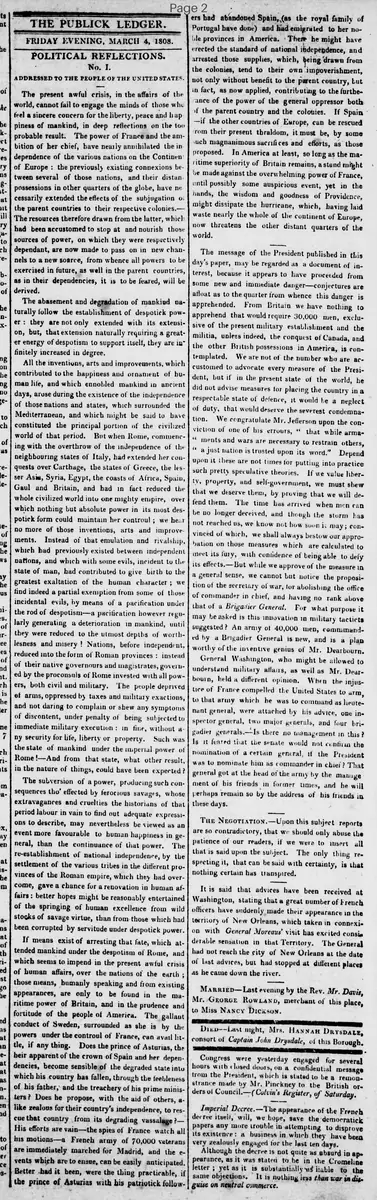
THE PUBLICK LEDGER.
FRIDAY EVENING. MARCH 4, 1808.
POLITICAL REFLECTIONS.
No. I.
ADDRESSED TO THE PEOPLE OF THE UNITED STATES.
The present awful crisis, in the affairs of the world, cannot fail to engage the minds of those who feel a sincere concern for the liberty, peace and happiness of mankind, in deep reflections on the too probable result. The power of France and the ambition of her chief, have nearly annihilated the independence of the various nations on the Continent of Europe : the previously existing connexions between several of those nations. and their distant possessions in other quarters of the globe, have necessarily extended the effects of the subjugation of the parent countries to their respective colonies. The resources therefore drawn from the latter, which had been accustomed to stop at and nourish those sources of power, on which they were respectively dependant, are now made to pass on in new channels to a new source, from whence all powers to be exercised in future, as well in the parent countries, as in their dependencies, it is to be feared, will be derived.
The abasement and degradation of mankind naturally follow the establishment of despotick power : they are not only extended with its extension, but, that extension naturally requiring a greater energy of despotism to support itself, they are infinitely increased in degree.
All the inventions, arts and improvements, which contributed to the happiness and ornament of human life, and which ennobled mankind in ancient days, arose during the existence of the independence of those nations and states, which surrounded the Mediterranean, and which might be said to have constituted the principal portion of the civilized world of that period. But when Rome, commencing with the overthrow of the independence of the neighbouring states of Italy, had extended her conquests over Carthage, the states of Greece, the lesser Asia, Syria, Egypt, the coasts of Africa, Spain, Gaul and Britain, and had in fact reduced the whole civilized world into one mighty empire, over which nothing but absolute power in its most despotick form could maintain her controul; we hear no more of those inventions, arts and improvements. Instead of that emulation and rivalship, which had previously existed between independent nations, and which with some evils, incident to the state of man, had contributed to give birth to the greatest exaltation of the human character; we find indeed a partial exemption from some of those incidental evils, by means of a pacification under the rod of despotism--a pacification however regularly generating a deterioration in mankind, until they were reduced to the utmost depths of worthlessness and misery ! Nations, before independent, reduced into the form of Roman provinces : instead of their native governours and magistrates, governed by the proconsuls of Rome invested with all powers, both civil and military. The people deprived of arms, oppressed by taxes and military exactions, and not daring to complain or shew any symptoms of discontent, under penalty of being subjected to immediate military execution : in fine, without any security for life, liberty or property. Such was the state of mankind under the imperial power of Rome!--And from that state, what other result, in the nature of things, could have been expected?
The subversion of a power, producing such consequences tho' effected by ferocious savages, whose extravagances and cruelties the historians of that period labour in vain to find out adequate expressions to describe, may nevertheless be viewed as an event more favourable to human happiness in general, than the continuance of that power. The re-establishment of national independence, by the settlement of the various tribes in the different provinces of the Roman empire, which they had overcome, gave a chance for a renovation in human affairs: better hopes might be reasonably entertained of the springing of human excellence from wild stocks of savage virtue, than from those which had been corrupted by servitude under despotick power.
If means exist of arresting that fate, which attended mankind under the despotism of Rome, and which seems to impend in the present awful crisis of human affairs, over the nations of the earth ; those means, humanly speaking and from existing appearances, are only to be found in the maritime power of Britain, and in the prudence and fortitude of the people of America. The gallant conduct of Sweden, surrounded as she is by the powers under the controul of France, can avail little, if any thing. Does the prince of Asturias, the heir apparent of the crown of Spain and her dependencies, become sensible of the degraded state into which his country has fallen, through the feebleness of his father, and the treachery of his prime ministers? Does he propose, with the aid of others, alike zealous for their country's independence, to rescue that country from its degrading vassalage?-- His efforts are vain--the spies of France watch all his motions--a French army of 70,000 veterans are immediately marched for Madrid, and the events which are to ensue, can be easily anticipated.
Better had it been, were the thing practicable, if the prince of Asturias with his patriotick followers had abandoned Spain, (as the royal family of Portugal have done) and had emigrated to her noble provinces in America. There he might have erected the standard of national independence, and arrested those supplies, which, being drawn from the colonies, tend to their own impoverishment, not only without benefit to the parent country, but in fact, as now applied, contributing to the furtherance of the power of the general oppressor both of the parent country and the colonies. If Spain --if the other countries of Europe, can be rescued from their present thraldom, it must be, by some such magnanimous sacrifices and efforts, as those proposed. In America at least, so long as the maritime superiority of Britain remains, a stand might be made against the overwhelming power of France, until possibly some auspicious event, yet in the hands, the wisdom and goodness of Providence, might dissipate the hurricane, which, having laid waste nearly the whole of the continent of Europe, now threatens the other distant quarters of the world.
The message of the President published in this day's paper, may be regarded as a document of interest, because it appears to have proceeded from some new and immediate danger—conjectures are afloat as to the quarter from whence this danger is apprehended. From Britain we have nothing to apprehend that would require 30,000 men, exclusive of the present military establishment and the militia, unless indeed, the conquest of Canada, and the other British possessions in America, is contemplated. We are not of the number who are accustomed to advocate every measure of the President, but if in the present state of the world, he did not advise measures for placing the country in a respectable state of defence, it would be a neglect of duty, that would deserve the severest condemnation. We congratulate Mr. Jefferson upon the conviction of one of his errours, "that while armaments and wars are necessary to restrain others, a just nation is trusted upon its word." Depend upon it these are not times for putting into practice such pretty speculative theories. If we value liberty, property, and self-government, we must shew that we deserve them, by proving that we will defend them. The time has arrived when men can be no longer deceived, and though the storm has not reached us, we know not how soon it may; convinced of which, we shall always bestow our approbation on those measures which are calculated to meet its fury, with confidence of being able to defy its effects.--But while we approve of the measure in a general sense, we cannot but notice the proposition of the secretary of war, for abolishing the office of commander in chief, and having no rank above that of a Brigadier General. For what purpose it may be asked is this innovation in military tactics suggested? An army of 40,000 men, commanded by a Brigadier General is new, and is a plan worthy of the inventive genius of Mr. Dearbourn.
General Washington, who might be allowed to understand military affairs, as well as Mr. Dearbourn, held a different opinion. When the injustice of France compelled the United States to arm, to that army which he was to command as lieutenant general, were attached by his advice, one inspector general, two major generals, and four brigadier generals.--Is there no management in this? Is it feared that the senate would not confirm the nomination of a certain general, if the President was to nominate him as commander in chief ? That general got at the head of the army by the management of his friends in former times, and he will perhaps remain so by the address of his friends in these days.
The Negotiation.--Upon this subject reports are so contradictory, that we should only abuse the patience of our readers, if we were to insert all that is said upon the subject. The only thing respecting it, that can be said with certainty, is that nothing certain has transpired.
It is said that advices have been received at Washington, stating that a great number of French officers have suddenly made their appearance in the territory of New Orleans, which taken in connexion with General Moreau's visit has excited considerable sensation in that Territory. The General had not reach the city of New Orleans at the date of last advices, but had stopped at different places as he came down the river.
FRIDAY EVENING. MARCH 4, 1808.
POLITICAL REFLECTIONS.
No. I.
ADDRESSED TO THE PEOPLE OF THE UNITED STATES.
The present awful crisis, in the affairs of the world, cannot fail to engage the minds of those who feel a sincere concern for the liberty, peace and happiness of mankind, in deep reflections on the too probable result. The power of France and the ambition of her chief, have nearly annihilated the independence of the various nations on the Continent of Europe : the previously existing connexions between several of those nations. and their distant possessions in other quarters of the globe, have necessarily extended the effects of the subjugation of the parent countries to their respective colonies. The resources therefore drawn from the latter, which had been accustomed to stop at and nourish those sources of power, on which they were respectively dependant, are now made to pass on in new channels to a new source, from whence all powers to be exercised in future, as well in the parent countries, as in their dependencies, it is to be feared, will be derived.
The abasement and degradation of mankind naturally follow the establishment of despotick power : they are not only extended with its extension, but, that extension naturally requiring a greater energy of despotism to support itself, they are infinitely increased in degree.
All the inventions, arts and improvements, which contributed to the happiness and ornament of human life, and which ennobled mankind in ancient days, arose during the existence of the independence of those nations and states, which surrounded the Mediterranean, and which might be said to have constituted the principal portion of the civilized world of that period. But when Rome, commencing with the overthrow of the independence of the neighbouring states of Italy, had extended her conquests over Carthage, the states of Greece, the lesser Asia, Syria, Egypt, the coasts of Africa, Spain, Gaul and Britain, and had in fact reduced the whole civilized world into one mighty empire, over which nothing but absolute power in its most despotick form could maintain her controul; we hear no more of those inventions, arts and improvements. Instead of that emulation and rivalship, which had previously existed between independent nations, and which with some evils, incident to the state of man, had contributed to give birth to the greatest exaltation of the human character; we find indeed a partial exemption from some of those incidental evils, by means of a pacification under the rod of despotism--a pacification however regularly generating a deterioration in mankind, until they were reduced to the utmost depths of worthlessness and misery ! Nations, before independent, reduced into the form of Roman provinces : instead of their native governours and magistrates, governed by the proconsuls of Rome invested with all powers, both civil and military. The people deprived of arms, oppressed by taxes and military exactions, and not daring to complain or shew any symptoms of discontent, under penalty of being subjected to immediate military execution : in fine, without any security for life, liberty or property. Such was the state of mankind under the imperial power of Rome!--And from that state, what other result, in the nature of things, could have been expected?
The subversion of a power, producing such consequences tho' effected by ferocious savages, whose extravagances and cruelties the historians of that period labour in vain to find out adequate expressions to describe, may nevertheless be viewed as an event more favourable to human happiness in general, than the continuance of that power. The re-establishment of national independence, by the settlement of the various tribes in the different provinces of the Roman empire, which they had overcome, gave a chance for a renovation in human affairs: better hopes might be reasonably entertained of the springing of human excellence from wild stocks of savage virtue, than from those which had been corrupted by servitude under despotick power.
If means exist of arresting that fate, which attended mankind under the despotism of Rome, and which seems to impend in the present awful crisis of human affairs, over the nations of the earth ; those means, humanly speaking and from existing appearances, are only to be found in the maritime power of Britain, and in the prudence and fortitude of the people of America. The gallant conduct of Sweden, surrounded as she is by the powers under the controul of France, can avail little, if any thing. Does the prince of Asturias, the heir apparent of the crown of Spain and her dependencies, become sensible of the degraded state into which his country has fallen, through the feebleness of his father, and the treachery of his prime ministers? Does he propose, with the aid of others, alike zealous for their country's independence, to rescue that country from its degrading vassalage?-- His efforts are vain--the spies of France watch all his motions--a French army of 70,000 veterans are immediately marched for Madrid, and the events which are to ensue, can be easily anticipated.
Better had it been, were the thing practicable, if the prince of Asturias with his patriotick followers had abandoned Spain, (as the royal family of Portugal have done) and had emigrated to her noble provinces in America. There he might have erected the standard of national independence, and arrested those supplies, which, being drawn from the colonies, tend to their own impoverishment, not only without benefit to the parent country, but in fact, as now applied, contributing to the furtherance of the power of the general oppressor both of the parent country and the colonies. If Spain --if the other countries of Europe, can be rescued from their present thraldom, it must be, by some such magnanimous sacrifices and efforts, as those proposed. In America at least, so long as the maritime superiority of Britain remains, a stand might be made against the overwhelming power of France, until possibly some auspicious event, yet in the hands, the wisdom and goodness of Providence, might dissipate the hurricane, which, having laid waste nearly the whole of the continent of Europe, now threatens the other distant quarters of the world.
The message of the President published in this day's paper, may be regarded as a document of interest, because it appears to have proceeded from some new and immediate danger—conjectures are afloat as to the quarter from whence this danger is apprehended. From Britain we have nothing to apprehend that would require 30,000 men, exclusive of the present military establishment and the militia, unless indeed, the conquest of Canada, and the other British possessions in America, is contemplated. We are not of the number who are accustomed to advocate every measure of the President, but if in the present state of the world, he did not advise measures for placing the country in a respectable state of defence, it would be a neglect of duty, that would deserve the severest condemnation. We congratulate Mr. Jefferson upon the conviction of one of his errours, "that while armaments and wars are necessary to restrain others, a just nation is trusted upon its word." Depend upon it these are not times for putting into practice such pretty speculative theories. If we value liberty, property, and self-government, we must shew that we deserve them, by proving that we will defend them. The time has arrived when men can be no longer deceived, and though the storm has not reached us, we know not how soon it may; convinced of which, we shall always bestow our approbation on those measures which are calculated to meet its fury, with confidence of being able to defy its effects.--But while we approve of the measure in a general sense, we cannot but notice the proposition of the secretary of war, for abolishing the office of commander in chief, and having no rank above that of a Brigadier General. For what purpose it may be asked is this innovation in military tactics suggested? An army of 40,000 men, commanded by a Brigadier General is new, and is a plan worthy of the inventive genius of Mr. Dearbourn.
General Washington, who might be allowed to understand military affairs, as well as Mr. Dearbourn, held a different opinion. When the injustice of France compelled the United States to arm, to that army which he was to command as lieutenant general, were attached by his advice, one inspector general, two major generals, and four brigadier generals.--Is there no management in this? Is it feared that the senate would not confirm the nomination of a certain general, if the President was to nominate him as commander in chief ? That general got at the head of the army by the management of his friends in former times, and he will perhaps remain so by the address of his friends in these days.
The Negotiation.--Upon this subject reports are so contradictory, that we should only abuse the patience of our readers, if we were to insert all that is said upon the subject. The only thing respecting it, that can be said with certainty, is that nothing certain has transpired.
It is said that advices have been received at Washington, stating that a great number of French officers have suddenly made their appearance in the territory of New Orleans, which taken in connexion with General Moreau's visit has excited considerable sensation in that Territory. The General had not reach the city of New Orleans at the date of last advices, but had stopped at different places as he came down the river.
What sub-type of article is it?
Foreign Affairs
Military Affairs
War Or Peace
What keywords are associated?
Napoleonic Threat
European Despotism
Roman Empire Parallel
Us Military Defense
Jefferson Message
Dearborn Proposal
French Officers New Orleans
What entities or persons were involved?
France
Napoleon
Britain
United States
Thomas Jefferson
Henry Dearborn
George Washington
Prince Of Asturias
Spain
Portugal
General Moreau
New Orleans
Editorial Details
Primary Topic
Threat Of French Despotism And Need For American Defense
Stance / Tone
Alarmed Advocacy For Vigilance And Military Preparedness
Key Figures
France
Napoleon
Britain
United States
Thomas Jefferson
Henry Dearborn
George Washington
Prince Of Asturias
Spain
Portugal
General Moreau
New Orleans
Key Arguments
French Power Annihilates European Independence And Extends To Colonies
Despotism Leads To Human Degradation, As In Roman Empire
Britain's Maritime Power And American Fortitude Key To Resisting France
President's Message Wisely Calls For Defense Amid Global Crisis
Critique Of Proposed Military Structure Lacking Commander In Chief
Washington's Model Superior To Dearborn's Innovations
French Officers In New Orleans Raise Suspicions